





Additional features
-
Night mode

Greenhouses, construction sites and factories face action amid worsening air quality
According to Doniyor Turgunov, director of the Scientific Research Institute of Hydrometeorology, as of 23 November 2025, air pollution across Central Asia, including Uzbekistan, remains persistent due to a low-gradient, high-pressure atmospheric system combined with a temperature inversion. To mitigate the situation, large-scale inspections and practical measures are being carried out in Tashkent and neighboring districts.
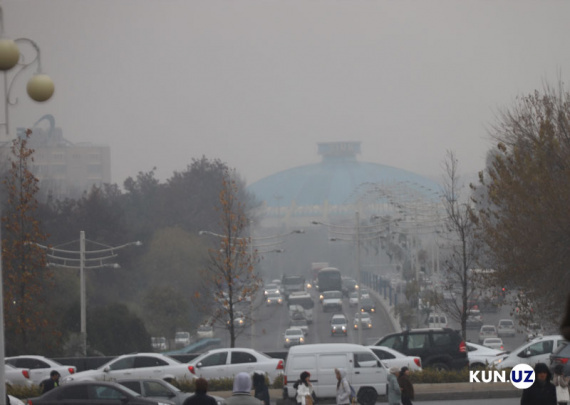
Photo: KUN.UZ
Turgunov noted that the current inversion has restricted vertical air movement. As a result of the disrupted vertical circulation, fine particulate matter has accumulated in the lower layers of the atmosphere, keeping pollution levels elevated for an extended period.
A rapid-response headquarters operating 24/7 has been established under the National Committee for Ecology and Climate Change. The unit conducts its work based on real-time assessments and scientific data, and several practical measures have already been implemented.
In particular, street cleaning and dust-washing operations are continuing across Tashkent. Authorities have also inspected greenhouse farms located near the capital. The operations of 106 greenhouses identified as having a significant environmental impact have been halted.
Construction activity in the city has been placed under strict supervision as well. Following inspections, 14 construction sites that violated regulations or posed a high risk of air pollution were issued warnings and given specific recommendations on how to proceed with their work.
Industrial enterprises of the first and second categories operating in and around Tashkent have also been reviewed. Based on the findings, 883 dust- and gas-filtration units at 305 industrial plants are now undergoing modernization.
Turgunov added that the rapid-response headquarters is developing a new comprehensive program aimed at reducing air pollution. It consists of two components: immediate short-term measures, and medium- to long-term strategic actions.
The Ecology Committee, relevant ministries and agencies, specialists and scientists are involved in drafting the program. It is expected to be submitted to the Government for approval in the coming days.
Related News
16:23 / 11.12.2025
Environmental breaches prompt temporary shutdowns across Tashkent
15:10 / 10.12.2025
Tashkent resident fined UZS 82 million for turning empty lot into green space
16:50 / 05.12.2025
Nature journal retracts high-profile climate study after major data errors found for Uzbekistan
16:48 / 05.12.2025