How to buy and sell a car in Uzbekistan in 2026: costs, documents and registration
09:5924318 min
Since April 1, 2026, Uzbekistan has introduced mandatory cashless payments for the purchase and sale of vehicles manufactured within the past 10 years. Here's how to choose and inspect a car, complete a sales agreement, prepare the required documents and calculate the costs of buying and registering a vehicle.
magnific.commagnific.com
What changed on April 1, 2026?
When buying or selling vehicles in categories M, N, O and G that were manufactured no more than 10 years ago, as well as special-purpose vehicles, payments must be made without cash.
The buyer no longer hands cash directly to the seller. Instead, the payment is processed through a bank using an escrow arrangement. The bank confirms to the notary that the funds are available and transfers the money to the seller once the sales agreement has been notarized.
The bank may use the buyer's existing account, bank card or electronic wallet, provided it meets the requirements for escrow payments.
To arrange the payment, the buyer contacts a bank and signs the relevant agreement. An application may also be submitted electronically if the bank offers this option.
What if you have cash?
You can deposit the cash at a bank branch. The payment for the vehicle will still be treated as a cashless transaction.
Once the required amount has been deposited, the bank informs the notary. After notarizing the agreement, the notary sends the bank electronic confirmation that the transaction has been completed.
When will the seller receive the money?
If the bank receives confirmation from the notary during its business hours, the money will be transferred on the same day. If confirmation arrives after banking hours, the transfer will be made on the next business day.
What happens if the transaction falls through?
If the notary does not certify the agreement, the buyer can contact the bank to request a refund of the money held in escrow. The conditions for refunding bank service fees should be checked separately.
Private banks may charge different fees. Before completing the transaction, check the amount and payment conditions, especially if the buyer and seller use different banks.
How to find a car online
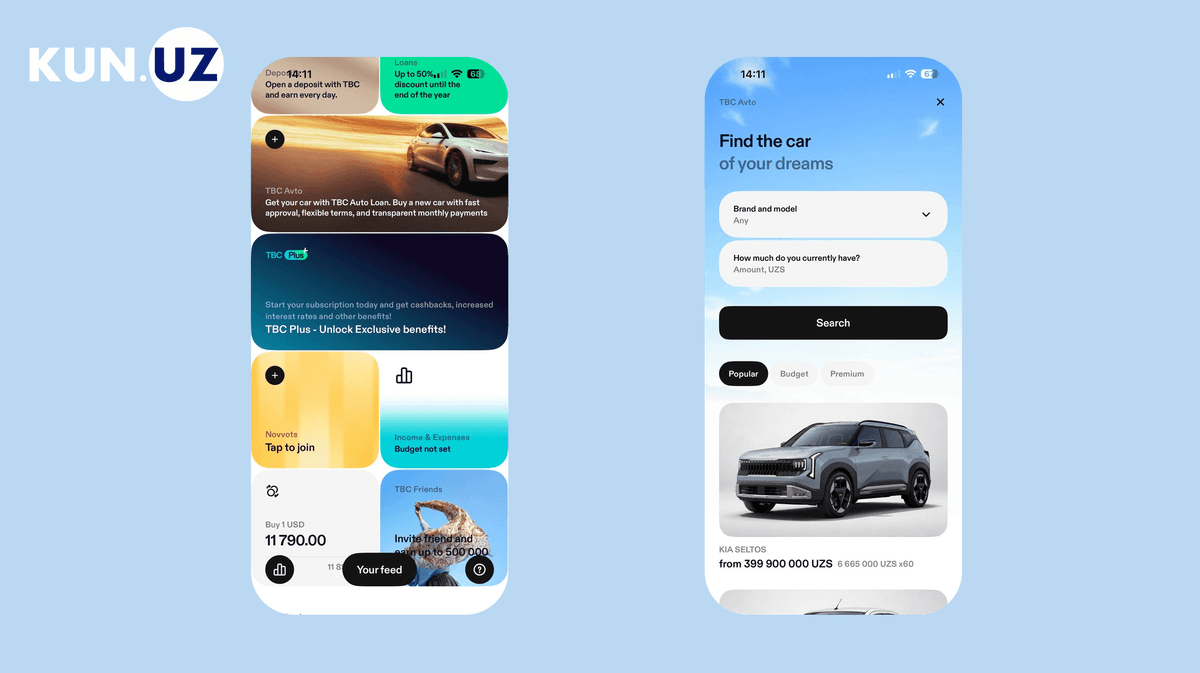
If you haven't chosen a car yet, you can search for one through a banking app. TBC Auto offers this option, allowing users to find vehicles based on make, model and available budget. To search for a car, open the "Auto" section in the TBC Auto app, select a make and model, and enter how much money you currently have available. If you have no savings, you can enter 0.
Kun.uz
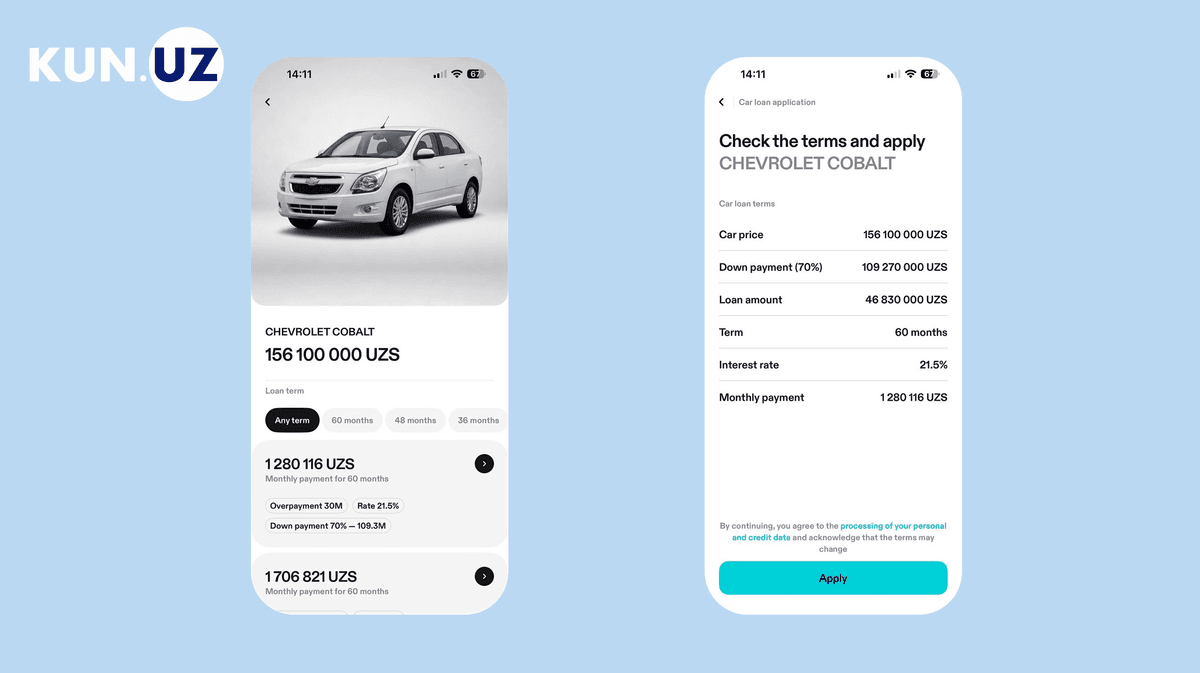
The service displays available vehicles and payment options. If you want to buy a car without taking out a loan, scroll to the bottom of the offers and select "Pay in cash."
Kun.uz
After submitting an application, a TBC Auto representative will contact you, usually on the same day or the following day. They will answer your questions, help you choose a suitable vehicle and arrange a visit to a car dealership.
At the dealership, the representative will help prepare the necessary documents. If the transaction can be completed that day, the buyer may be able to take the car home immediately. TBC Auto does not charge customers for vehicle selection assistance or support during the purchase process.
What to check before buying a car
Before paying for a vehicle or signing an agreement, make sure the seller has the legal right to sell it and that the information in the documents matches the vehicle.
Ask the seller to provide:
Passport or ID card. Check that the seller's details match the registered owner's information.
Vehicle registration certificate. Compare the make, model, license plate number and vehicle identification number (VIN) with the details on the car itself.
Power of attorney, if the vehicle is being sold by a representative. Make sure it is valid and specifically authorizes the representative to sell the vehicle, not merely drive it.
Important: A power of attorney does not replace a sales agreement. If the owner only gives the buyer a power of attorney, ownership of the vehicle does not transfer to the buyer.
What can you check on my.gov.uz?
Several services are available through Uzbekistan's government services portal:
Checking restrictions on vehicle sales. This service shows whether the notarial system contains information about restrictions on transferring ownership of a vehicle.
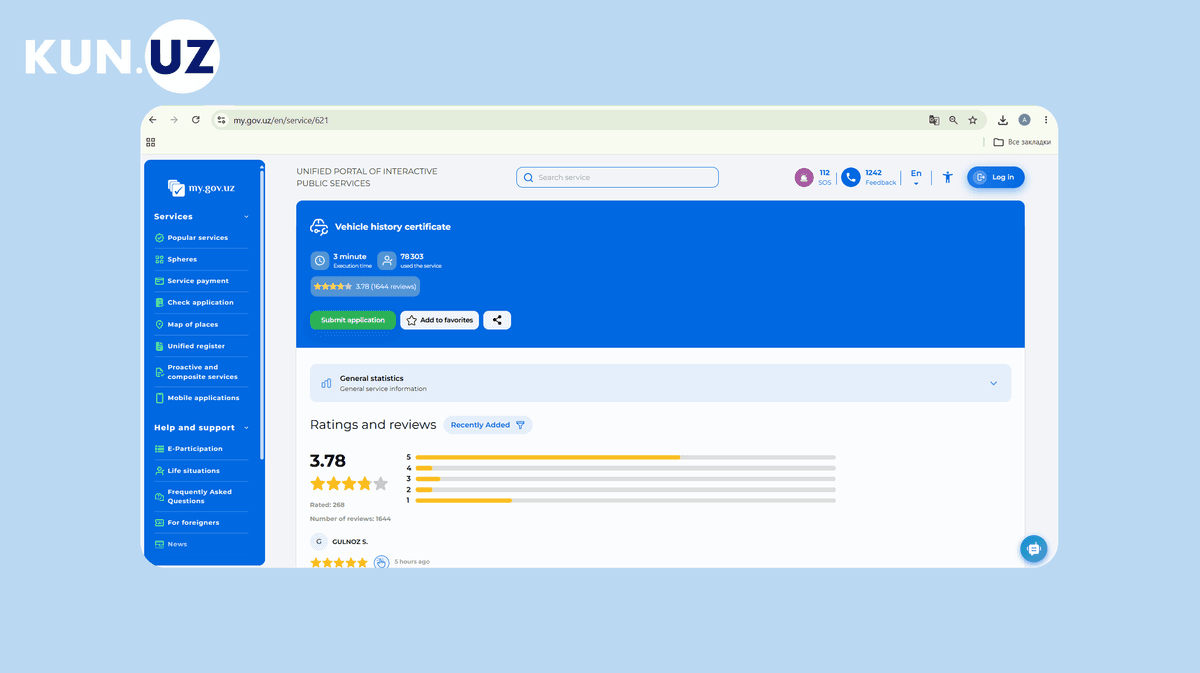
Vehicle information. A free service providing vehicle details from government information systems.
Additional information is available through the Vehicle history service. The report is generated automatically and costs UZS 39,600, or 0.09 BCV.
Kun.uz
If the buyer cannot independently obtain information about someone else's vehicle, they can ask the owner to complete the check and show the results.
Even if government services reveal no restrictions, this does not guarantee that the vehicle is mechanically sound. Before buying, it is advisable to have the car inspected at a service center, including its bodywork, engine and transmission.
Does the car need to be inspected by the traffic police before notarization?
Yes. Before the sales agreement is notarized, the vehicle must be presented to the Road Traffic Safety Service (traffic police). Officers compare the identification numbers on the body and other components with those listed in the vehicle registration certificate.
The inspection can be carried out either where the vehicle is registered or where the parties intend to complete the transaction. No fee is charged for this inspection.
However, traffic police officers only check whether the vehicle's identification details match its documents. They do not assess its mechanical condition. A separate inspection at a service center is needed to identify hidden defects.
How to complete a car sales agreement
When buying a vehicle from another private individual, the sales agreement must be notarized. After the vehicle has been inspected, the parties agree on the price and payment method and prepare the required documents.
The process involves five steps:
Prepare the documents. Where necessary, obtain consent from a spouse, bank or other parties whose rights may be affected by the transaction.
Arrange payment through a bank. If the vehicle is subject to the cashless payment requirements, the buyer arranges escrow and ensures that sufficient funds are available.
Visit a notary. The buyer and seller attend the appointment. The notary verifies their identities, checks the vehicle's details and reviews any restrictions.
Sign the agreement. Before signing, carefully check the price, the buyer's and seller's details, the vehicle information and all other terms.
Transfer the money to the seller. The bank releases the payment based on the notary's electronic confirmation.
The parties should also agree in advance when the buyer will receive the vehicle, keys and documents. For example, they may arrange for the car to be handed over once the money reaches the seller's bank account.
What documents are required?
For a standard vehicle sale, the parties need:
The buyer's and seller's passport or ID card.
The vehicle registration certificate.
Additional documents may be required in certain circumstances:
Spousal consent if the vehicle is jointly owned marital property.
Consent from a bank or another secured creditor if the vehicle is pledged as collateral.
A power of attorney if a representative acts on behalf of the buyer or seller.
Inheritance documents if the seller inherited the vehicle.
Guardianship-related documents if the transaction involves property belonging to a person under guardianship.
Loan documents if required for the particular transaction.
A notary can obtain some information independently through electronic systems. It is therefore best to explain the circumstances of the sale in advance and ask which additional documents will be needed.
In addition to the price of the vehicle, buyers should budget for notary services, bank payment processing and registration in the new owner's name.
How much does notarization cost?
The state duty for notarizing a standard vehicle sales agreement is 3 BCV, or UZS 1,320,000.
Reduced rates apply in certain cases.
Type of transaction
State duty
Standard vehicle sale
UZS 1,320,000
Sale to a close relative
UZS 66,000
Vehicle purchased with a bank loan
UZS 132,000
The reduced rate of UZS 66,000 applies when a vehicle is sold to the owner's spouse, parents, spouse's parents, children and their spouses, grandchildren, grandparents, brothers or sisters. If a vehicle is purchased using a bank loan, the state duty is UZS 132,000.
What other notary fees may apply?
In addition to the state duty, the notary may charge for preparing the agreement, explaining the transaction and checking restrictions on the vehicle's sale.
The following maximum fees apply in 2026:
Service
Maximum fee
Preparing the sales agreement
UZS 88,000
Explaining the transaction
UZS 66,000
Checking restrictions and seizure orders
UZS 66,000
These are maximum fees, not fixed prices. A notary may charge less but cannot exceed the prescribed amounts. The fees are established by Ministry of Justice Order No. 3235.
The parties may also choose to have the agreement printed on special official stamped paper. This costs UZS 44,000, or 10% of the BCV. Since December 2025, the use of this paper has been optional. Therefore, the fee should not automatically be included in the cost of every transaction.
How much does vehicle registration cost?
When ownership of an already registered vehicle changes, the procedure is treated as state registration rather than re-registration. For a standard passenger car, the registration fee is 6.84 BCV, or UZS 3,009,600.
If the buyer receives a new vehicle registration certificate and standard license plates, the costs are as follows:
Expense
Petrol-powered car
Electric car
Registration
UZS 3,009,600
UZS 660,000
Registration certificate
UZS 616,000
UZS 616,000
Pair of license plates
UZS 4,620,000
UZS 4,620,000
Document preparation*
UZS 44,000
UZS 44,000
Total
UZS 8,289,600
UZS 5,940,000
This example covers the purchase of a used passenger car from another private individual, including the issuance of a new registration certificate and standard license plates. It does not include the purchase price, MTPL insurance, additional notary services or optional stamped paper. The actual bank fee may also vary.
We explain the documentation and registration process in more detail in a separate article.
What to do after buying a car
After notarizing the sales agreement, the buyer must register the vehicle in their name and obtain compulsory motor insurance.
When must the vehicle be registered in the new owner's name?
During registration, officers inspect the car and compare its details with the documents. Once the inspection is completed and the required fees are paid, the buyer receives a vehicle registration certificate and, if necessary, license plates.
What happens to car insurance when the vehicle is sold?
When vehicle ownership changes, the previous compulsory motor third-party liability insurance (MTPL) policy becomes invalid. The buyer must obtain a new policy.
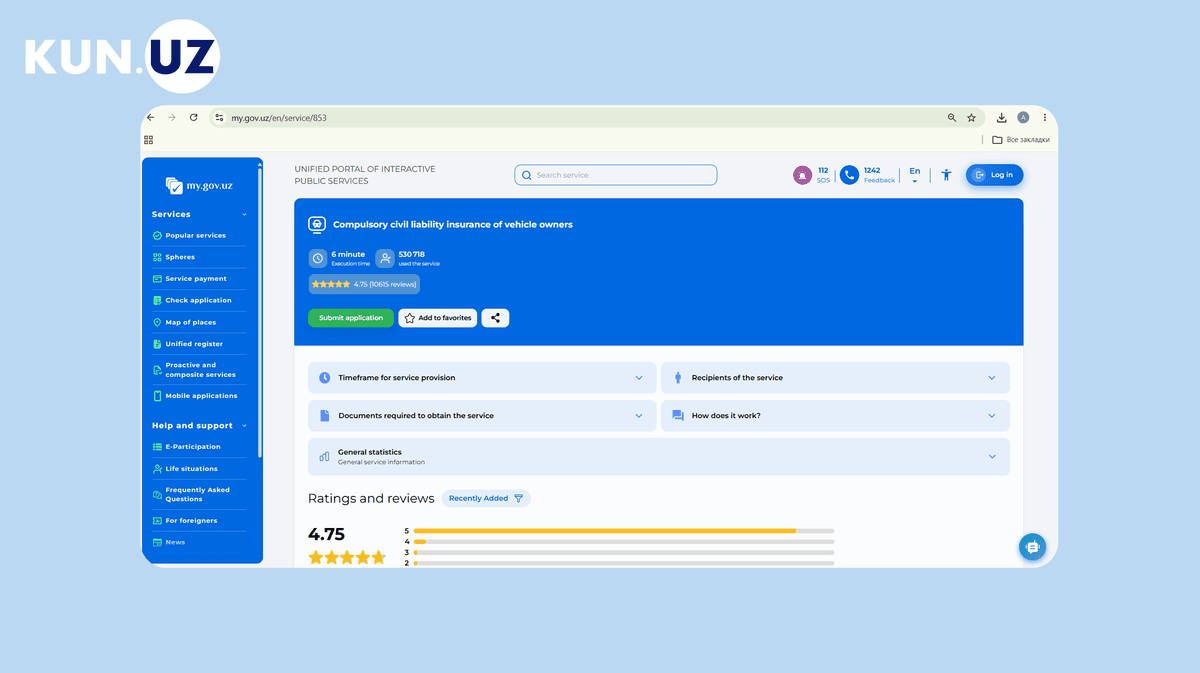
Under the law, the new owner has 10 days from the purchase date to arrange compulsory motor third-party liability insurance. However, a valid insurance policy is required to drive the vehicle on public roads. MTPL insurance can be purchased from an insurance company or through the my.gov.uz portal.
Kun.uz
Can the seller get a refund for their previous insurance policy?
Yes. If the policy has not yet expired, the seller can contact their insurance company to request a refund for the unused portion of the coverage.
The insurance company must refund the eligible amount within 14 calendar days of receiving the request. The amount depends on the remaining coverage period and any insurance payouts already made.
Different tax rules apply if vehicle sales are carried out as part of a business activity.
Key takeaways
Before buying a vehicle, check the seller's documents, the car's identification details and any restrictions on its sale. Before notarization, the vehicle must undergo a free identification-number check by the traffic police.
From April 1, 2026, payments for vehicles covered by the new requirements must be processed without cash through a bank.
A sales agreement for a used vehicle between private individuals must be notarized. The standard state duty is UZS 1,320,000, with additional services charged separately.
After purchasing a vehicle, the buyer must apply to the traffic police within 10 calendar days to register it in their name. From April 1, 2026, new registration certificates are issued for five years.
A new MTPL insurance policy must be obtained. The seller can request a partial refund for the unused period of their previous policy.