





Additional features
-
Night mode

How do people in Uzbekistan pay and who leads the market
At the end of April, five payment companies in Uzbekistan published their first-quarter reports. Nearly 90% of revenue across all of them comes from the same core source: transaction fees for P2P transfers, bill payments, and merchant acquiring.
Kun.uz
On top of this common foundation, each company is building its own ecosystem: subscriptions, marketplaces, mini-apps, and platform services. These products generate relatively little direct revenue, but they keep users inside the app and encourage them to use the core services more often, which is where the companies actually make money.
We reviewed their reports and product offerings to show how payment companies in Uzbekistan retain users within their ecosystems.
Financial performance in the first quarter
.png)
*Of Paynet’s 449.5 billion UZS profit, 321.1 billion UZS came from a one-time dividend income from subsidiaries following its acquisition of the Humo payment system operator. Excluding this item, operating profit was around 128 billion UZS.
How payment services make money
The reports do not provide an exact breakdown of revenue by product. However, based on the structure of income and expenses, as well as public company materials, it is clear that the primary revenue stream for all players comes from transaction commissions.
These commissions consist of three main components:
- P2P transfer fees (percentage charged for transfers between cards without a subscription);
- service payment commissions (utilities, telecom, taxes, fines);
- merchant acquiring fees, meaning commissions charged to merchants for accepting card or QR payments.
All three are essentially variations of the same business model: taking a percentage from each completed transaction.
Why subscriptions, cashback, mini-apps, and partner services matter
These are primarily retention tools. A company may not earn much directly from a subscription, but subscribers use the app more frequently, and every additional transaction generates commission revenue.
That is why it makes more sense to read these companies’ reports as a story about user retention.
Click is building a super app. Payme is focusing on its Payme Plus subscription model. Paynet relies on its physical infrastructure, Humo’s payment network, and the Xolis platform for self-employed users. Beelab is developing Beepul as the financial component of the Hambi super app.
How Click simplifies everyday life through its super app
According to its first-quarter 2026 report, Click posted 209.4 billion UZS in net revenue and 78.6 billion UZS in net profit. Click is developing a super app model that combines proprietary services with partner mini-apps covering most everyday needs.
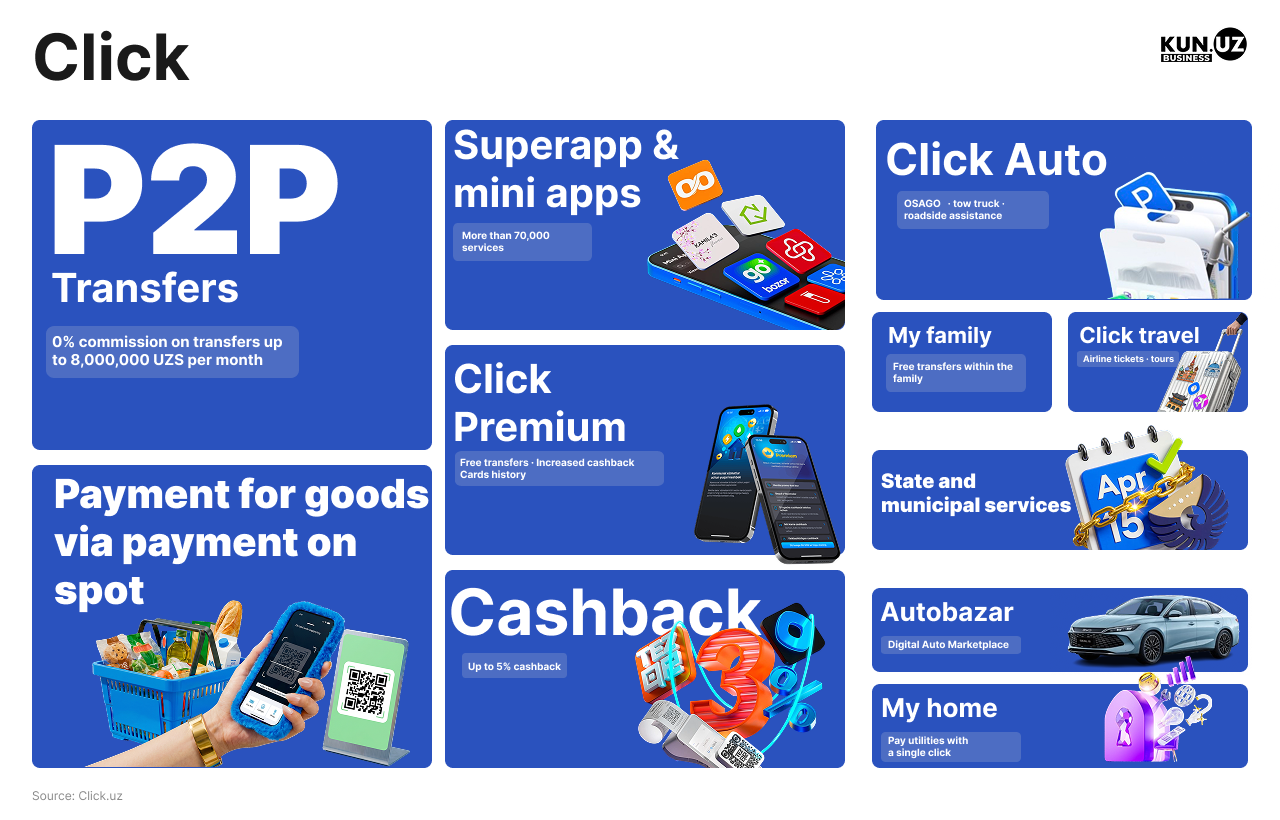
Click Avto. A car services ecosystem including vehicle listings, traffic police registration, insurance, window tinting, roadside assistance, towing, rentals, and EV charging. Listings from private sellers are verified using PINFL.
Click Home. Utility account management, household spending analytics, and booking of home services such as electricians, plumbing, and repairs.
Click Travel. Flight tickets, tour packages, and eSIM services including Globi eSIM, Fly eSIM, SalomSIM, and Beeline eSIM.
Mini-app ecosystem. Dozens of partner services inside Click across multiple categories:
- transport (MyTaxi, FacePay Metro, ioka)
- food (MaxWay, Bellissimo Pizza, Safia, Rakat Osh)
- shopping (Buchet, Rebus, Brandshop, Uzbek Soul, Topbox)
- healthcare (Med24, Paramedics, SwissLab)
- education (Osnova, StudyGO, Bilimdor, Kotib Assist AI)
How Payme scales subscriptions
According to its first-quarter 2026 report, Payme posted 230.1 billion UZS in net revenue and 104.0 billion UZS in net profit.
In addition to standard P2P transfers and service payments, Payme offers a paid subscription model and several integrated services.
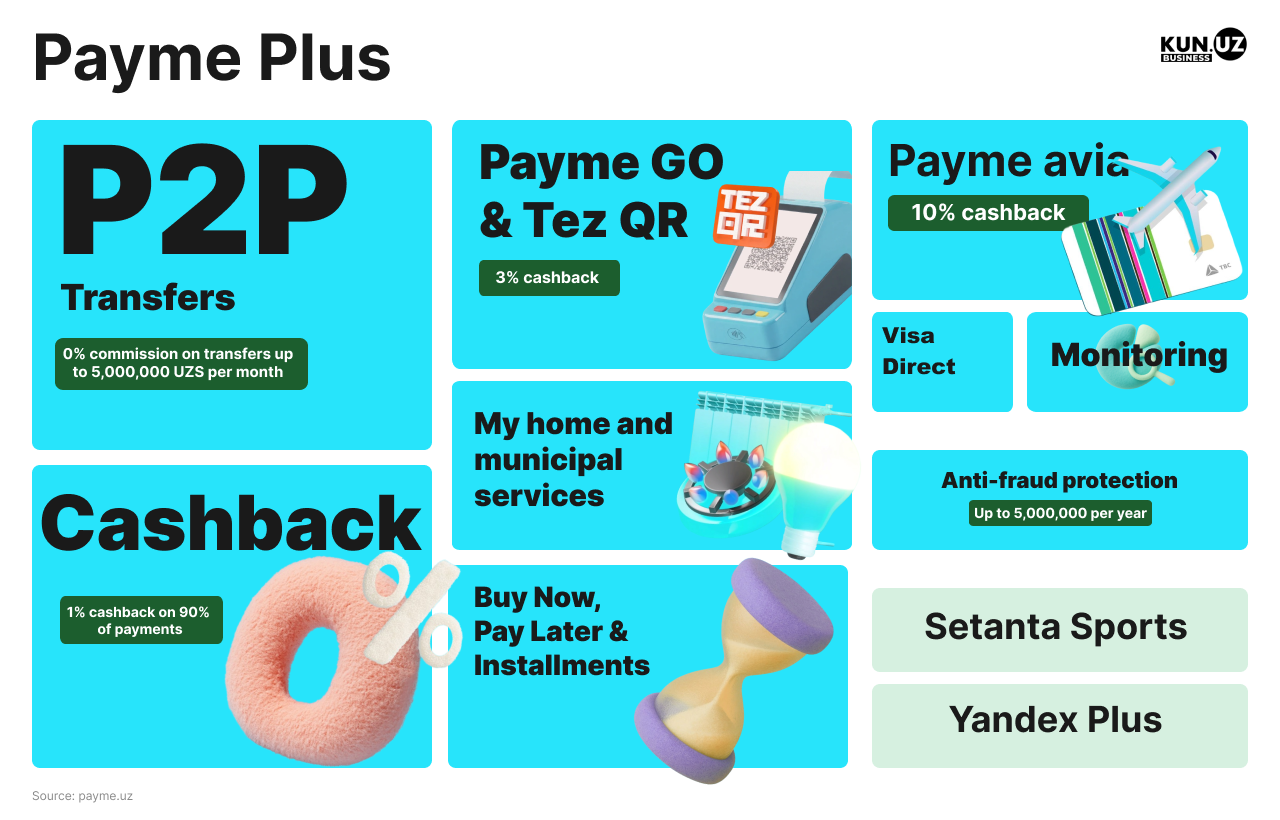
Payme Plus subscription tiers
Monitoring (4,990 UZS). Expense analytics only, without P2P transfers or cashback. This is the most popular plan, chosen by 40% of subscribers.
Basic. Includes expense tracking, basic fraud protection, and access to the Pay Later installment feature for purchases from partners.
All Inclusive (39,990 UZS). Includes:
- commission-free P2P transfers up to 5 million UZS per month;
- 1% cashback on 90% of payments;
- fraud protection up to 5 million UZS per year;
- bundled subscriptions to Yandex Plus and Setanta Sports.
Additional services inside Payme
Payme GO and Tez QR. QR payments in stores and cafés with cashback of up to 3%.
Payme Avia. Flight tickets with 10% cashback.
Visa Direct. International transfers.
Pay Later. Deferred payment service.
My Home and Government Services. Utilities and public services in one section.
How Paynet remains the market leader
According to its first-quarter 2026 report, Paynet posted 558.5 billion UZS in net revenue and 449.5 billion UZS in net profit. Of that profit, 321.1 billion UZS came from one-time dividend income from subsidiaries. Excluding this, operating profit was approximately 128 billion UZS.
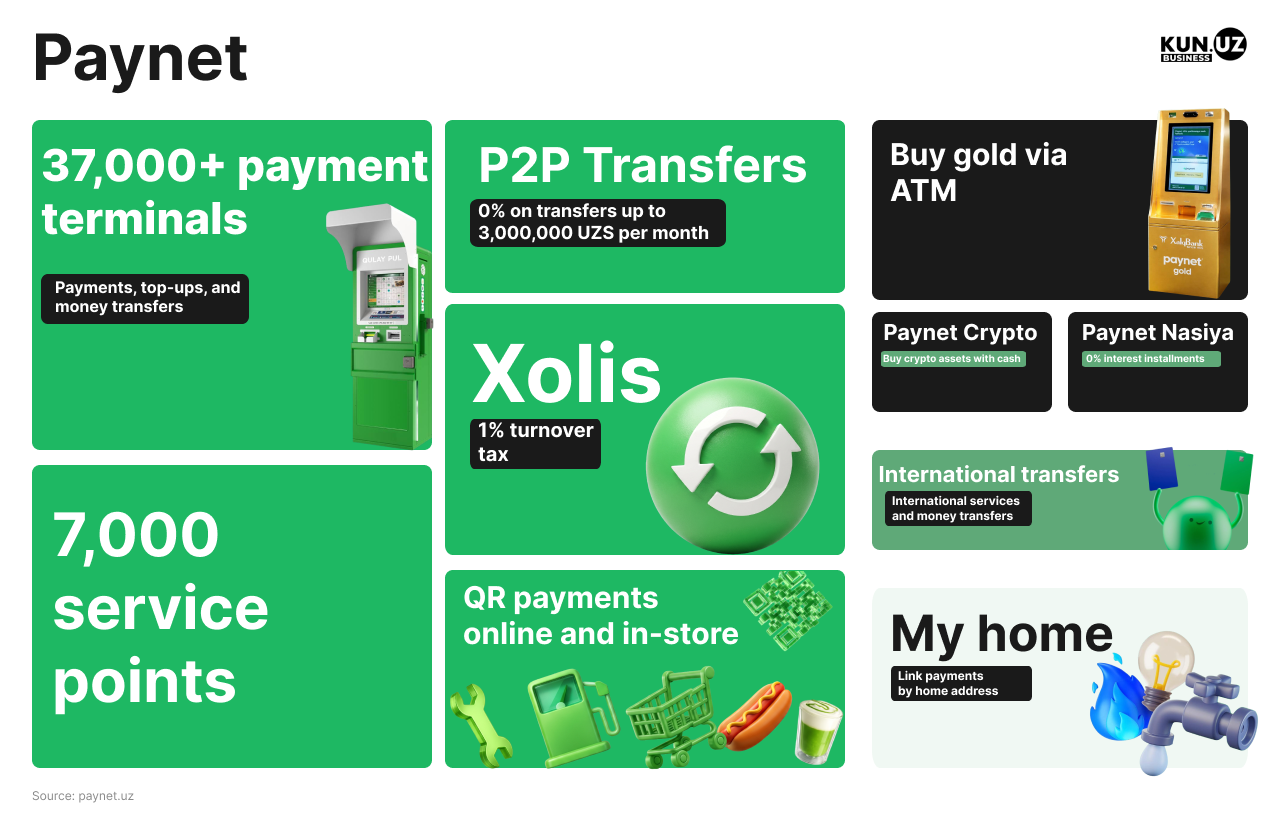
Physical network. More than 37,000 24/7 terminals and 7,000 agent locations nationwide, in addition to its mobile app.
Bill payments. Utilities, telecom, internet, taxes, and fines.
Expanded product line. Installments, gold purchases, investments, crypto wallet services, cross-border transfers, and agent cash withdrawals.
Paynet Xolis. A platform for self-employed workers and sole proprietors:
- 1% turnover tax instead of 4%;
- free QR payment acceptance;
- automatic fiscalization without a cash register.
By the end of 2025, the platform had around 200,000 users.
Humo acquisition. In December 2024, Paynet acquired the operator of the national payment system Humo, gaining control over part of Uzbekistan’s card payment infrastructure.

Related News
20:00 / 22.09.2025
JSC “Paynet” and W Straits Sign Strategic Memorandum of Understanding to Promote Fintech Innovations in Uzbekistan
12:41 / 23.07.2025
Click and Halyk Bank announce historic $237 million partnership to transform Uzbekistan’s financial services
15:49 / 07.11.2024
Uzbekistan’s fintech companies disclose earnings amid regulatory changes

10:56 / 24.04.2024