ADB official speaks about importance of CAREC projects for Uzbekistan in a special interview for Kun.uz
|02:45 / 15.05.20216,15515 min
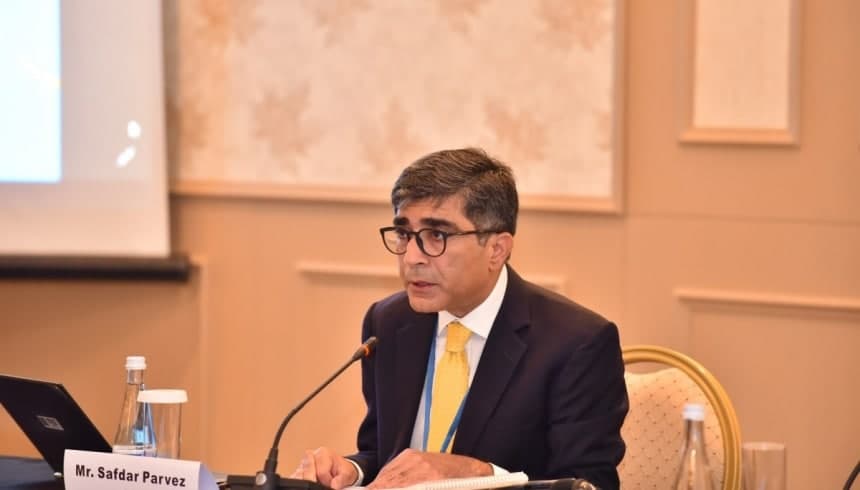
Kun.uz has conducted a written interview with Safdar Parvez, the Director of Regional Cooperation and Operations Coordination Division of the Central and West Asia Department at ADB, on Central Asia Regional Economic Cooperation Program (CAREC).
The ADB official explained the importance of regional cooperation and the role of CAREC projects for Uzbekistan, spoke about the impact of COVID-19 on the country’s economy and commented on monitoring of funds allocated by ADB for different projects in the republic.
Why is regional cooperation so important for Uzbekistan and what are some of CAREC’s main projects here?
Regional cooperation is particularly important for Uzbekistan given its geographic position as a double-landlocked country. Merchandise exports and imports need to travel long distances to reach their destinations (through Kazakhstan in the north and northwest, the Kyrgyz Republic and Tajikistan in the east and southeast, Turkmenistan in the southwest, and Afghanistan in the south). This makes Uzbekistan more reliant on connections with its neighbors to trade with the world.
Uzbekistan has been a very important and long-standing member of the Central Asia Regional Economic Cooperation (CAREC) Program – a partnership to promote economic growth and development through regional cooperation. The CAREC Program has seen investments of over $7.2 billion, in 23 projects in the transport and energy sectors, in Uzbekistan. The transport sector projects have addressed logistical challenges by developing regional transport corridors, and the energy sector projects have improved efficiency and transmission of the energy systems and promoted energy trade in the region. Technical assistance projects in the trade sector are facilitating Uzbekistan’s accession into the World Trade Organization, and last year Uzbekistan successfully acceded into the International Plant Protection Convention.
Three of CAREC’s six transport corridors (Corridor 2, Corridor 3, and Corridor 6) transit through Uzbekistan. Some of CAREC’s major on-going projects include, amongst others: The Karakalpakstan Road Project and the Pap–Namangan–Andijan Railway Electrification Project (under CAREC Corridor 2), the Railway Efficiency Improvement Project, Second Central Asia Regional Economic Cooperation Corridor 2 Road Investment Program (Tranche 3). Recently, the Afghanistan Energy Supply Improvement Investment Program (Tranche 6) was approved, which will oversee the construction of 201 kilometers of a 500-kilovolt overhead transmission line from the Surkhan substation in Uzbekistan to the Khwaja-Alwan substation in Afghanistan. Completed CAREC projects include, amongst others: Transport Network Development Investment Program - Tranche 1, CAREC Corridor 2 Road Investment Program (Tranche 3), Talimarjan Transmission Project, and the Talimarjan Power Project (formerly CASAREM-Talimarjan Energy Development Project).
Related topics
COVID-19 placed significant pressure on regional economies, with tourism being one of the most severely impacted sectors. CAREC recently endorsed a new long-term tourism strategy. How will this help Uzbekistan recover and further develop in the region?
The CAREC Tourism Strategy 2030 aims at promoting the uniqueness of CAREC member countries’ tourism products while building regional synergies and creating greater opportunities for sharing knowledge and best practices across CAREC countries.
Uzbekistan is part of the Heart of Central Asia tourism cluster identified in the CAREC Tourism Strategy 2030, targeting the tourism segments of culture, adventure, and city and business travel. Uzbekistan is positioned at the center of the Silk Road and possesses numerous historical, architectural, and religious sites in cities such as Samarkand, Bukhara, and Khiva. Tourists can experience the unique gastronomy and local traditions, as well as adventure activities such as mountaineering, rock climbing and skiing. Moreover, Tashkent city has the unique potential of allowing multi-seasonal business and city-related tourism, which could result in higher occupancy rates for hotels and resorts.
A common regional brand, “Visit Silk Road,” has been established under the CAREC Tourism Strategy to leverage the region’s most important tourism asset –the Silk Road– through further development of multi-country itineraries to expand the range of tourism experiences that the region can offer. It will be promoted through a CAREC Tourism Portal, which will be launched in the coming months to promote the region as a safe tourism destination and support acceleration of post-COVID-19 recovery for Uzbekistan’s tourism sector and that of the other countries in the region.
The CAREC Tourism investment framework will enable investments in various cities of Uzbekistan. For example, a forthcoming Integrated Urban Development Project (IUDP) will further improve the coverage, quality, efficiency, and reliability of targeted urban services for tourism development in cities like Khiva. The IUDP will demonstrate bottom-up, integrated planning solutions, and strengthen local government capacity to enhance livability and competitiveness of four cities in Uzbekistan.
Could COVID-19 also be an opportunity for greater cooperation on healthcare in Central Asia?
COVID-19 has put the health systems of CAREC countries to an unprecedented test, where the need for protecting their citizens including more vulnerable groups such as migrants, mobile persons, and border communities from the pandemic has become a paramount priority. But, given its transboundary and contagious nature, COVID-19 also creates an opportunity for CAREC countries to address the pandemic together particularly in strengthening healthcare through joint actions such as enhancing regional surveillance for infectious diseases, improving health information systems, and improving healthcare for migrants, mobile persons, and border communities.
ADB has stepped up its assistance to help CAREC countries mitigate the health, social, and economic impacts of the pandemic. A total of $3.14 billion (as of 31 Dec 2020) in sovereign loans and grants were committed to supporting CAREC countries for COVID-19 responses. This includes a $500 million budget support loan to support the government’s Anti-Crisis Plan and an additional $100 million in emergency assistance to help strengthen Uzbekistan’s resilience to public health emergencies.
Under CAREC, ADB mobilized more than $4 million in technical assistance to strengthen CAREC national health systems, enhance regional health security and protect migrant workers, mobile persons, and border communities through joint efforts. A CAREC health strategy leading to 2030 is being formulated to guide CAREC health cooperation in the long run.
Since the start of the pandemic and with the allocation of funds by international and regional organizations to restore the economy, a number of large corruption cases were reported in Uzbekistan. Being one of the major investors, does CAREC take such factors into consideration when providing funds to the country? Does it monitor how money allocated for regional projects is being spent? If yes, how?
CAREC relies on funding from its development partners, including ADB and others, to finance regional development initiatives.
CAREC as a program and platform, while supported by ADB and other development partners, is an enabler of cooperation through policy dialogue, priority regional project preparation and facilitation, analysis, and capacity development. Any allegations of corruption under projects and programs financed by various partners, including ADB, are investigated seriously and dealt with in accordance with the partners’ respective policies.
Underpinned by a zero tolerance for corruption, the Asian Development Bank strengthens governance across Asia and the Pacific as it mitigates integrity risks, investigates integrity violations, and promotes integrity among ADB’s stakeholders through ADB’s Office of Anticorruption and Integrity.
How can CAREC help the region rehabilitate the roads and make cross-border cooperation more efficient? Are there any negative impacts from developing transport corridors with neighboring countries?
CAREC’s Transport Strategy 2030 aims to construct and rehabilitate transport corridors, while increasing their inherent sustainability and the quality of the region’s transport networks. The strategy focuses on five key areas: roads and road asset management, railways, cross-border transport and logistics, road safety, and aviation as relevant to CAREC member countries.
The CAREC program provides a communication and coordination platform, enabling its members to align their priorities and build a well-connected transport network, regulations, and operational practices. Particular attention and support are given to those countries where procedural and infrastructure bottlenecks are high, negatively impacting the overall performance of individual corridors and the entire network.
In Uzbekistan, the CAREC program has achieved significant results in upgrading the road and rail network. This includes rehabilitating 175 km of road along the A380 on CAREC Corridor 2, from Guzar to Beyneu. Reconstructing a 240 km section of the A380 in Karakalpakstan is ongoing. The average daily traffic is expected to increase by almost 30% while travel time will be 15% shorter. ADB is reconstructing another 87 km of this road and 58 km of the A373 road from Tashkent to Osh.
These projects are modernizing a key trade route in the region, strengthening connections with neighboring Kazakhstan, facilitating cargo movement to Europe and CIS countries, and integrating CAREC members into the global economy. This will help to reduce barriers to cross-border trade and logistics, and support free trade and economic development within the region.
The Central Asian region relies heavily on land routes, including very difficult ones, for the movement of goods and people. Countries in the region are mutually dependent due to being landlocked and developing transport corridors is crucial to improve connectivity and cooperation between them. The CAREC platform allows all parties to discuss and address any impediments to developing these important links. Any project that is implemented is ensured to meet all safeguard requirements to prevent negative impacts on people and the environment.
Central Asia holds significant potential to improve energy efficiency and create a more sustainable energy sector. Are there any CAREC projects that promote this?
Energy efficiency is a key strategic priority under CAREC’s long-term energy strategy, and the Program is supporting its members to double regional energy efficiency levels by 2030. CAREC is actively working on creating an enabling environment for improved regional energy efficiency.
In Uzbekistan, technical assistance work is underway to improve cross-border power trading between the country and its five neighbors: Afghanistan, Kazakhstan, the Kyrgyz Republic, Tajikistan, and Turkmenistan. The Coordinating Dispatch Center Energiya, which coordinates power flow between the national electricity grids of the Central Asian Power System, is being modernized under the project.
Another project aims to improve export-import and development of the electricity industry between Uzbekistan and Tajikistan. It will restore the 63km 500kV Guzar-Regar overhead line in the Surkhandarya region of Uzbekistan, helping to improve the reliability of the power supply with the parallel operation of the power systems of two countries.
A third project will develop a 500-kilovolt power interconnection from the Surkhan substation in Uzbekistan to the Khwaja-Alwan substation in Afghanistan. Given the fragile and conflict-affected situation in Afghanistan, importing power from energy-rich neighbors is an efficient way to address power shortages and affordability issues.
Across the region, CAREC is supporting energy efficiency awareness campaigns to encourage consumers to use energy more judiciously. CAREC is also conceptualizing a regional energy marketplace to attract investments in green energy projects including on energy efficiency. All activities will be complemented by capacity-building measures to improve overall energy efficiency policy-making in Uzbekistan and the wider CAREC region.