During an international reporting tour titled ‘Democracy is More Than Election Day’, arranged by the Global Public Affairs Bureau of the U.S. Department of State, through its Foreign Press Centers and in cooperation with the Meridian International Center, a lecture was organized at the University of Nevada with Dr. David Damore, Professor of Political Science and Executive Director of the Lincy Institute and Brookings Mountain West. In his lecture, Dr. Damore spoke about the political landscape in Nevada, including election cycles and electoral candidates as the state is preparing for upcoming presidential elections in the U.S. in November 2024.
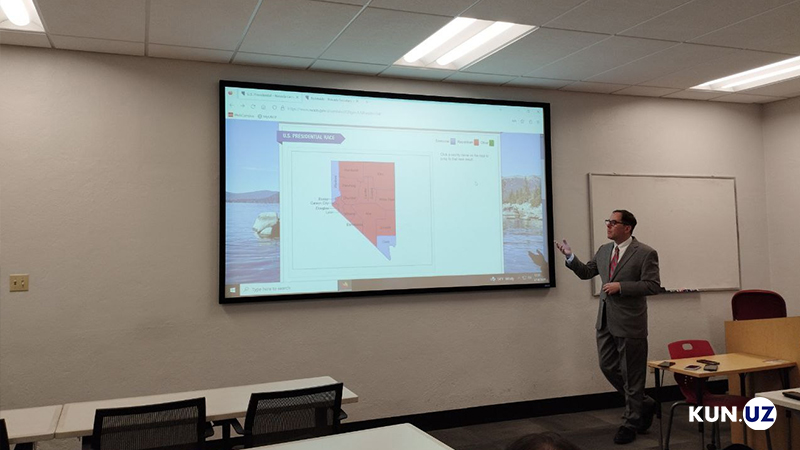
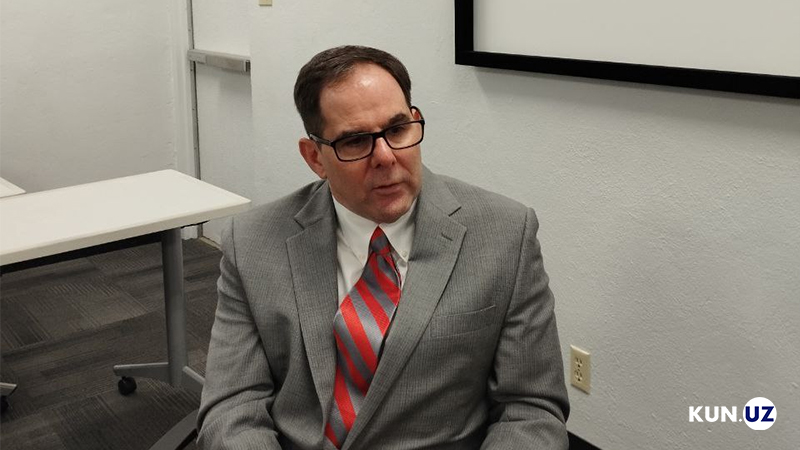
Following the lecture, Dr. Damore gave a special interview for Kun.uz, commenting on Nevada's unique demographic and electoral characteristics, the impact of political advertising on undecided voters, and possible shifts in the U.S. foreign policy if Donald Trump is elected president.
Dr. Damore, could you please elaborate on how demographic shifts and political trends in Nevada are influencing its pivotal role in U.S. Presidential elections?
Nevada, particularly, the Las Vegas metro region has the demographic composition that America is predicted to have in the second half of the century. In general, the state’s growing ethnic and racial diversity has been a main driver shifting Nevada from Republican to Democratic leaning over the course of the last decade or so. However, lower levels of voter turnout among minorities compared to whites and the state’s low levels of educational attainment keep the GOP in the game here.
What impact do campaign strategies and political advertising have on undecided voters in Nevada, especially in close races?
The effects of advertising are twofold. In a race where the candidates are already well known such as the presidential elections, the goal is to prime the issues and factors that voters who are either undecided or who may not be sold on a candidate draw on as the vote decision nears.
In a race such as the US Senate where the incumbent, Rosen, has a name recognition and fundraising advantage, advertising from July through September will be used to define the opposition, presumably Sam Brown, in unfavorable terms. Since Brown is not well known and will not have as much money, he will have to be very strategic about when and how he uses his money with the caveat being if he waits too long then the Rosen campaign will be able to define the terms of the campaign.