Forging an empire: How Abdullah Khan II united the Shaybanid domains
|19:30 / 06.04.20258,61611 min
Abdullah Khan II, born in 1533 (or 1534, according to some sources) in the village of Ofarinkent in Miyankal, was the most prominent ruler from the Shaybanid dynasty of the Bukhara Khanate. He left a lasting legacy as a statesman, military commander, and patron of science, enlightenment, and culture. His full name was Abdullah ibn Iskandar Khan ibn Jonibek Sultan ibn Khoja Muhammad ibn Abulkhair Khan.
Ascension to the throne
After the death of Shaybanid ruler Abdulaziz Khan, a struggle for the throne ensued. Abdullatif Khan, who ruled in Samarkand, placed two grandsons of Shaybani Khan – Yar-Muhammad Sultan and Burkhan Sultan – on the throne in Bukhara. However, following Abdullatif Khan’s death in 1551, Barak Khan, ruler of Tashkent, seized Samarkand and assumed power there under the name Navruz Ahmad Khan, proclaiming himself supreme Khan of the Uzbeks. Abdullah Sultan, from a cadet branch of the Shaybanids and then ruler of Kermine, opposed him with the support of his uncle, Pirmuhammad Khan, ruler of Balkh. After Navruz Ahmad's death in 1556, Pirmuhammad Khan was declared supreme ruler.
Struggle to unite the state
In 1557, with the support of Sufi sheikhs, Abdullah Sultan seized Bukhara and became its ruler. By 1561, he was confident enough to proclaim his father Iskandar – then ruler of Kermine and Miyankal – as the supreme Khan of all Uzbeks. Iskandar was a modest, non-militaristic man focused on religious practices, so he entrusted state affairs to his son Abdullah.
Abdullah aimed to unify the four Shaybanid domains – Bukhara, Samarkand, Tashkent, and Balkh – into a single state. This effort took decades and was only fully realized by 1582. He fought a long war with the sons of Navruz Ahmad – Baba Sultan and Darvish Bek – suffering many setbacks before eventually defeating them. He went on to subdue Fergana and captured Balkh in 1573 after a prolonged siege. By 1574, Shakhrisabz, Karshi, and Hisar were added to his domains. In 1576, he recaptured Samarkand and took Tashkent.
Abdullah Khan’s monetary reform
In several stages, Abdullah Khan II implemented monetary reform. To address the shortage of silver and coins, he began minting gold coins under his father’s rule and oversaw their high-quality production in Bukhara. His reforms aimed to adjust the exchange rate of silver coins in response to rising silver prices. When Iskandar Khan was still the nominal head (1560–1583), minting silver coins remained decentralized. Nevertheless, silver tangas were minted in Bukhara, Samarkand, Balkh, Tashkent, Andijan, Akhsikent, and Yassi (Turkestan) under his name.
In 1583, Abdullah Khan centralized silver coin production in Bukhara. He also introduced copper coins of varying denominations for daily urban trade. These reforms successfully ended the monetary crisis, stopped massive capital outflow, and supported all types of commerce – transit, intercity, and local trade.
Territorial expansion
In the summer of 1581, Abdullah Khan expelled Baba Sultan from Tashkent and seized his forts: Shahrukhiya, Sayram, and Akhangaran. Baba Sultan fled and took control of several cities along the middle and lower Syr Darya: Yassi, Sauran, Arkuk, and Suzak.
In 1582, Abdullah Khan, along with Shigay and Tauke Khan, launched a campaign against Baba Sultan. After laying siege to all occupied cities, Tauke Khan defeated and killed Baba Sultan near Yassi, transferring control of key Turkestan cities – Sauran, Yassi, Otrar, and Sayram – to Abdullah Khan.
In 1583, his son Abd al-Mumin sacked Mashhad. That same year, following Iskandar’s death, Abdullah Khan was proclaimed Khan of all Uzbeks, and his state became known as the Bukhara Khanate.
In 1584, he annexed Badakhshan, and in 1588, Khorasan.
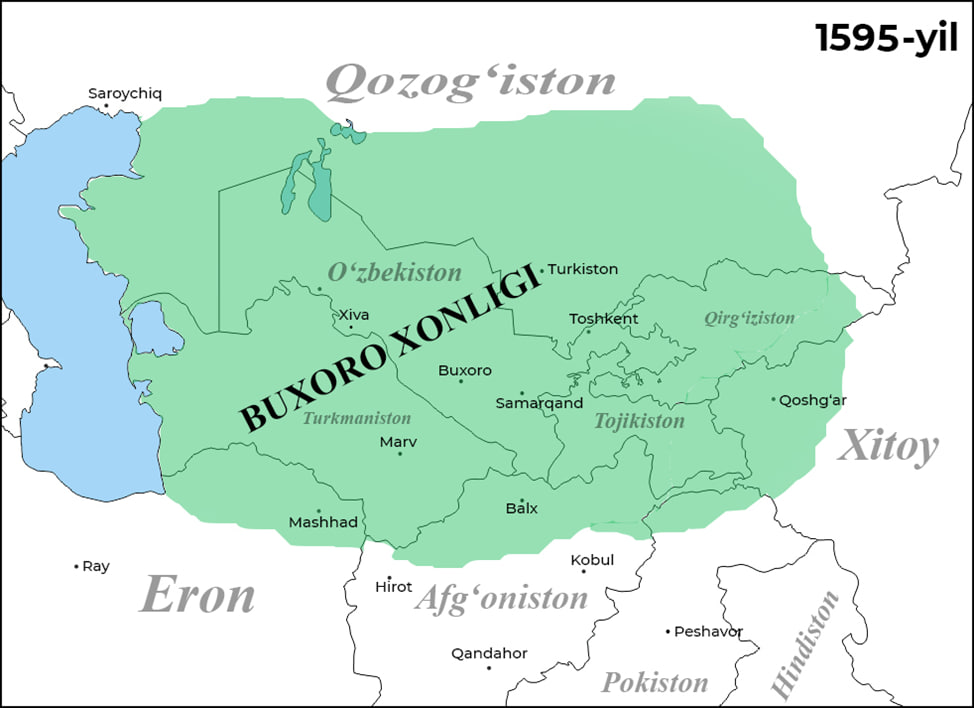
He brought under his rule all of Transoxiana, Turkestan, Kashgar, the Dasht-i Qipchaq, Khorezm, Balkh, and Badakhshan. Then he aimed to liberate Khorasan from the Qizilbash and captured it from Shah Abbas, son of Shah Tahmasp, up to Yer-Kupruk—the farthest point of Khorasan.
In 1572 and 1574, Siberian Shaybanid Khan Kuchum requested Muslim scholars from Abdullah Khan to preach in Siberia and to help establish an Islamic ideological basis for the Siberian Khanate.
By 1593–1594, Abdullah Khan had conquered Khorezm, and his forces entered Khiva without resistance.
The territory of the Bukhara Khanate during the last years of Abdullah Khan II's reign | Muhammadqodir Sobirov
Some Kazakh sultans, such as Shigay Khan and his son Tauke, served as Abdullah’s vassals. But relations soured, and in 1598, upon learning of a rebellion by Abd al-Mumin, Kazakhs launched a campaign against Tashkent. While preparing for war against his son, Abdullah Khan died before any battle took place.
Foreign policy
Under Abdullah Khan II, the Bukhara Khanate maintained diplomatic relations with the Mughals in India, the Ottoman Empire, and Russia. In a 1577 letter, Mughal Emperor Akbar informed Abdullah Khan of his intent to expel the Portuguese from India.
In 1575, Ottoman Sultan Murad III sent guns and cannons to Abdullah to aid his fight against Shiite Iran.
Russo-Bukhara relations – revived through the envoy A. Jenkinson – were strained in the 1580s due to Abdullah Khan’s support for Kuchum Khan, the Siberian Shaybanid.
Kuchum Khan waged a long struggle against Siberian Khan Yediger, aided by Uzbek, Nogai, and Kazakh troops. He achieved decisive victory in 1563.
In 1589, Abdullah Khan sent a delegation to Russian Tsar Fyodor Ivanovich. Another embassy was dispatched to Moscow in 1596.
In 1595, Abdullah Khan sought closer ties with the Nogais, offering them a fortress in Saraychik on the Ural River. That February, an envoy from Kazakh Tauke Khan warned Moscow that Abdullah Khan planned to use it as a base to attack Astrakhan.
In August 1595, Tauke Khan sent his son Murad to Moscow as a hostage to obtain weapons to fight Abdullah Khan II and Kuchum.
Tsar Fyodor requested that Tauke Khan force Abdullah Khan II and Kuchum to submit to Moscow. A well-equipped army was to be sent to Samara, led by Tauke Khan against Bukhara and Kuchum Khan.
Cultural policy
Abdullah Khan II was not only a talented military leader but also a remarkable statesman. He expanded Bukhara’s trade – especially with Russia and India – and invested heavily in monumental architecture: madrasas, khanqahs, caravanserais, covered markets, reservoirs, and bridges.
He was also a patron of education and the arts, surrounding himself with scholars, writers, and chroniclers. Court poets and historians praised him. Chief among them was the poet Mushfiqi, known for his odes, lyrics, and epigrams, and who also served as a skilled diplomat. On Abdullah Khan’s orders, Mushfiqi composed inscriptions for state buildings. Court historian Hafiz Tanish compiled the fact-rich chronicle “Abdullahnama.” Literature thrived in Persian, Turkic, and partly Arabic.
Bukhara reached its peak under Abdullah Khan II (1557–1598), with over 200 madrasas and numerous bazaars, all within its 16th-century city walls.
From 1582 to 1598, he ruled Turkestan, overseeing the completion of the portal of the Khoja Ahmad Yasavi mausoleum, left unfinished since Timur’s death. He also ordered partial restorations, built many new structures including a bathhouse with chimney heating, still preserved today.
Architecture of the Abdullah Khan era
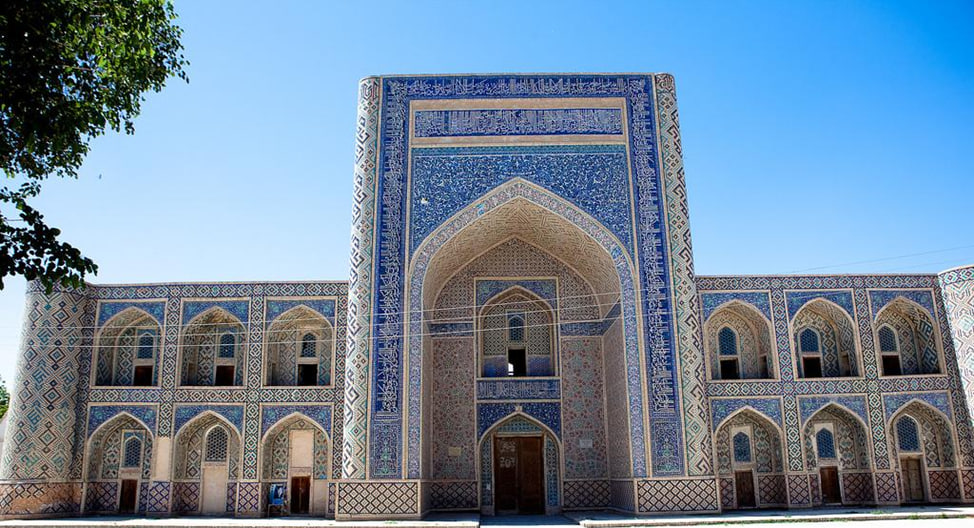
During his rule, the Kosh Madrasah ensemble was built in Bukhara. The first – Modari Khan Madrasah – was constructed around 1567 in honor of his mother. The second, named after Abdullah Khan himself, was built between 1588 and 1590. He also commissioned Shoh Akhsavi Madrasah.
Abdullah Khan Madrasah | Uzbek Travel
Under his patronage, covered markets were built in Bukhara, including: Tim Abdullah Khan, Toki Sarrafon, and Toki Zargaron.
Death
Abdullah Khan II died on February 8, 1598. After his death, the throne passed to his son, Abd al-Mumin. Abd al-Mumin was forced to go to the Syr Darya to deal with his cousin, Khazar Sultan, the son of Uzbek Sultan, who had rebelled and declared himself khan. Abd al-Mumin first moved east toward Shahrukhia and Ahsiket, and then north to Tashkent. The death of Abdullah Khan II signaled the restoration of Khorezm’s independence. He was buried near the mausoleum of Baha-ud-Din Naqshband, near Bukhara.