





Additional features
-
Night mode

InfinBANK’s in-house AI strategy: Improving customer experience through data, microservices, and automation
Recently, at a government meeting, President Shavkat Mirziyoyev emphasized that the development of artificial intelligence should happen locally rather than by simply replicating external experiences. At Kun.uz, we decided to explore how the banking sector is responding to this challenge. It turns out that some banks began moving in this direction earlier and are already ready to share their initial results.

Server Abdurayimov and Aziz Siayev from InfinBANK explained how they develop their own AI solutions instead of relying on external platforms – from an in-house data center and customer-scoring systems to a Telegram bot and even a holographic assistant in a branch.
What has changed
After updating its customer-scoring model, InfinBANK improved prediction accuracy by 10%, while application-processing speed also increased. The system now analyzes data more effectively and makes faster decisions, allowing customers to receive quicker responses and the bank to operate more efficiently.
The data center is built on a hyper-converged platform, ensuring independence and scalability: all nodes and channels are fully redundant, and the system can handle peak loads without downtime. The bank’s Telegram bot and virtual assistant serve users in Uzbek and Russian 24/7, gradually reducing the workload on human operators. In branch offices, a holographic avatar helps visitors navigate and access information about banking services.
Why we built everything in-house
In a typical regional bank, customer scoring is handled through third-party services, core systems run on outdated platforms, and chatbots rely on external solutions. This approach poses three major challenges:
- Data exposure. Sensitive customer records sent to external providers create security and compliance risks.
- Limited control over technology. External models function as “black boxes,” making adaptation to local contexts difficult. Price increases or service changes can leave the bank dependent on the provider.
- Scaling difficulties. Rented data centers and cloud services in Uzbekistan often have high latency, and acquiring additional capacity can take months.
In response, InfinBANK decided to rebuild its systems from the ground up: constructing a data center, developing its own scoring systems, designing a microservice architecture, and building a chatbot from scratch. Although this required higher initial investment and complexity, it provided full control over data, architecture, and products.
Why we built our own data center instead of renting one
To create its data center, InfinBANK engaged specialized companies with the necessary expertise. The design, installation, and commissioning were carried out alongside technical partners and solution vendors, ensuring compliance with international standards for reliability and energy efficiency.
Why not simply rent capacity?
- Independence. The bank manages its computing resources directly, without reliance on an external provider.
- Data security. In-house infrastructure allows stricter control over customers’ personal data.
- Knowledge retention. Expertise remains within the team.
While building a data center requires significant upfront investment, renting can be more expensive in the long run. The in-house infrastructure also becomes a lasting asset for the bank.
How the data center is built
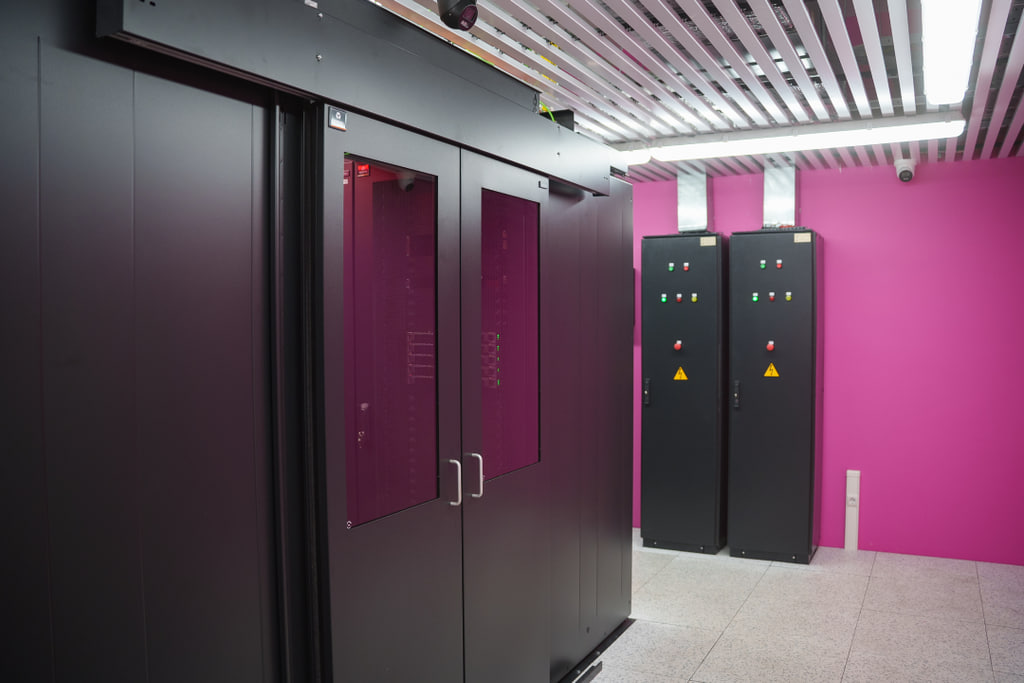
InfinBANK approached the data center as an engineering platform supporting the stability of all banking services, not merely a “room with servers.”
- Hyperconvergence. Computing resources, storage, and virtualization are integrated into a single management system. Scaling is simplified – new nodes can be added without downtime or bottlenecks. The entire infrastructure is managed through a unified interface.
- Fault tolerance. All nodes are duplicated, so if one fails, the system automatically redistributes the load. Power and cooling systems are redundant, with backup circuits for potential malfunctions. Continuous monitoring tracks temperature, humidity, and energy consumption.
- Data storage. Data is hosted in a distributed storage system that integrates compute and storage resources. As servers are added, performance and resilience improve. The system automatically creates copies and balances the load across storage nodes. Key services and databases are replicated across sites, ensuring availability even during outages.
All network, compute, and engineering metrics are displayed on a unified dashboard, used to generate load forecasts and response scenarios – the system is designed not only to withstand failures but also to anticipate and prevent them.
How customer application processing works
When redesigning the application-processing system, InfinBANK focused on both speed and security.
- Submitting an application. Customers can apply via the mobile app, internet banking, ATMs, POS terminals, or partner APIs. All requests enter a traffic intake zone, where data is encrypted, load balancers distribute the workload across servers, and each request is validated.
Processing inside the bank
Once submitted, applications are routed into a virtualized environment where the bank’s core services operate: the core banking system, CRM, and application-processing systems. Each service runs on a separate cluster so that updates or errors in one do not affect the others.
The microservice chain
In simplified terms, the system works as follows:
- Intake service: receives and validates the application.
- Verification service: retrieves the required data from external sources.
- Scoring service: calls machine learning models for analysis.
- Calculation service: determines product parameters.
- Document services: generate necessary documents and confirm them via OTP.
- Execution service: completes the operation.
Message brokers facilitate data exchange between microservices, ensuring reliable communication. Scaling is straightforward – adding more server capacity increases overall throughput.

Failure protection
When external systems malfunction, a protection mechanism is activated: the service temporarily stops sending requests to the unavailable provider and queues applications so that the entire system continues running. This mechanism follows the circuit breaker pattern, isolating failures and preventing dependent services from being overloaded. At every stage, monitoring tools analyze data flows in real time, helping detect anomalies and prevent overloads.
How the customer scoring system works
InfinBANK’s scoring system relies not only on credit history but also on alternative data: transaction patterns, incoming payments, balance dynamics, and questionnaire information.
- Explainability principle: Transparency is key. Instead of “black boxes,” interpretable models such as logistic regression are used. These models make predictions and show the contribution of each feature to the final decision.
- Continuous cycle: Modeling never stops. Feature distributions and quality metrics are constantly analyzed. Obsolete features – for example, those no longer reflecting current consumer behavior or economic conditions – are replaced with new, more informative factors.
- What we monitor: Business metrics such as prediction accuracy, throughput, and processing times; and technical metrics such as segmentation quality, error rates, and data distribution stability.
How the model is updated
When performance declines, the model undergoes retraining through a structured process:
- A new version runs in the background, processing applications without affecting decisions.
- A small portion of applications is routed to the new model for A/B testing.
- Performance metrics are compared.
- If results meet standards, the model goes into production; otherwise, it is revised.
This approach ensures a balance between processing speed and decision quality.
How new factors improved accuracy by 10%
During one update, the team discovered that the previous model had become less effective due to changes in customer behavior. Obsolete features were removed and new factors reflecting current behaviors were added. The result: prediction accuracy increased by 10%, and throughput improved.
The updated model better understands customers’ needs, allowing more applications to be processed with higher quality – benefiting both customers and the bank.
What about AI assistants
Generative AI is deliberately not used in scoring systems to avoid reliance on “black boxes” for critical decisions. It is applied in services where natural interaction is key.
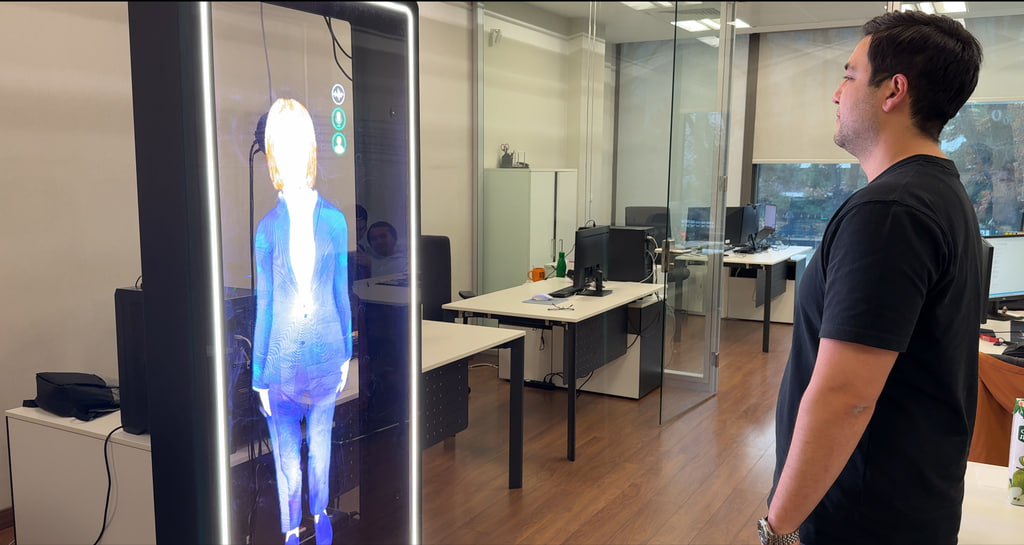
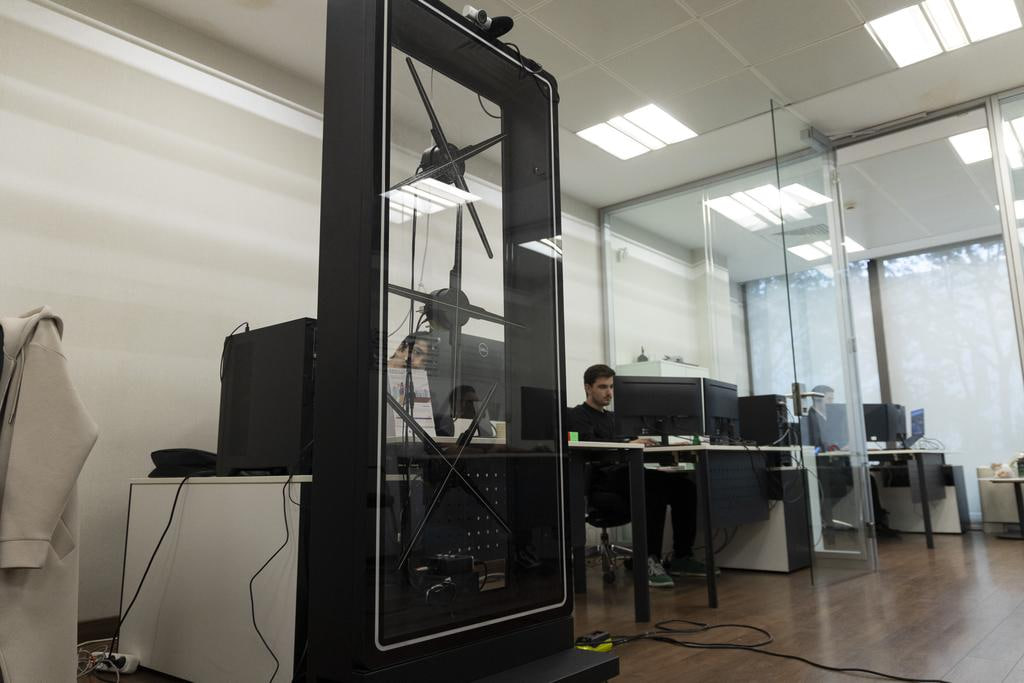
- Holographic assistant in the branch: The AI avatar greets customers, “sees” them via computer-vision models, understands speech, and responds with a natural-sounding voice. The system first interprets the question, searches the internal knowledge base, and then generates a text answer. Open models such as Gemma and LLaMA are fine-tuned for the task. Answers are verified to prevent hallucinations before speech and animation are synthesized.
- Telegram bot: Powered by the same architecture, the bot is available 24/7, supports Uzbek and Russian, and helps users select services or obtain answers.
- Inquiry analytics: Data from customer interactions is analyzed to identify trends, understand frequently asked questions, and detect service issues. This allows the bank to respond quickly to user needs and improve services.
What we learned from our own experience
- Build what provides a competitive advantage: Developing core components – scoring systems, microservices, and the chatbot – in-house allows adaptation to the local market and avoids dependency on external vendors.
- Focus on data, not just the model: Data cleaning, process configuration, and monitoring often deliver better results than relying solely on complex algorithms.
- AI as a tool, not a replacement: InfinBANK builds technologies to make interactions with the bank feel as natural as talking to a person.
For those interested in production ML, microservices, or building AI assistants in Uzbek, the team encourages reaching out in the comments. They hope their experience will be useful to others.