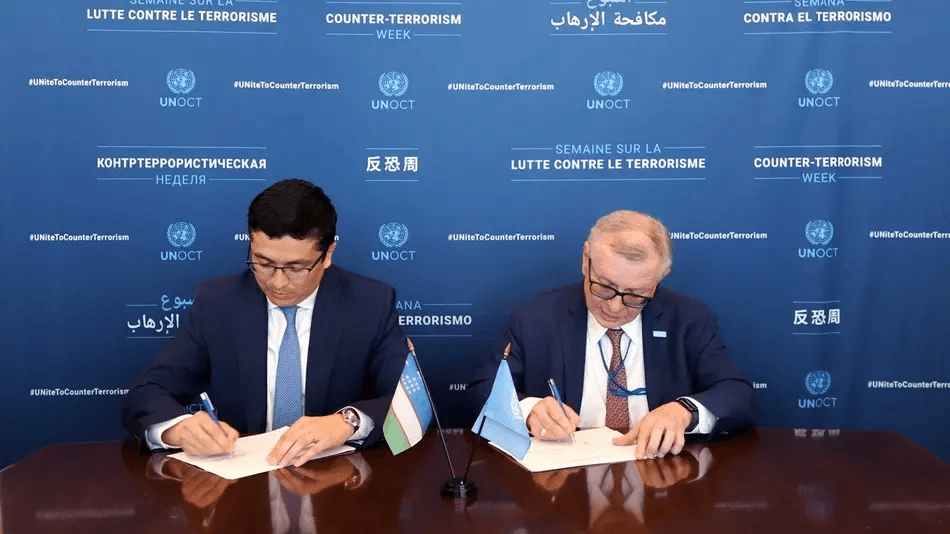
The agreement was signed on the sidelines of UN Counter-Terrorism Week in New York during a meeting between an Uzbek delegation led by Botir Tursunov, First Deputy Chairman of the State Security Service, and Alexander Zuev, UN Assistant Secretary-General and Acting Head of UNOCT.
According to the parties, the roadmap builds on their existing partnership by expanding technical assistance and expert cooperation. Discussions focused on ongoing joint programs, including specialized training for law enforcement personnel, countering the misuse of emerging technologies by extremist groups, and strengthening efforts to combat terrorist financing.
A key topic of the meeting was the proposed establishment of an International Competence Center for the Rehabilitation and Reintegration of Persons Returned from Conflict Zones in Uzbekistan. The initiative was first proposed by President Shavkat Mirziyoyev during the 80th session of the UN General Assembly in September 2025.
The center is expected to draw on Central Asia's experience in repatriating citizens from conflict zones and serve as an international platform for developing rehabilitation and reintegration practices. In addition to training security and social service professionals, it would support educational and vocational programs for returnees while promoting research and preventive measures aimed at countering radicalization.
The Uzbek delegation also met with Natalia Gherman, Executive Director of the UN Counter-Terrorism Committee Executive Directorate (CTED), to discuss closer cooperation in research and policy analysis. The talks included the possible inclusion of the Institute for Strategic and Regional Studies under the President of Uzbekistan in CTED's Global Research Network, which brings together research institutions working on terrorism and security issues.
If approved, the institute would gain access to international analytical resources and collaborative research projects while contributing Uzbekistan's expertise to the network.
The meetings concluded with both sides reaffirming their commitment to deepening cooperation in response to evolving transnational security threats. Held from June 26 to July 2, UN Counter-Terrorism Week brings together member states, international organizations, and security experts to coordinate the implementation of the UN Global Counter-Terrorism Strategy.