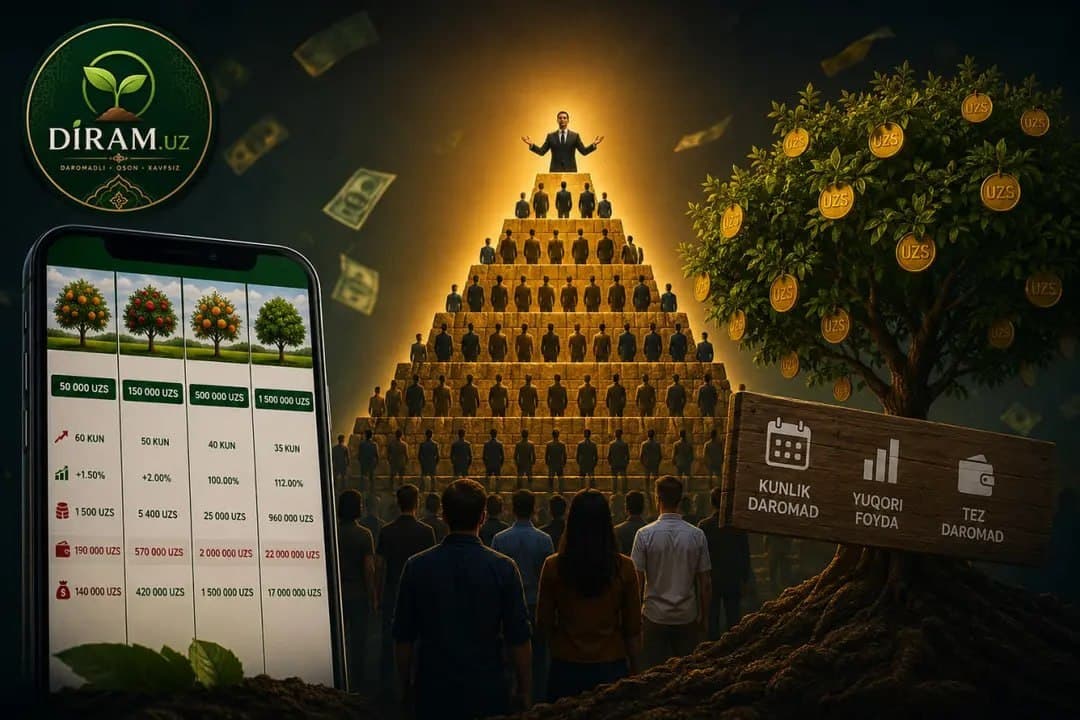
Financial pyramid schemes that have targeted Uzbek citizens in recent years have largely followed the same formula – participants are encouraged to make an initial deposit, promised daily profits, and rewarded for recruiting new members. Those three elements form the foundation of most such schemes.
Previous platforms have promoted a variety of investment narratives. Some claimed users could earn money by renting Parker power banks, watching videos, reading books, or purchasing AI-powered robots. Others, including Whats, AIF, HNK, XCM, OMD, and FastAI, were presented as innovative online earning opportunities.
Most of those platforms were registered abroad. The XCM website, for example, was found to have been registered in Canada using a Singaporean mobile phone number despite actively operating in Uzbekistan.
Investment presented as orchard creation
Unlike earlier schemes, diram.uz does not advertise video-watching tasks or equipment rentals. Instead, users are invited to create a virtual orchard by purchasing fruit tree seedlings.
Behind that concept, however, are the same core mechanisms associated with financial pyramids.
The initial investment is framed as the purchase of one of five types of fruit tree seedlings. The cheapest option, an apricot tree, costs UZS 100,000. Other options include a pomegranate tree for UZS 300,000, a peach tree for UZS 1 million, a walnut tree for UZS 3 million, and a pistachio tree for UZS 5 million.
The website promises that these "seedlings" begin generating income the day after purchase. According to the platform, a walnut tree matures over 35 days and yields a total return of 112%, meaning an UZS 3 million investment would generate UZS 3.36 million by the end of the period.
Like many similar schemes, the platform also offers referral bonuses to users who recruit new participants. In addition, it invites users to establish "Diram orchards" across different regions of Uzbekistan.
Internal currency used for transactions
The platform masks withdrawals as the sale of harvested fruit. After registering, users purchase seedlings using an internal unit called DRM, described on the website as a payment unit pegged to the US dollar. The resulting profits can then be withdrawn to a bank card.

Investigation traces platform's developer
According to publicly available records, the diram.uz domain was registered in late April 2026 by Best Internet Solution, a private enterprise affiliated with Eskiz IT Company.
Seeking clarification, Kun.uz contacted Eskiz IT. A company representative confirmed that the domain had been registered by Best Internet Solution and said the customer was an individual identified as Madina Madrakhimova.
During its investigation, Kun.uz identified Husniddin Rofiyev, an IT specialist from Bukhara, as the person behind the project and contacted him for comment.
Rofiyev denied that Diram is a financial pyramid.
"I am an IT specialist and developed this website myself. It has not been fully launched yet because technical improvements are still underway. Registered users may choose either to make a deposit or invite other people. Their income does not depend solely on referrals, so this is not a financial pyramid," he said.
He also claimed that the fruit trees advertised on the website would be planted in real orchards rather than existing only virtually.
"I will personally plant these trees. The orchards will be real. I do not intend to create only a virtual garden," he said.
Asked how the platform could begin paying returns one day after a seedling is purchased, Rofiyev said the payouts would initially come from his own funds. He claimed to have UZS 5.3 billion in personal savings that would be used to cover the promised returns.
According to him, money paid by participants is transferred directly to his company's bank account, and the project was launched after notifying the tax authorities and obtaining the necessary approvals.
Despite repeatedly insisting that the platform is not a financial pyramid, Rofiyev's explanation does not appear to align with basic economic principles underpinning investment returns.
Public records show that Rofiyev is also the founder of TXKA LLC, a company registered in November 2023.
The appearance of a platform exhibiting the characteristics of a financial pyramid under Uzbekistan's national domain represents a troubling development. As suspicious investment platforms continue to emerge under different guises, stronger regulatory enforcement and decisive action against fraudulent operators may be needed to reduce the risk of further financial losses for the public.