From a Village in Jizzakh to Yale: How I applied and got accepted
|18:0218214 min
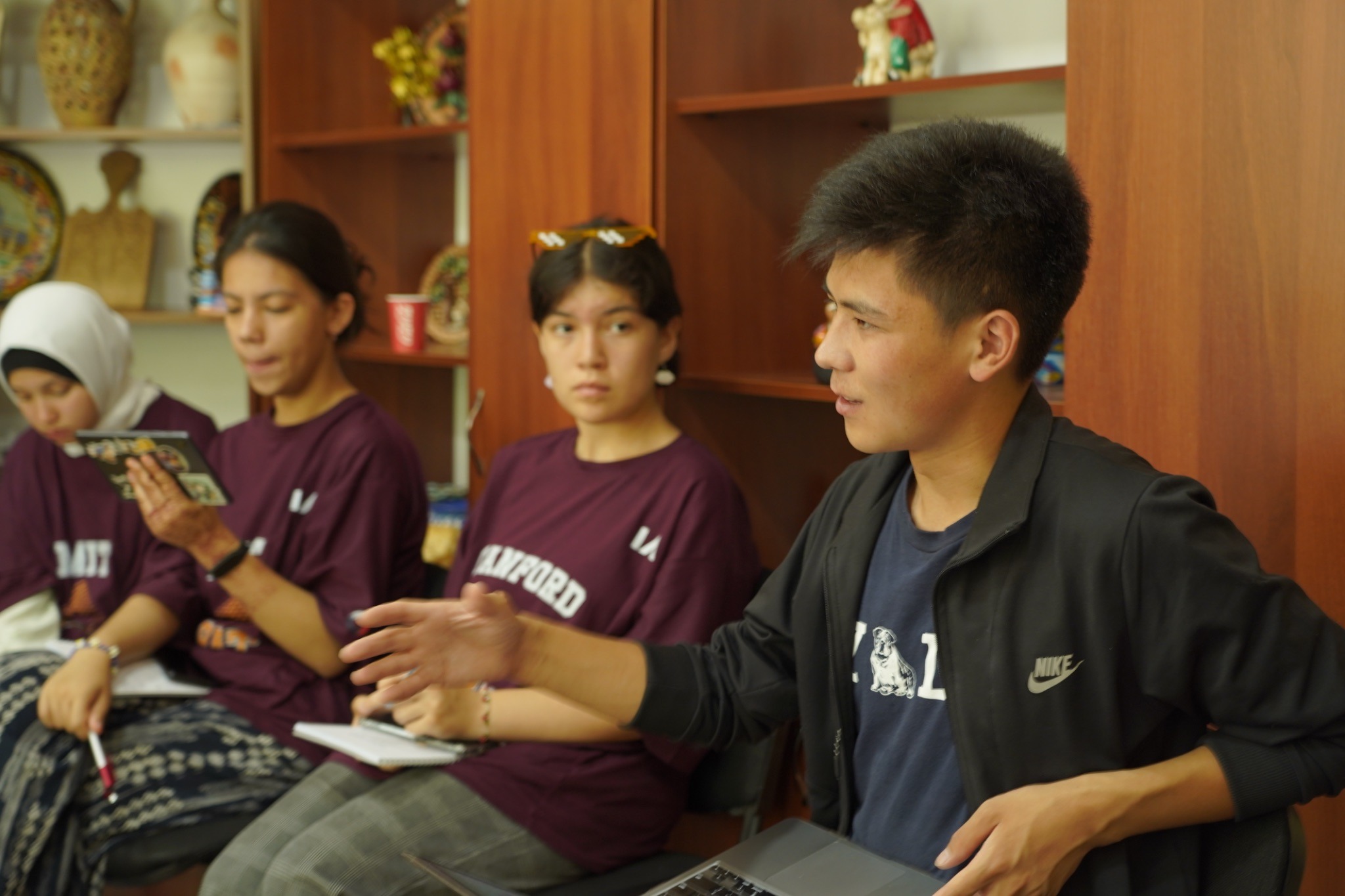
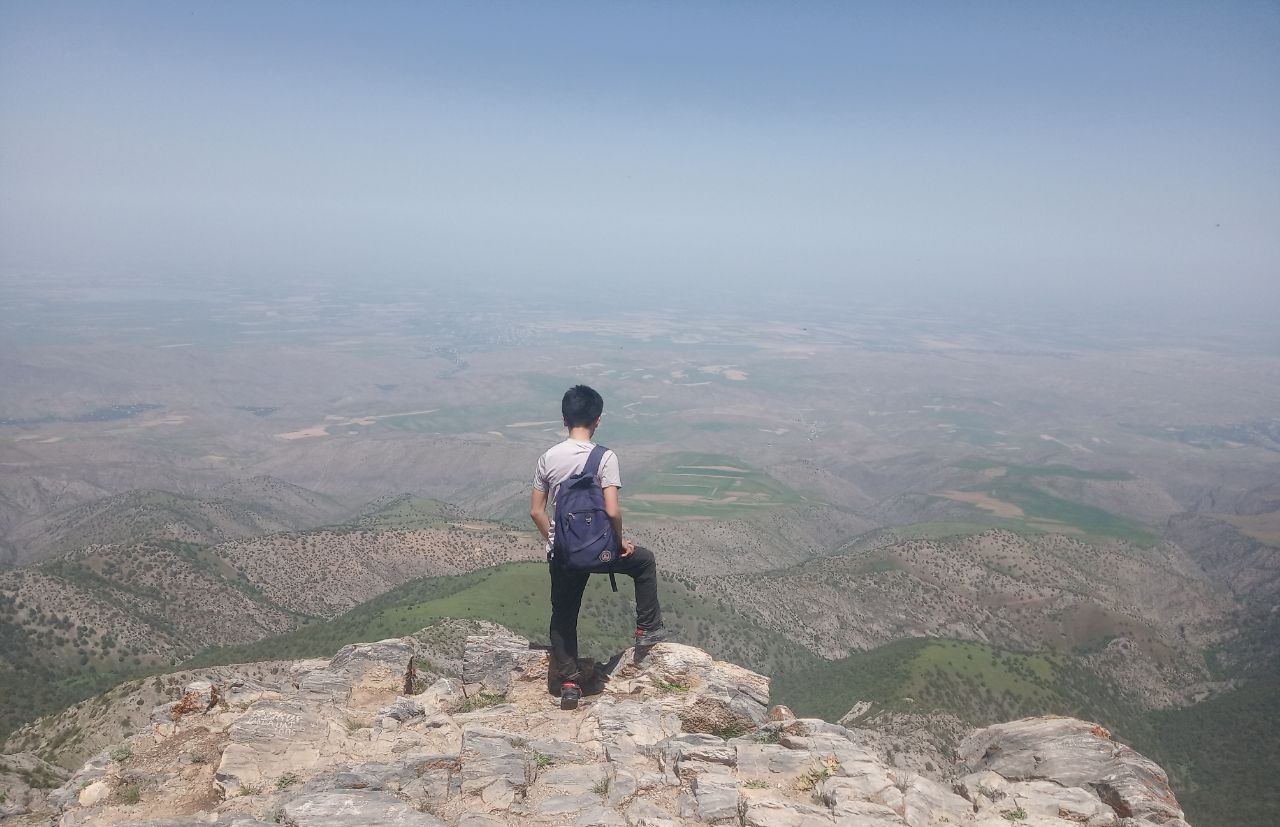
I'm Khosilmurod Abdukholikov. I was born and raised in Jizzakh. Until I was 14, we had no internet at home, and I first heard of Yale in 10th grade. After finishing school in 2022, I applied to several US universities and was rejected. After a gap year, I applied only to Yale and was admitted in December 2022. I'm now studying Computer Science at Yale.
Yale UniversityYale University
Now that I'm a student here, I want to say this: getting into Yale was not a miracle or a coincidence. Any candidate who works seriously on three things - academic results, extracurricular activities, and essays - has a real chance in admission. Let's walk through the path to Yale using my own experience.
What Do You Need to Apply to Yale?
To apply to Yale as an undergraduate, you first submit your application through one of three platforms: the Common Application, the Coalition Application on SCOIR, or QuestBridge. You can use only one per admission cycle.
academic preparation as the most important factor in the admissions process. High grades matter, but almost every applicant has them. To tell strong students apart, the university looks at how rigorous your courses were, how fully you used the most challenging courses your school offered, and how well you performed in them.
I took my schoolwork seriously too. But as a student in Uzbekistan, I faced an additional problem: limited opportunities. Because I grew up in a village in Jizzakh without the internet, I learned about international universities, courses, and olympiads later than my peers.
Yale says it evaluates applicants within the context of their own circumstances. For example, if your school doesn't offer AP or IB, you won't be penalized for not taking them. What matters is how you use the opportunities available to you. So my advice is not to stop at "My school doesn't have that." I started looking for opportunities outside school myself.
SAT or ACT: Rejected with 1420, Back with 1500
When I finished school in 2022, I applied to several US universities with an SAT score of 1420. I was rejected by NYU, Amherst, and Williams. The following year I retook the SAT and scored 1500. In total, I took the test four times.
A score around 1500 gives a useful edge for applicants to highly selective universities like Yale. But keep in mind that the SAT alone isn't enough. So I treated it as just one part of my application and focused on the strengths that set me apart from other candidates.
In my case, I believe it was my extracurricular activities and my essays that distinguished my application.
IELTS or TOEFL: I Took the IELTS Once
For international students, English proficiency matters too. If you haven't studied for at least two years at a school where English is the language of instruction, Yale requires an English test in addition to the SAT or ACT. IELTS, TOEFL, Cambridge, the Duolingo English Test, and other options are accepted.
I took the IELTS at 16 and scored 7.5. I never retook it. Yale indicates that its most competitive applicants currently show IELTS scores of 7 or higher.
But studying English only for the test is both wrong and insufficient. To study at Yale, you need to understand complex texts, write well, and express your ideas clearly. These same skills later became very important to me when writing my essays.
You Apply Through the Common Application or Coalition Application
Yale doesn't have its own application form. Instead, you apply through one of three websites: the Common Application, the Coalition Application on SCOIR, or QuestBridge. The Common App and Coalition App are general application sites that many universities use, and Yale treats them exactly the same, so you can choose whichever you prefer. QuestBridge is a nonprofit program for high-achieving students from lower-income families, with its own process and a shorter set of Yale questions. You can only use one of the three per year.
I chose Early Action because Yale was my first choice. But don't assume Early Action automatically increases your chances. Yale says it gives no such advantage in its selection process.
Essays: The story my CV Couldn't tell
In my opinion, the essays were the strongest part of my application, because they reveal something a CV can't fully show: who you are as a person.
I expressed interest in Computer Science and Philosophy at Yale. In one of my essays, I wrote about philosophical concepts such as consciousness and philosophical zombies. I studied this topic in depth and worked intensively with the material for about two weeks.
In the other parts of my essays, I wrote about life in the village, moving to Tashkent, my experiences during COVID, and having to create opportunities for myself.
The most important thing for me was not to simply write "I'm very hardworking." For example, the fact that "I had no internet at home until I was 14" is only part of the story. What matters is that, in a setting where the internet and opportunities were limited, I later began seeking out opportunities for myself: I took part in international courses, built projects, and taught myself various subjects independently.
Yale also encourages applicants to show their personal perspective and their own voice in the essays. In the university's 2026–27 admissions cycle, one essay is up to 400 words and asks you to write about an experience discussing an important topic with someone who disagrees with you, a community you belong to, or a personal experience you would bring to the campus environment.
So instead of answering "Why Yale?" by praising Yale, it's more important to show who you are.
Extracurricular Activities: I Focused on Seven
In my view, the key question about extracurriculars is not "How many activities do I have?" It's how they connect, their scale, their value, and what you learned from them.
I had seven main activities:
Study Buddy project. I brought together about 100 participants from eight countries. The goal was to study together subjects that are rarely taught in schools.
Philosophy club. In 2021–2022, about 10 of us read complex philosophical texts together.
Veritas AI course -I took part on a grant.
Photography. I did it for two years and developed it into a business rather than just a hobby.
Farming. This was one of our family's main sources of income.
Software engineer at PDP. At 15, I took part in developing an educational platform.
Sales and warehouse management system. At 16, I built a system for a chain of jewelry stores in Tashkent that managed inventory, sales, revenue, and orders. We launched it in two branches, and I worked with the clients myself.
That's why I'd advise students to do real work in a few areas rather than simply list 20 activities.
My activities weren't all alike. What they had in common is that in each of them, I wasn't just a participant but someone who produced real results.
Recommendation Letters: Choose a Teacher Who Knows You Well
First-time undergraduate applicants to Yale are required to submit recommendations from two teachers and a school counselor. The university advises choosing teachers who know the student well and can illustrate their abilities and growth with specific examples.
This mattered in my story too, because a recommendation letter shouldn't consist only of statements like "this student gets good grades." Yale itself says the most useful letters are those that show, through concrete examples, how a student thinks, how they learn, how they contribute to the school community, and their intellectual curiosity.
So don't leave getting recommendations for the last week. It's important to choose a teacher who knows you well and can speak specifically about your work in class and your character..
Yale Is Expensive, but Financial Aid Exists
Yale is expensive, but financial aid is available for international students. Yale's annual tuition for 2026/27 is $72,000, and students may spend roughly another $25,500 on housing, food, books, personal expenses, and other fees. As a result, the total annual cost, excluding travel, comes to about $97,500.
Expense
2026–27
Tuition
$72,500
Student activities fee
$185
Housing
$12,080
Food
$9,520
Books and supplies
$1,000
Personal expenses
$2,700
Estimated total cost
$97,985
Yale considers international applicants in the admissions process regardless of their family's financial means, and states that it meets 100% of demonstrated financial need for admitted students through need-based aid. Thus, if you get in and are unable to pay, your expenses will be covered. This aid comes as grants, not loans.
I was admitted to Yale on a full scholarship worth about $400,000. So before concluding "Yale is too expensive, so I can't apply," be sure to look into the university's financial aid policy.
Don't Wait for Opportunity. Create It Yourself.
When I finished school, I didn't get into Yale. My SAT was 1420. I was rejected by NYU, Amherst, and Williams. I was admitted to the University of South Florida with a scholarship and began preparing to study there.
Then I saw a friend of mine get into Yale. That moment mattered to me, because Yale stopped being a university "only for people from very strong American schools" and became a place I could try for too.
I took a gap year. I retook the SAT. I worked on my essays. I revisited the projects and activities I had done. And I applied again.
I also worked on my essays with a mentor, Valera Arakelyan, who had previously mentored two Uzbekistani students admitted to Yale. So I wouldn't say "I got into Yale all by myself." I sought help and direction when I needed them.
In my opinion, the most important idea behind my application was high agency: not waiting for opportunities, but creating them for yourself. Don't accept the world as a place where opportunities are fixed in advance. Many things most people consider impossible are often just things no one has seriously tried.
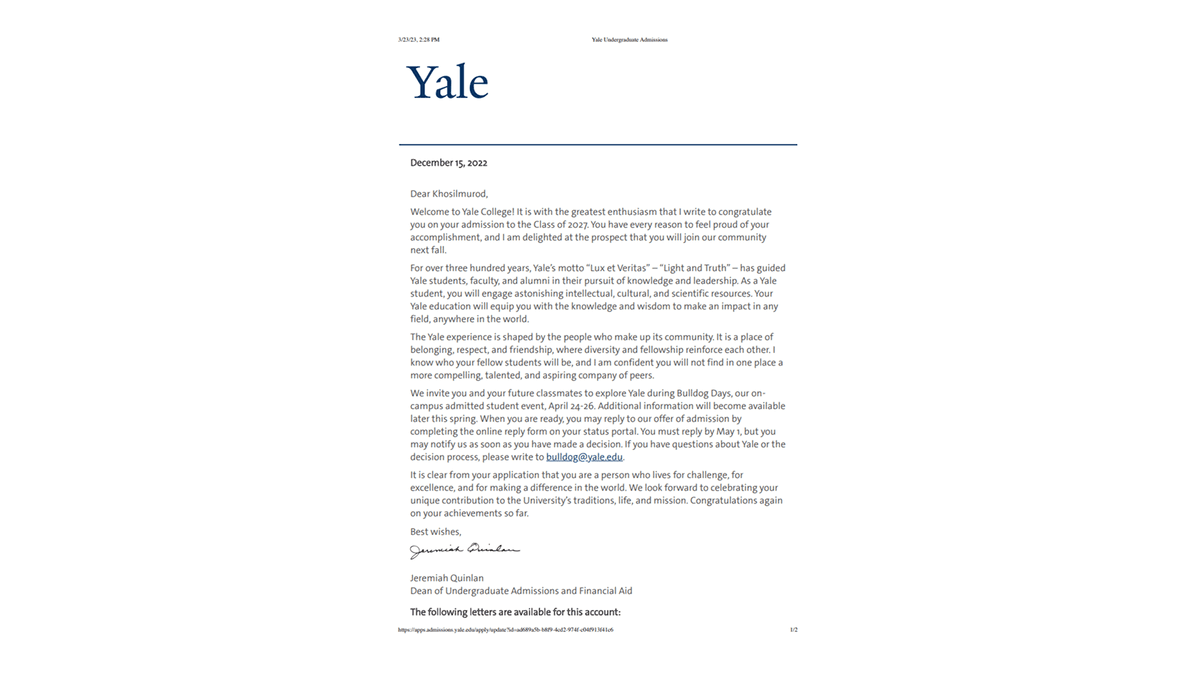
I didn't know about Yale until 10th grade. But once I knew, I started acting, and in December 2022 I finally received my acceptance letter from that university.