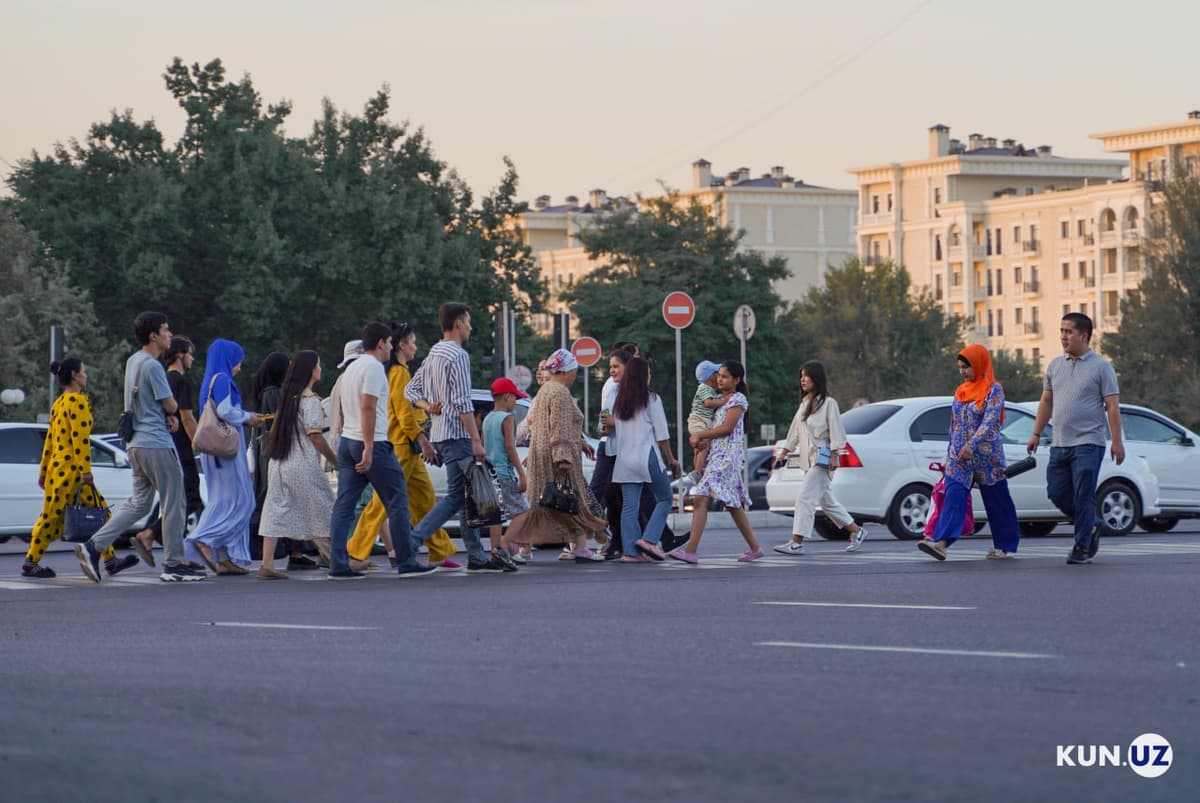
Here’s the population density trend by year:
- 1991 – 46.1 people/km²
- 1995 – 50.2 people/km²
- 2000 – 54.6 people/km²
- 2005 – 58.0 people/km²
- 2010 – 62.4 people/km²
- 2015 – 69.1 people/km²
- 2020 – 75.5 people/km²
- 2025 – 83.6 people/km²
Population density per square kilometer by region (As of April 1, 2025):
- Republic of Karakalpakstan – 12.2
- Andijan region – 807.9
- Bukhara region – 51.8
- Jizzakh region – 72.8
- Kashkadarya region – 128
- Navoi region – 9.9
- Namangan region – 422.7
- Samarkand region – 257.3
- Surkhandarya region – 147.3
- Syrdarya region – 218.3
- Tashkent region – 206.2
- Fergana region – 615.7
- Khorezm region – 337.1
- Tashkent city – 6,983.2
Population figures
As of April 1, the permanent population of Uzbekistan was 37.7 million people – an increase of 2% compared to the same period in 2024.
Breakdown:
- Women – 18.7149 million
- Men – 18.9829 million
- Urban population – 19.2164 million
- Rural population – 18.4814 million
According to forecasts, 223,900 people are expected to die in Uzbekistan in 2025. The average life expectancy in the country stands at 74.3 years. More than half of all deaths are attributed to cardiovascular diseases.
As of January 1, the number of women aged 15 to 49 in Uzbekistan was 9.424 million. This figure has shown steady growth over the years:
- 1991 – 4.8212 million
- 1995 – 5.4185 million