In 2025, people in Uzbekistan bought 661 kg of gold bars. That is more than the total purchased over the previous five years combined. Gold rose by 54.5% in UZS, making it the most profitable investment in the country, outperforming both bank deposits and real estate.
Photo: Central BankPhoto: Central Bank
I looked into how buying gold from banks works: what documents you need, what you sign, what paperwork you receive, and how much you lose on the spread.
How it works
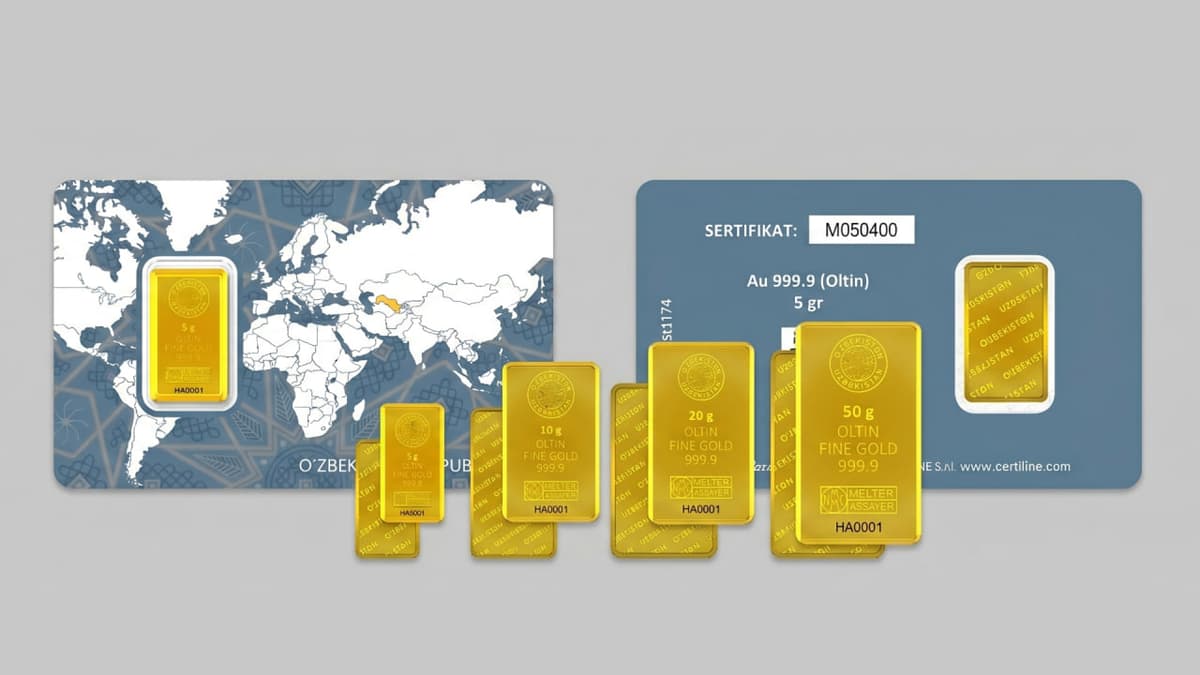
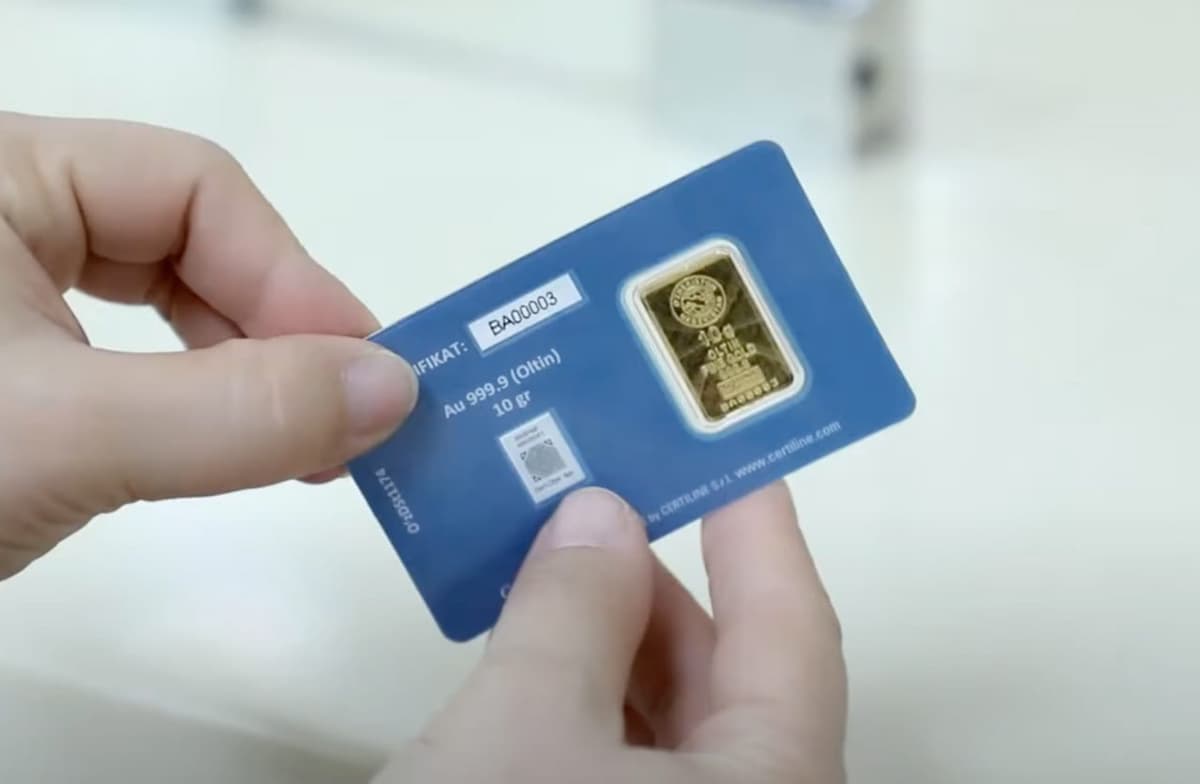
The Central Bank of Uzbekistan issues 999.9 fine gold bars and sells them to individuals through commercial banks.
Five denominations are available: 5, 10, 20, 50, and 100 grams. Anyone with a passport can buy one. You can only sell it back to a bank. Since November 2025, the entire process has been governed by Central Bank Regulation No. 3698 dated November 3, 2025. Issues related to purchases and buybacks that are not covered by this regulation are governed by Cabinet of Ministers Resolution No. 412 dated June 30, 2020, which the regulation explicitly references.
How much does a gold bar cost
The Central Bank sets gold bar prices daily. The formula is based on three factors: the global gold price on the London Bullion Market Association (LBMA) market, the UZS-to-US dollar exchange rate, and the Central Bank’s margin, which covers production costs.
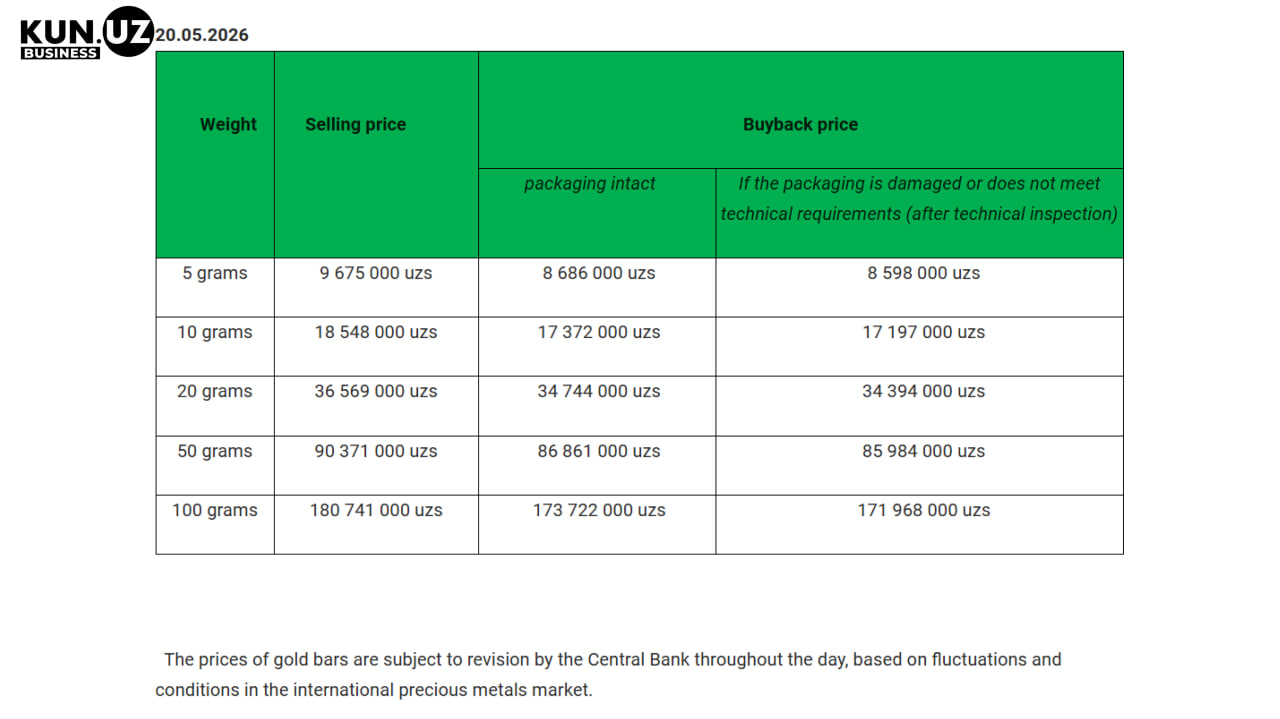
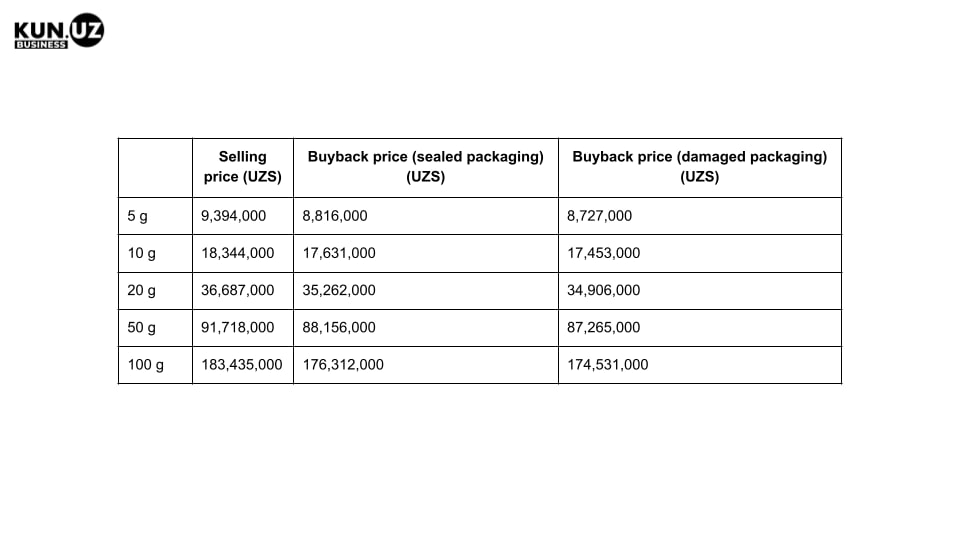
Current prices as of May 1, 2026Prices in UZS. They change every day, sometimes several times a day.
Now let’s calculate the spread — the difference between the purchase price and the price at which the bank buys the gold bar back in intact packaging.
5-gram bar you buy it for 9,394,000 UZS and sell it back for 8,816,000 UZS.
Your loss is 578,000 UZS, or 6.1%. That is effectively like paying a 578,000 UZS entry fee.
10-gram bar you buy it for 18,344,000 UZS and sell it back for 17,631,000 UZS.
Related topics
Your loss is 713,000 UZS, or 3.9%.
For all denominations from 10 grams and above, the spread is the same: 3.9%. The 5-gram bar is the exception — its spread is about one and a half times higher. So if your budget allows, buying one 10-gram bar makes more financial sense than buying two 5-gram bars.
How not to lose money
To break even on a 5-gram gold bar, the gold price must rise by at least 6.1%. In 2025, this kind of growth happened on average within three to four weeks. But in 2020–2021, gold prices declined, and some gold bar owners remained in the red for months.
No VAT is charged on gold bar purchases. Banks also do not charge any separate commission on top of the Central Bank price.
Moreover, under Clause 22 of Regulation No. 3698, when supplying gold bars to banks, the Central Bank does not seek to make a profit: the margin and discount are intended solely to cover operating costs.
When a bank purchases gold bars from the Central Bank and resells them independently (Chapter 3 of the Regulation), it sets its own prices based on LBMA rates and supply-demand conditions (Clause 26). Prices may change during the banking day, which means the price at a specific bank may differ from the one listed on the Central Bank website.
What documents are required to buy gold
A passport or ID card is sufficient. There are no citizenship restrictions — foreign nationals can also buy gold bars.
If the transaction amount exceeds the AML/CFT threshold established by law (around 500 base calculation units in 2026, or approximately 190 million UZS), the bank will carry out enhanced customer identification.
In practice, this means that when purchasing a 100-gram gold bar, the bank may request additional information, such as: source of funds; place of employment.
The exact BCU amount should be confirmed with the bank, as it is subject to revision.
How the purchase process works
Since November 2025, Uzbekistan has offered two ways to buy gold bars: at a bank branch or through a mobile app. The procedures and accepted payment methods differ.
Buying at a bank branch
1. Check availability on the Central Bank website
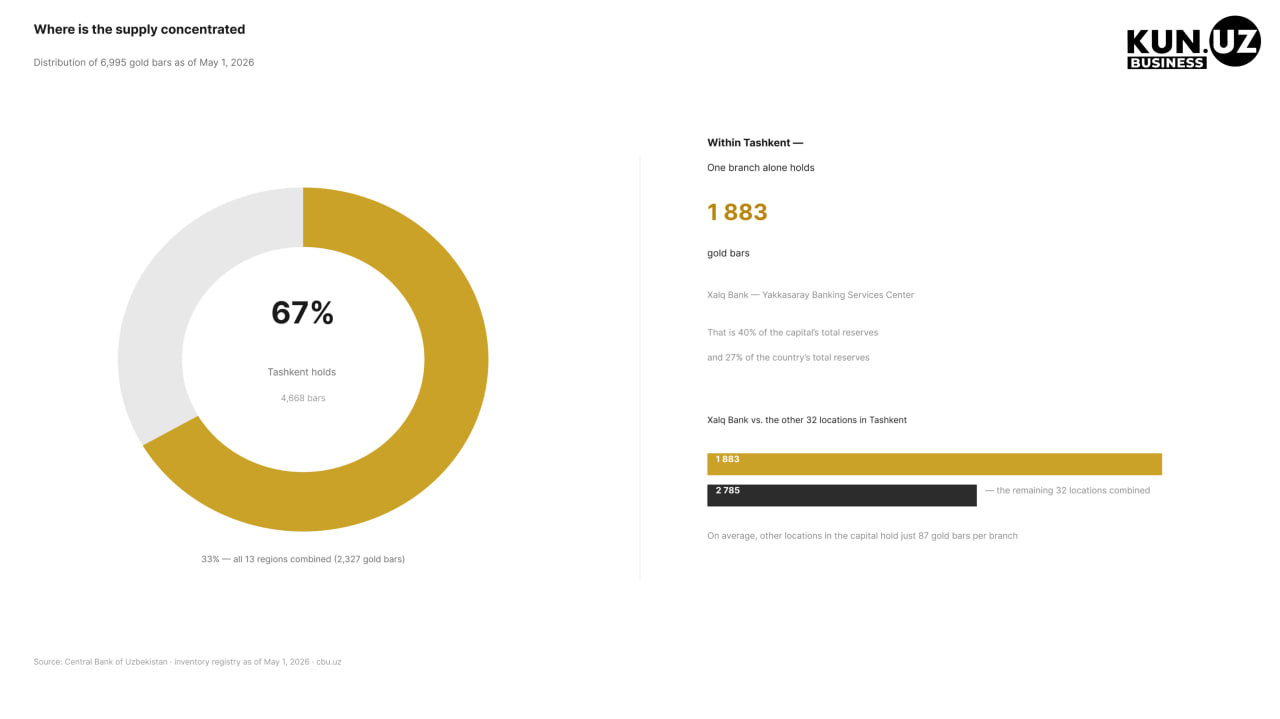
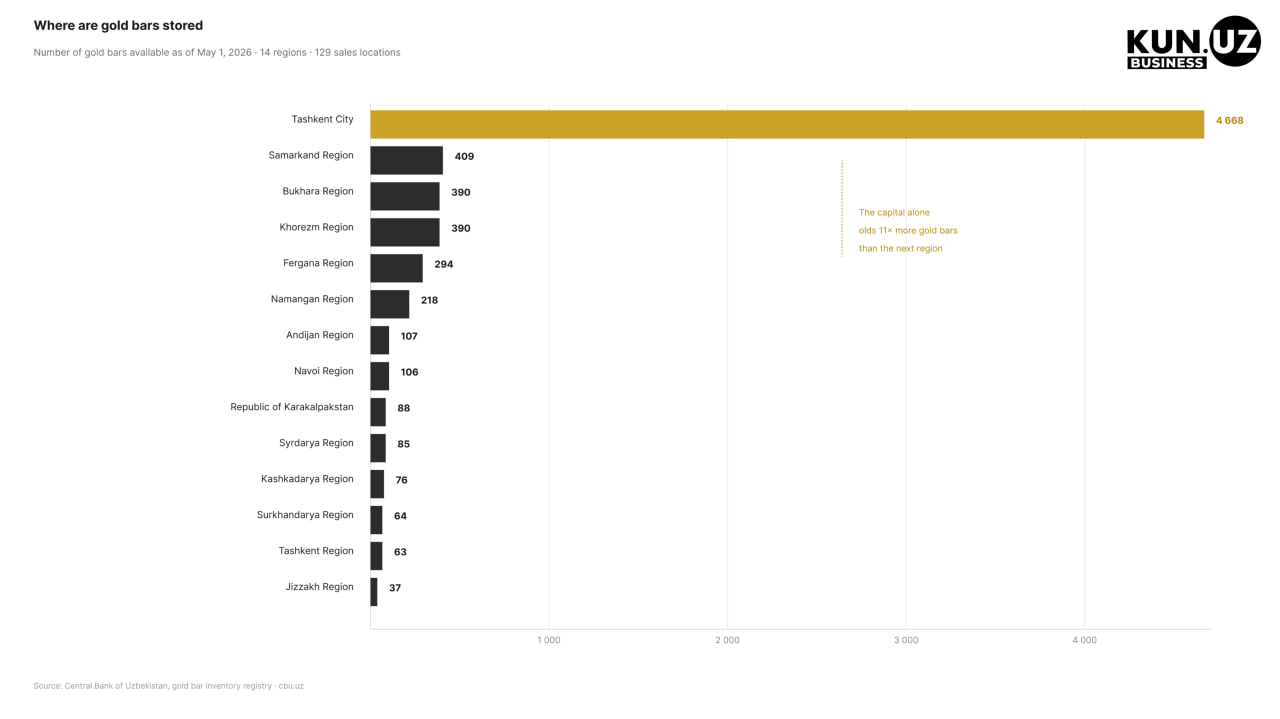
The Central Bank’s “Gold Bar Inventory Information” section shows real-time availability by denomination and location. As of May 1, 2026, a total of 6,995 gold bars were available for sale through 129 sales points across 14 regions. The official Central Bank registry lists 135 locations, but six of them had zero stock at the time of review.
Distribution is highly uneven: two-thirds of all available gold bars are concentrated in the capital. Tashkent holds 4,668 bars, or 66.7% of total supply.
The next largest regions are:
Samarkand — 409
Khorezm — 390
Bukhara — 390
At the bottom of the list is Jizzakh, with only 37 bars across three locations.
Within Tashkent, a single branch of the Yakkasaray Service Center of Xalq Bank holds 1,883 gold bars.
That represents:
27% of all gold bars in the country
40% of Tashkent’s total inventory
For comparison, the second-largest sales point (Ipak Yuli, Mirabad branch) holds only 130 bars, 14 times fewer.
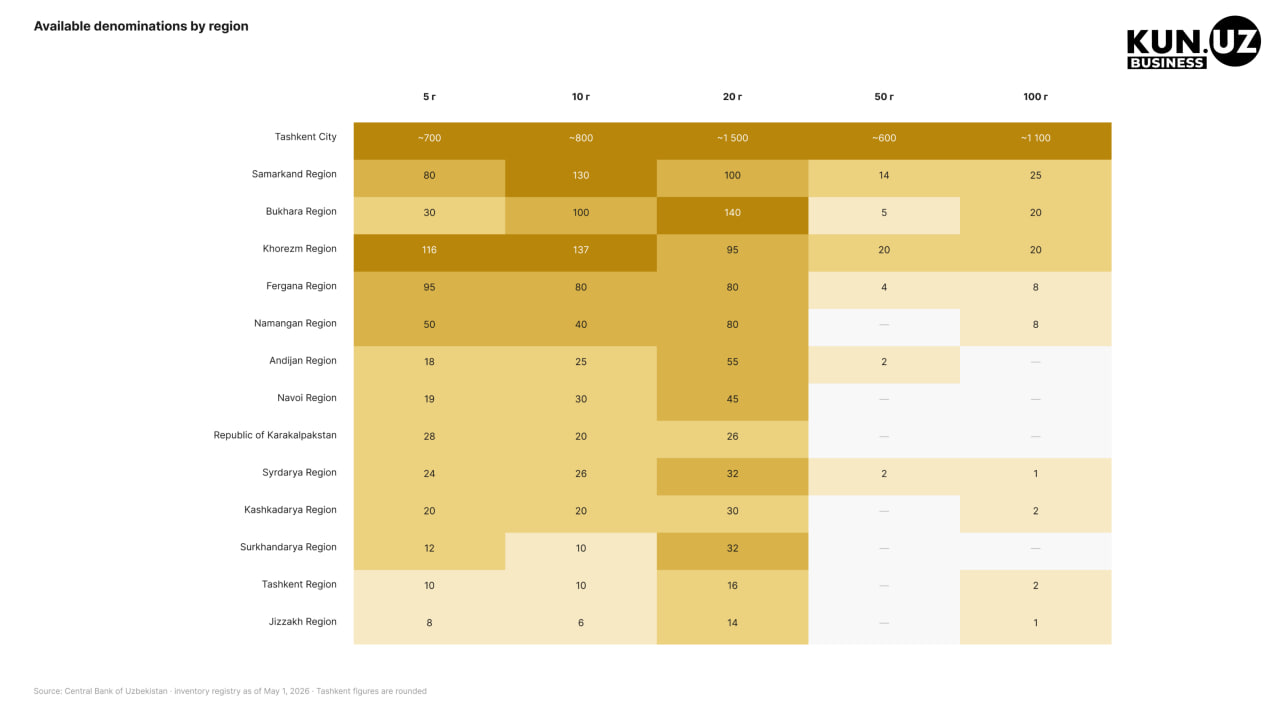
All 12 largest sales points are located in Tashkent. More than half of all 50-gram and 100-gram gold bars nationwide are concentrated there:
396 fifty-gram bars (61% of national stock)
352 hundred-gram bars (50%)
If you are looking for a 50g or 100g gold bar in Tashkent, the most practical option is to go directly to the Yakkasaray Xalq Bank branch (40 Kukhnur Street).
The regional picture is far more mixed.
Across other Tashkent branches, inventory is distributed more evenly: Kapitalbank has 7 branches with stock ranging from 23 bars (Mirzo Ulugbek branch) to 129 bars (Customer Service Center); Ipoteka Bank has 5 locations with stock ranging from 47 to 119 bars; Hamkorbank, Ipak Yuli, and Orient Finans Bank each operate large central branches holding 120–130 bars.
The picture becomes even more uneven for larger denominations.
Three regions have no large gold bars at all:
Karakalpakstan
Navoi Region
Surkhandarya Region
Another three regions have no 50-gram bars:
Tashkent Region
Kashkadarya Region
Jizzakh Region
If you are planning a larger purchase, it is generally more practical to buy in Tashkent, Samarkand, Khorezm, or Bukhara.
And not all listed branches are actually operational. In Surkhandarya Region, only 4 out of 8 listed sales points had actual stock. Inactive locations included: two Ipoteka Bank branches at the Karvonsaray and Sharq hotels; the Denov service center of NBU; the Termez branch of Business Development Bank. A similar situation exists in Bukhara and Samarkand, where one Hamkorbank regional branch in each region had zero stock.
Choose a bank
Gold bars are sold by 19 banks through branches across the country. The full list, including addresses and phone numbers, is available on the Central Bank website.
In Tashkent, the largest sales networks belong to Kapitalbank (7 branches, including Kapital Premium) and Ipoteka Bank (5 locations, including the Intercontinental Hotel and Alay Bazaar).
Bring your passport and make payment
At the branch, all payment methods are accepted:
cash
transfer from a bank account
bank card
Some banks also accept HUMO PAY and QR payments. The price is fixed at the moment of payment. If the gold price changes while you are on your way to the bank, you will pay the updated rate.
Sign the contract and receive the gold bar
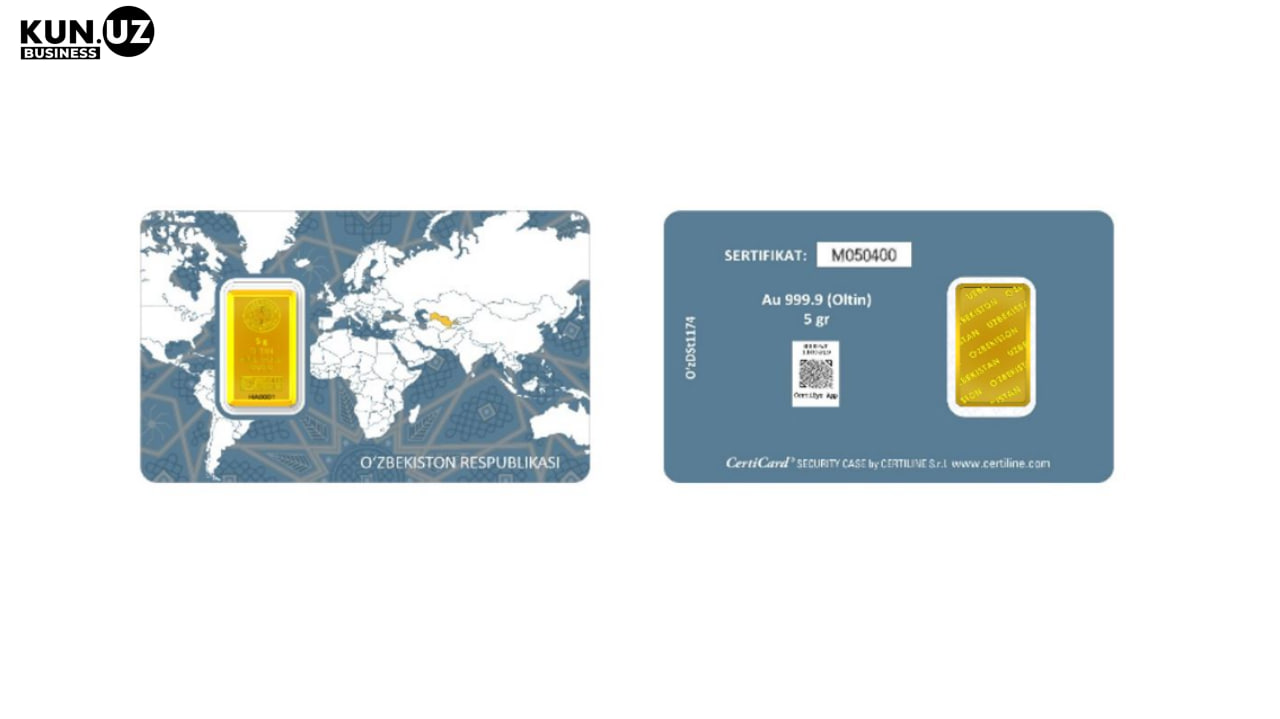
A purchase agreement is signed at the cashier desk. By law, the buyer receives the gold bar on the same day in protective packaging, which also serves as the certificate of authenticity. The serial number on the packaging matches the serial number engraved on the gold bar itself.
How the packaging works and why you should never open it
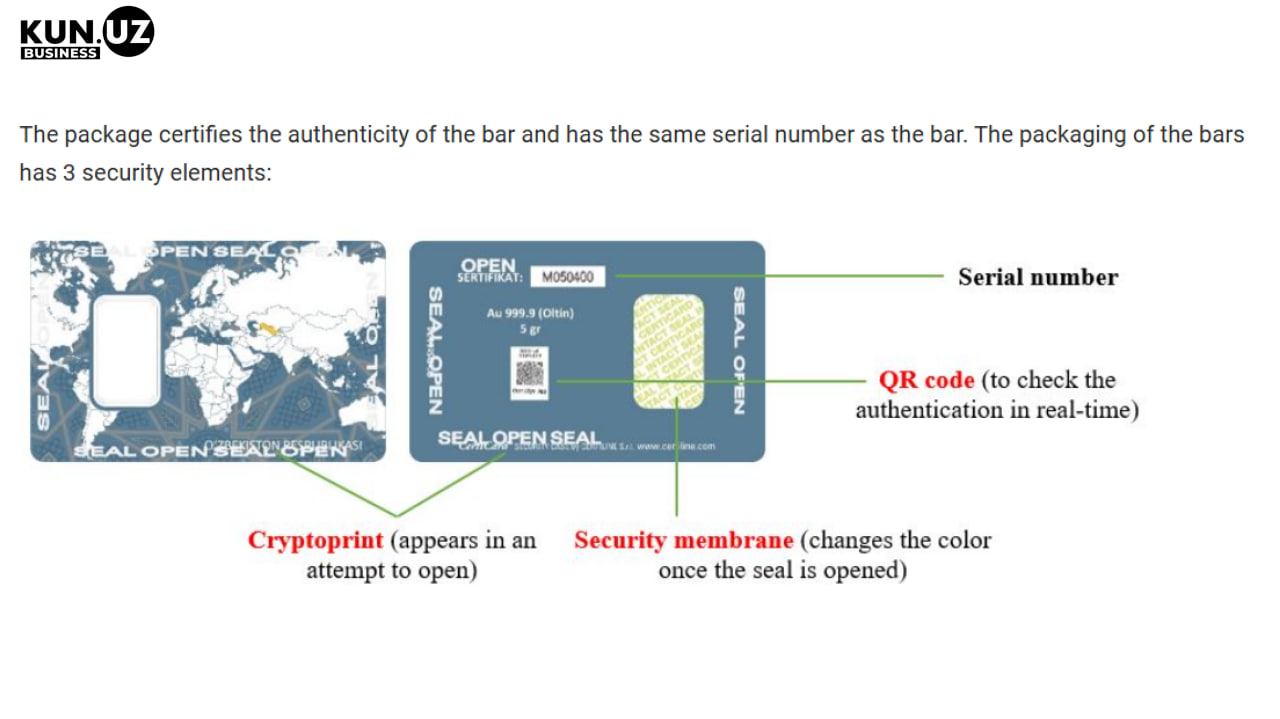
The packaging is not just plastic. It was developed jointly with the Italian company Certiline Srl and also serves as the certificate of authenticity. The serial number on the packaging matches the number on the gold bar.
The packaging includes three levels of protection:
Crypto print. A special security marking that becomes visible if someone attempts to open the package.
Protective membrane. Changes color if the seal is broken.
QR code. Allows real-time authenticity verification through the Certiline app.
If you open the packaging, you will lose an additional around 1% of the buyback price when selling the bar back. For a 100-gram gold bar, this amounts to 1,781,000 UZS, or approximately $135. You will also need to wait up to 20 working days while the bar undergoes technical examination.
How to sell the gold bar back to a bank
By law, you cannot sell a gold bar to another private individual. It can only be sold back to a bank through the same sales points listed on the Central Bank website.
If the packaging is intact
Bring your passport and the gold bar to the bank. The bank checks the packaging integrity and transfers the money on the same day at the official buyback price. For larger denominations, you will receive approximately 96.1% of the original purchase price (3.9% spread). For a 5-gram bar, you will receive around 93.9% (6.1% spread).
If the packaging is damaged
The bank accepts the gold bar and sends it for technical examination to the State Assay Office. This is explicitly provided for under Clause 29 of Regulation No. 3698, which references Cabinet Resolution No. 412. The process can take up to 20 working days. In addition to the standard spread, another approximately 1% is deducted.
This means the total loss compared to the purchase price for larger denominations will be around 4.9%.
If the gold bar is held in bank custody
It can be sold back directly through the mobile app without visiting a branch (Clause 17). This is one of the main advantages of storing gold with the bank.
If counterfeit signs are detected
Under Cabinet Resolution No. 412, the State Assay Office transfers the gold bar to security authorities. Such a bar is neither returned to the owner nor bought back. Since the beginning of 2026, the Central Bank has published official buyback prices on its website. Previously, customers had to check these prices directly with banks.
Where to store gold
At home. Free of charge, but risky: theft, fire, or even scratches on the packaging. For a 100-gram gold bar worth 183 million UZS, that is a significant risk.
Safe deposit box. Costs range from 30,000 to 250,000 UZS per month, depending on the bank and box size.
Security features typically include: steel doors, dual-key access, video surveillance
Bank custody storage. This option was introduced in November 2025 together with Regulation No. 3698. If a gold bar is purchased through a mobile app and not collected within five working days, it is automatically transferred into a custody storage account (Clauses 10 and 14).
The following details are recorded (Clause 12):
metal type
purity
weight
manufacturer
serial number
The gold bar can later be sold back through the mobile app without visiting a bank branch.
Taxes
The tax regime for gold bars is one of the most favorable in Uzbekistan.
VAT does not apply.
Excise tax does not apply.
Property tax does not apply either, as it only covers real estate.
A 12% personal income tax may theoretically apply to gains from resale. In practice, Regulation No. 3698 does not mention withholding income tax by the bank, which likely means the responsibility for declaring the income rests with the owner. It is worth confirming this with the bank before selling.
Can you take gold abroad
Presidential Decree No. UP-6066 allows individuals to take Central Bank gold bars and coins abroad without restrictions on quantity or weight.
Two conditions apply: the certificate of authenticity must be available (the protective packaging itself serves as the certificate); a customs declaration must be filed if the export exceeds passenger goods allowance limits.