





Additional features
-
Night mode

New financial pyramid emerges in Uzbekistan, using official documents to gain public trust
A new financial pyramid operating under the name SEVEN JADE has emerged in Uzbekistan, exploiting official government registration documents to deceive citizens. Representatives of the scheme are assuring the public of their legitimacy by showcasing a limited liability company (LLC) certificate and a value-added tax (VAT) registration issued by the Tax Committee. Investigations suggest that the mastermind behind the operation may be a Chinese national.

The Hong Kong headquarters illusion
On January 20, 2026, an entity named SEVEN JADE MANUFACTURING LLC was officially registered with the state. The company, whose listed activity is specialized wholesale trade, names Lin Nanzhou as its sole founder. Along with standard incorporation, the company secured a formal certificate as a VAT payer from the Tax Committee.
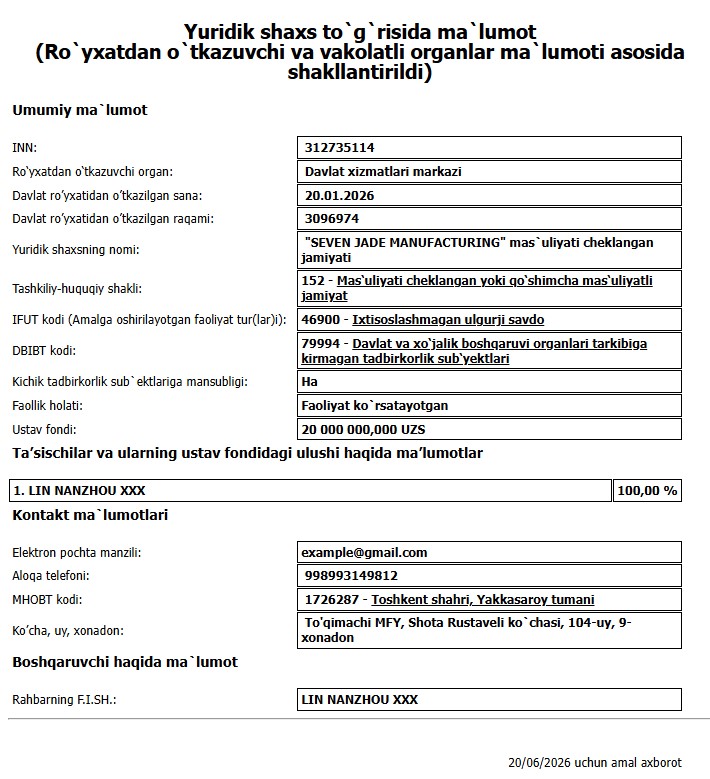
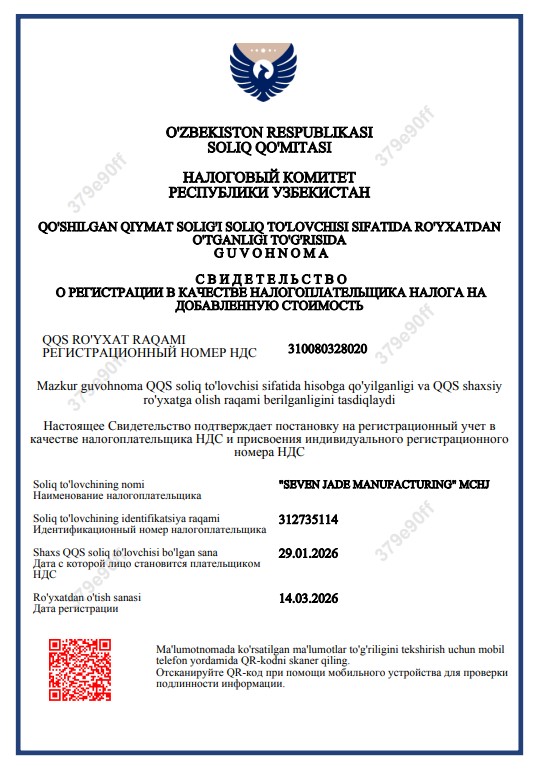
These two official documents have become the primary tools used by the coordinators of SEVEN JADE to convince unsuspecting citizens that their operations are entirely lawful. According to a promotional business plan tailored specifically for Uzbekistan, SEVEN JADE MANUFACTURING is framed as a processing enterprise headquartered in Hong Kong. However, a closer look at the documentation suggests the text was generated by artificial intelligence. Furthermore, a thorough search of the internet yields no records regarding either the Hong Kong parent company or the identity of Lin Nanzhou.
Rhetoric of a bright future
Following the playbook of classic financial pyramids, SEVEN JADE attracts participants with grand promises. On its official Telegram channel, the organization portrays itself as an international jewelry manufacturing and processing firm with a global retail network. The promotional material claims the company is currently building new factories within Uzbekistan to ensure rapid and high-quality order fulfillment.

The entity markets a "three-way win" business model: the company expands production to fulfill foreign orders and increase profits; employees secure stable jobs and high wages; and partners receive a share of the corporate growth through their investments.
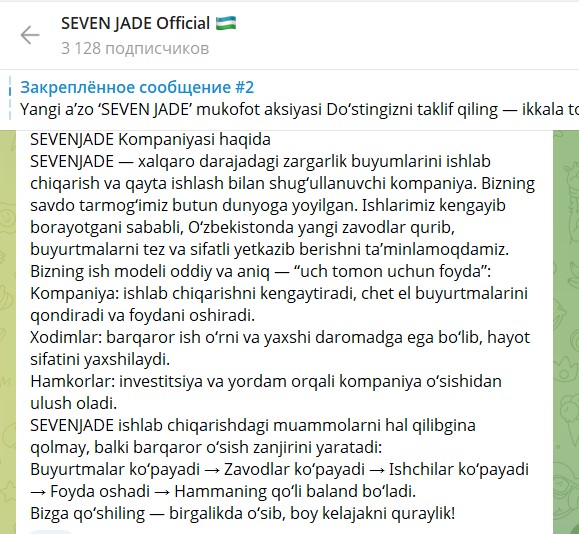
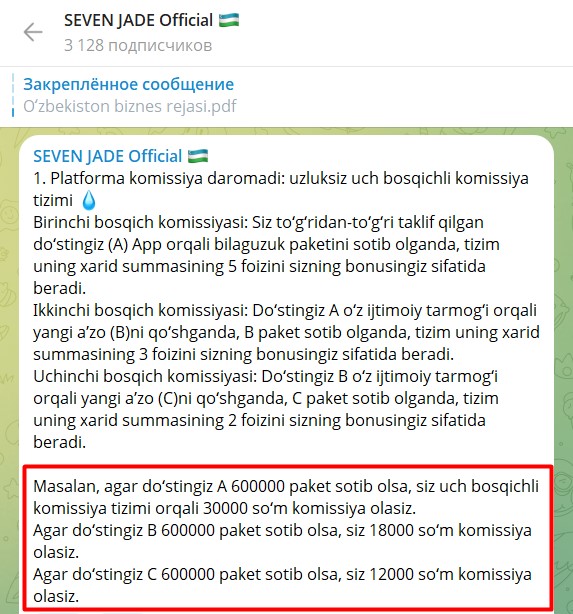
The requirement of an upfront investment to become a partner exposes SEVEN JADE as a financial pyramid. The scheme relies heavily on two structural pillars of illicit multi-level marketing: promising returns for recruiting new members and offering additional bonuses based on the specific investment packages purchased by those recruits.
Masked products and promises of daily returns
The operators have launched a dedicated online platform detailing various investment tiers, deposit methods, and daily withdrawal options. To obscure the financial fraud, the investment packages are masked as purchases of beaded jewelry.
For instance, the Azure glow bracelet package is priced at UZS 200,000 and remains active for 30 days. Buyers are promised a daily return of UZS 10,000, bringing the total monthly payout to UZS 300,000. Higher-tier options follow the same logic; the Vintage amethyst bracelet costs UZS 600,000 and promises a return of UZS 900,000 over a 30-day period. As the initial investment scales up, the promised profit margins increase proportionally.

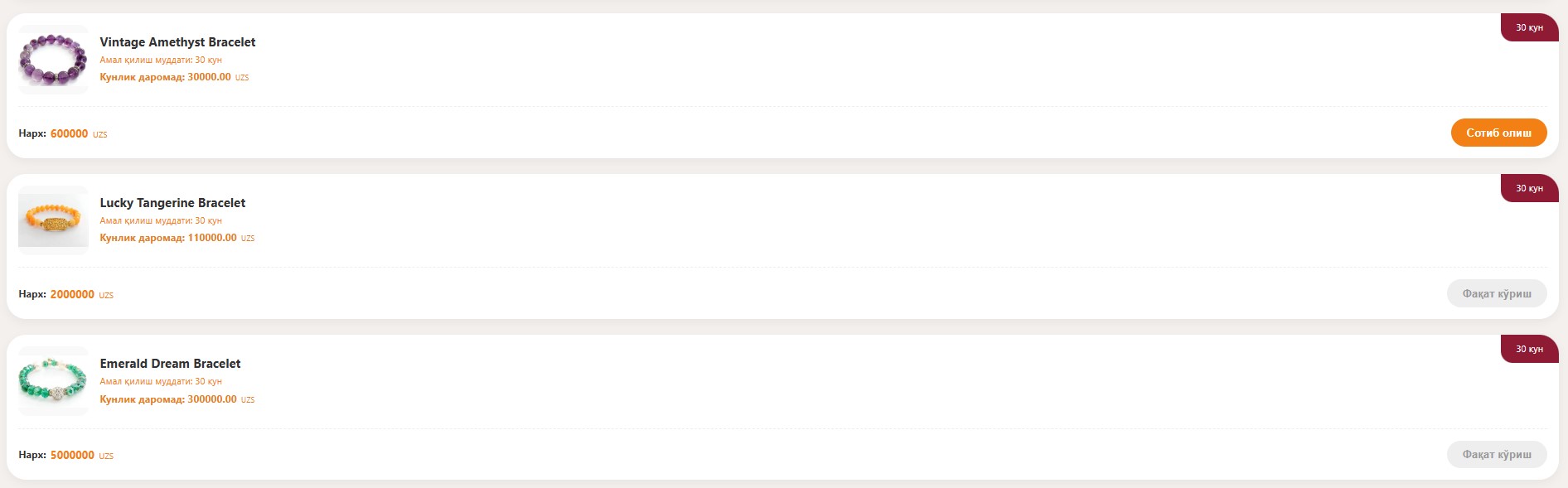
To purchase a package, users must register on the platform and open a personal account. Funds are deposited via peer-to-peer (P2P) transfers. The platform directs these payments to a specific bank card issued under the name of Lazokat Nasriddinova. The reliance on P2P transfers raises immediate red flags for an organization claiming to operate a global retail network and constructing domestic factories.
Direct links to physical addresses
To verify whether the online pyramid is connected to the registered entity, reporters visited Shota Rustaveli Street 104, the address listed for SEVEN JADE MANUFACTURING LLC in the state registry.
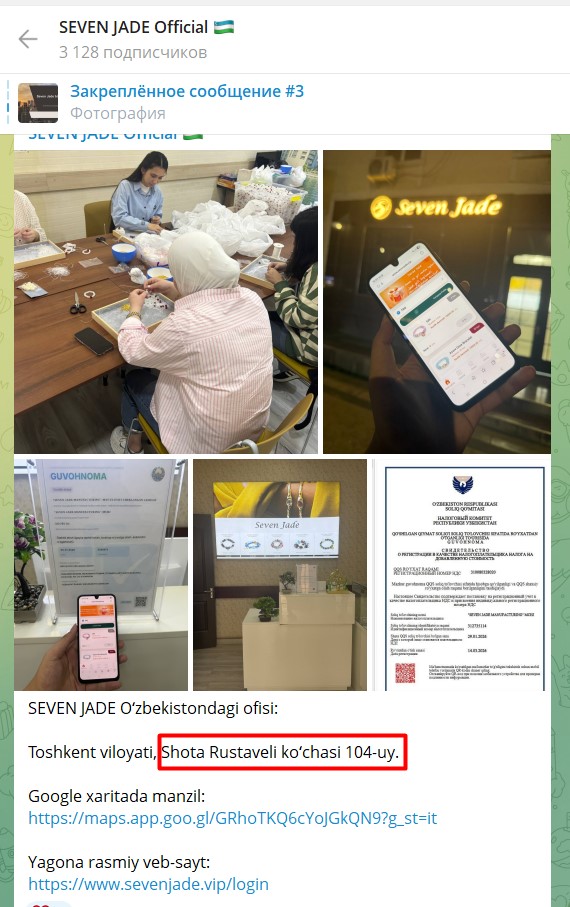
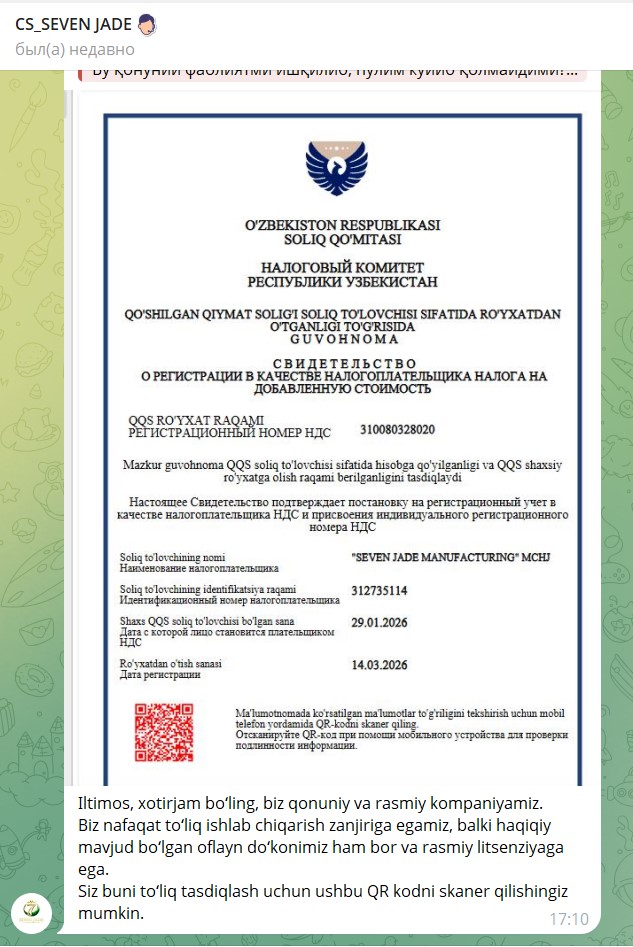
The location matches the address provided by the platform’s customer service agent, who shared the coordinates while reassuring potential investors that the business is fully legitimate and safe.
Preventing a repeat of past scams
The strategy of establishing a local LLC to defraud the public is not unprecedented in Uzbekistan. A notable parallel is the Golden cash store LLC case, where over 2,000 Uzbek citizens were defrauded of approximately $6 million within a 10-month period. That scheme was registered under the name of a Ukrainian citizen, Maksym Muntyan, and operated under the guise of retail watch and jewelry shops.
The SEVEN JADE model closely mirrors the Golden cash blueprint by directly soliciting public funds into a structured pyramid scheme. To prevent widespread financial damage, prompt intervention from relevant authorities, including cybersecurity units, is required to investigate the operations and identify the individuals behind the network.
Under Article 188-1 of the Criminal Code of Uzbekistan, engaging in illegal activities related to the accumulation of funds or other property carries strict criminal liability, including penalties of up to 10 years of imprisonment. Furthermore, the Criminal Procedure Code dictates that initiating a criminal case under this article does not require a formal complaint from a victim, allowing law enforcement agencies to take immediate preventive action.

Related News

16:25 / 10.07.2026
Police investigate illegal cryptocurrency trading worth UZS 2.8 billion

11:47 / 10.07.2026
Three suspected cyber fraudsters arrested in Navoi over UZS 336 million theft scheme
15:06 / 08.07.2026
Tashkent police dismantle cyber fraud network targeting Europeans and North Americans

12:28 / 08.07.2026