
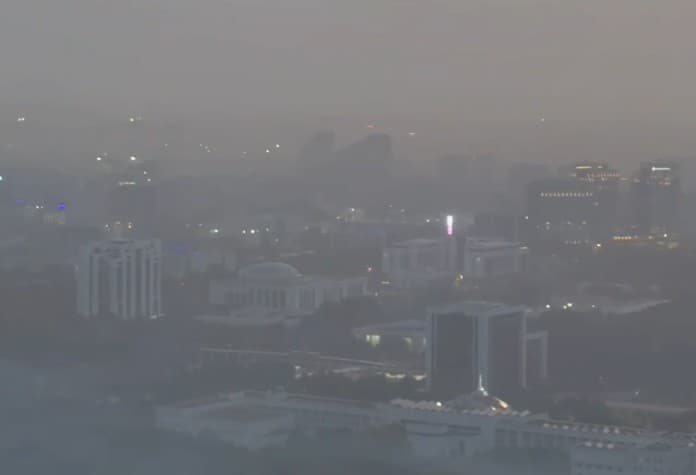
On 22 September, Tashkent ranked first globally for air pollution levels. At 17:15 that day, the city’s Air Quality Index (AQI) stood at 556 – a level considered hazardous. By 13:00 on 23 September, the index had dropped to 135.
The Ministry of Ecology, Environmental Protection and Climate Change said that on 21 September, a low-pressure zone formed over central Uzbekistan, lowering atmospheric pressure to 1010 gPa and driving daytime temperatures up to +35°C in Samarkand, Jizzakh, Syrdarya and Tashkent regions.
That night, westerly winds from the leading edge of a cold anticyclone over the Caspian Sea, with central pressure reaching 1028 gPa, entered the region. On 21 September and the morning of 22 September, strong and persistent westerly winds in eastern Navoi region and around the Aydarkul lakes shifted slightly northward near the Chordara reservoir.
By the afternoon of 22 September, dust masses lifted from eastern Kyzylkum and the Aydarkul area reached Tashkent. Starting from 15:00, concentrations of fine particulate matter (PM2.5 and PM10) rose in the city’s southwestern districts. For instance, the Horiba automatic station near the Uchtepa district administration recorded PM2.5 at 142 µg/m³ – four times higher than the national standard of 35 µg/m³.
By 16:00, southwesterly winds at 4 m/s carried the dust further into central and northeastern Tashkent. At the “New Uzbekistan” park, an automatic station registered PM2.5 levels at 68 µg/m³ – twice the permissible maximum. At the same time, visibility at Tashkent International Airport dropped to 5 km.
By 18:30, a sharp rise in PM2.5 concentrations was recorded citywide, reaching 150 µg/m³ – five times the standard. Visibility at the airport deteriorated to 4 km.
According to forecasts, a cold anticyclone with pressure up to 1025 gPa will pass through central regions of Uzbekistan, shaping weather conditions until 24 September.
“However, it will not be able to completely clear Tashkent’s air of accumulated particles. On the contrary, air flows will gradually push them closer to the ground. PM2.5 concentrations may rise again on the mornings and evenings of 23–24 September due to inversion. Only on the night of 24 September, with the departure of the anticyclone and the arrival of new cyclonic processes, can the city’s air rapidly improve,” the ministry predicted.