





Additional features
-
Night mode

Uzbekistan’s currency market sees higher supply amid rising demand
In the first nine months of 2025, demand for foreign currency in Uzbekistan rose to $42.7 billion, a 23.5% increase compared with the same period last year. At the same time, supply from companies and individuals reached $34.4 billion, excluding interventions by the Central Bank. Exports, external loans, and remittances were the main sources of foreign currency. Overall, the population sold $6.7 billion more to banks than it purchased.
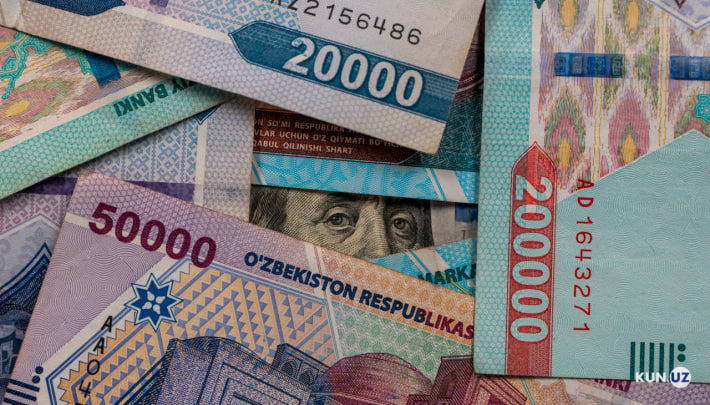
According to the Central Bank’s review, both demand and supply of foreign currency grew in January–September, with supply from legal entities and individuals significantly exceeding demand.
Sources of currency supply
An additional source of supply came from sterilization operations involving the sale of monetary gold purchased by the Central Bank. These operations were conducted on market principles without affecting the exchange rate, following the principle of reserve neutrality, the regulator said.
Uzbekistan exported $9.9 billion worth of gold in the first nine months of the year. If all gold export proceeds had been fully sterilized (sold without affecting the exchange rate), total currency supply could have reached $44.3 billion – $1.6 billion more than demand. Economist Mirkomil Kholboev suggested that the Central Bank may not yet have fully sterilized all proceeds from gold exports.
Central Bank interventions
The Central Bank carries out interventions in the domestic currency market to sterilize, or withdraw, newly issued money from the economy. To buy gold, the regulator issues sums, then purchases gold from domestic producers, sells it abroad, and obtains foreign currency. The currency is then supplied to the domestic market, where banks buy dollars for sums, effectively withdrawing excess liquidity.
In line with the neutrality principle, when the Central Bank buys gold from local producers in sums, it must sell an equivalent amount of foreign currency on the market to avoid increasing liquidity, which could intensify inflation.
Currency operations of legal entities
Currency supply from legal entities grew faster than their demand. Corporate demand increased by 24% year-on-year to $34.2 billion, while supply rose 37% to $16.8 billion. The resulting difference of $17.3 billion was 40% higher than last year ($12.3 billion).
The main source of supply was export revenue, totaling $13 billion (+18% compared with 2024), of which $7.1 billion (55%) was sold on the domestic market, a 22% increase. Foreign loans attracted through banks contributed $6.3 billion, up 61% from $3.9 billion a year earlier.
For import financing, the share of currency purchased domestically slightly declined, while the share of own funds in foreign currency increased marginally. In January–September, converted foreign currency accounted for 64.7% of import financing (65.5% in 2024), while own funds in foreign currency accounted for 24% (23.1% in 2024).
Distribution of purchased foreign currency was as follows:
- 51% for import of equipment, raw materials, and production goods
- 27% for repayment of foreign loans
- 18% for import of consumer goods and medicines
- 2% for repatriation of investor income
- 4% for other purposes
Currency operations of individuals
Individuals sold $15.2 billion to banks – 1.3 times more than a year ago ($11.8 billion). Currency purchases by the population rose 23% to $8.5 billion (up from $6.9 billion).
This resulted in a net positive balance of $6.7 billion for individuals, 1.4 times higher than last year. This may reflect reduced attractiveness of currency savings. According to the Central Bank, deposits in sums grew 23% to 205 trillion UZS. At the same time, dollarization declined: the share of foreign currency loans fell from 41% to 37%, and foreign currency deposits from 26% to 23%.
The main source of foreign currency for the population was remittances, which totaled $13.9 billion – a 24% increase from the previous year (+$2.7 billion) and 66% higher than in 2023 (+$5.5 billion). Meanwhile, $1.9 billion was sent abroad via international transfers, $127 million less than in the same period in 2024.
Market stability
Overall, the growth in export revenues, inflows from foreign loans, and remittances has ensured that currency supply outpaces demand, helping maintain stability in Uzbekistan’s foreign exchange market even amid rising demand.

Related News
12:30
Inflation perceptions in Uzbekistan fall to record low in June – Central Bank

12:21 / 14.07.2026
Rising obesity could cost Uzbekistan $21.6 billion by 2060, experts warn

19:41 / 13.07.2026
IMF advises caution as Uzbekistan prepares pension system reform

12:28 / 13.07.2026