





Additional features
-
Night mode

How much do apartments cost in Tashkent in 2026
Apartment prices in Tashkent vary significantly depending on theCERR district. The price per square meter in new developments currently ranges from $900 to $2,200, while the cost of one-bedroom apartments can differ by more than three times depending on location.
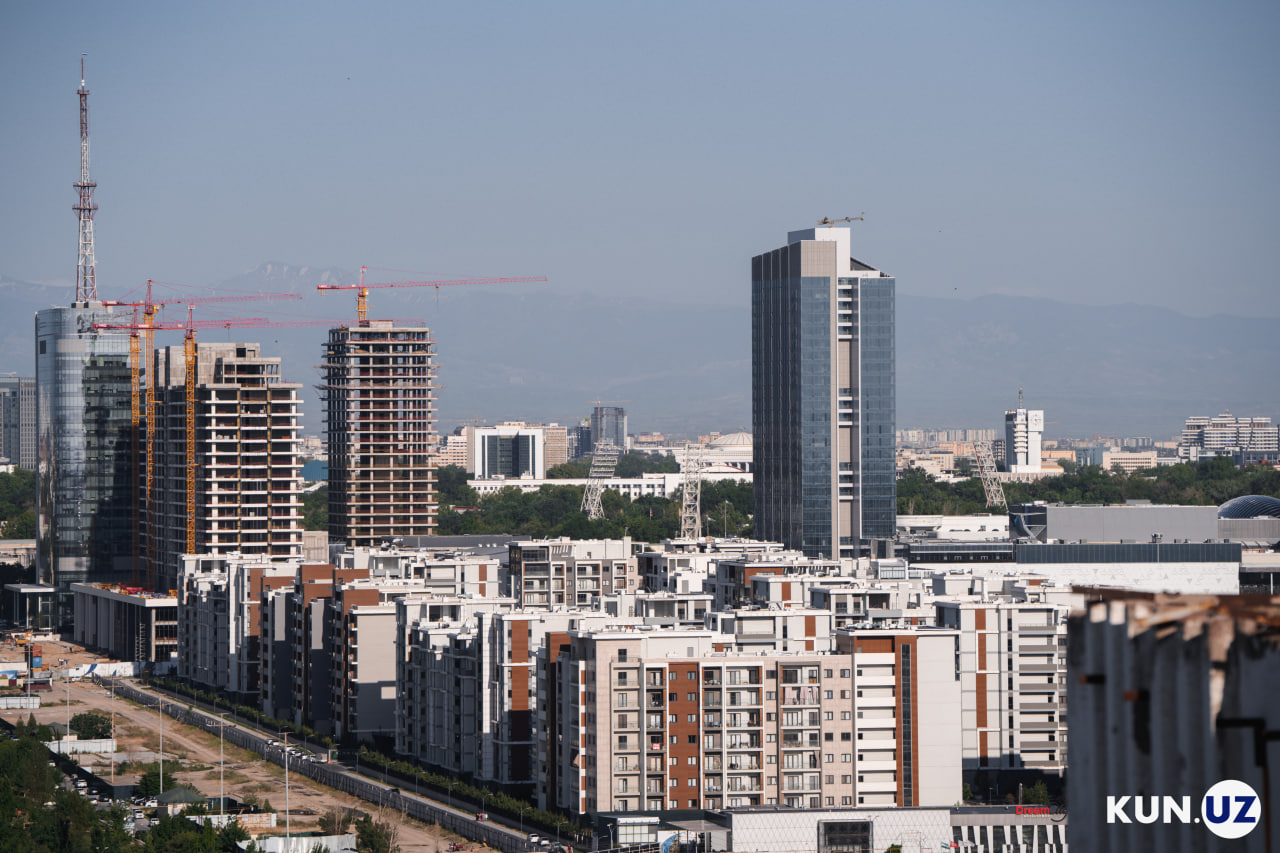
We analyzed listings across all districts of Tashkent, calculated актуальные prices by apartment type, and examined what is happening in the housing market.
Where the most expensive new developments are located
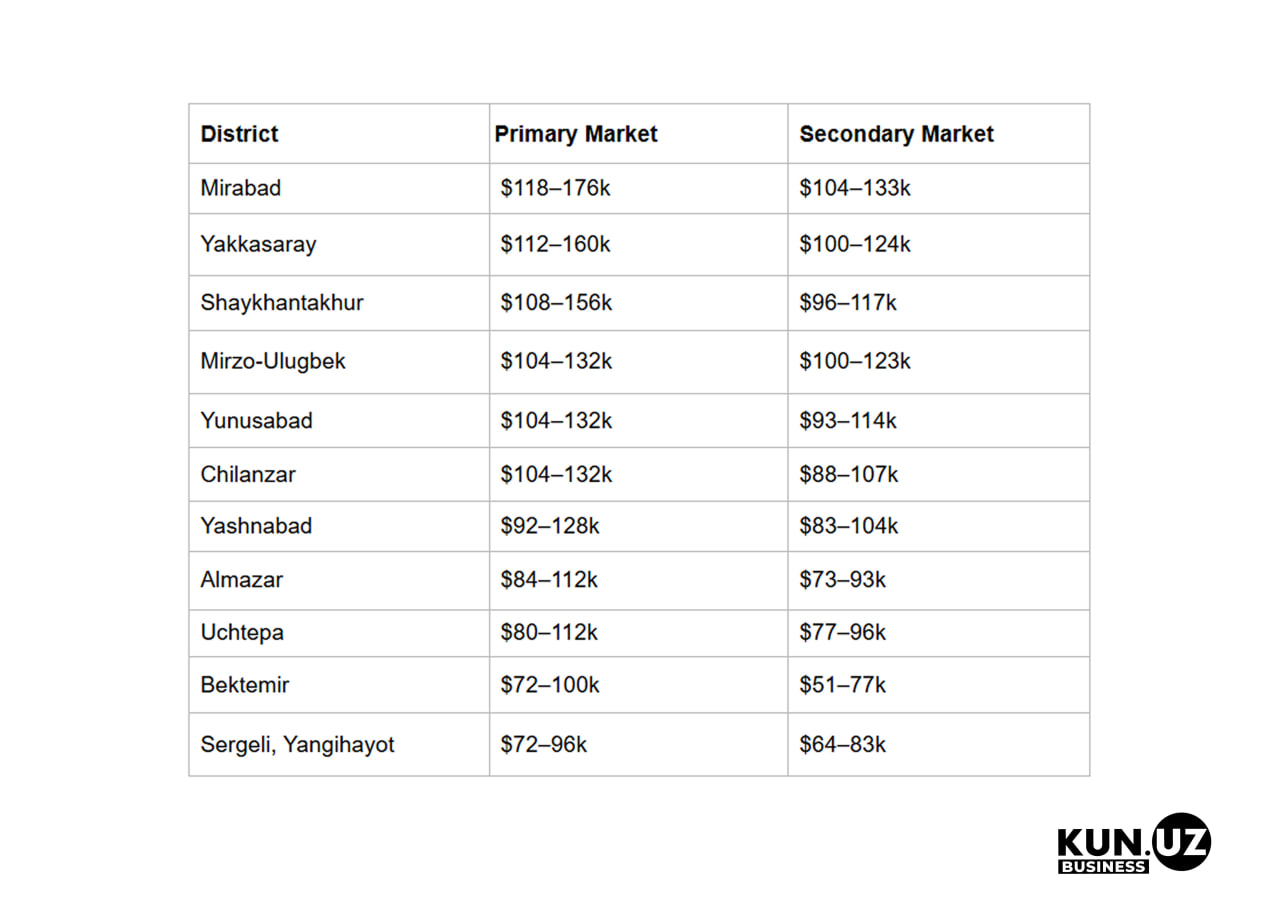
The highest prices in the primary market are in Mirabad, Yakkasaray, and Shaykhantakhur districts. Price per square meter based on listings:
- Mirabad: $1,470–2,200
- Yakkasaray: $1,400–2,000
- Shaykhantakhur: $1,350–1,950
In these districts, there are residential complexes with prices above average — $2,500–3,000 per m² and higher — but they are excluded from the calculations as they represent a separate premium segment.
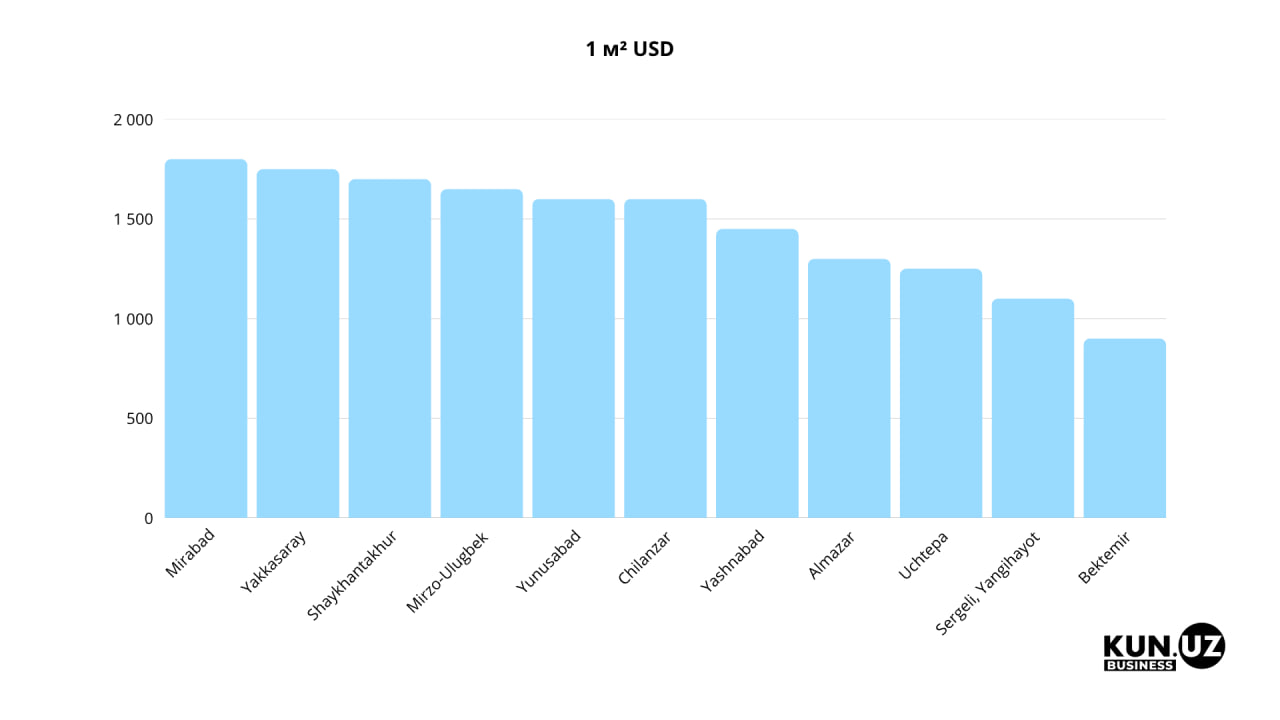
Mid-range prices are observed in Mirzo-Ulugbek, Yunusabad, and Chilanzar: $1,300–1,650 per m². The most affordable districts are Sergeli ($900–1,200) and Bektemir ($900–1,250).
How much apartments cost in 2026
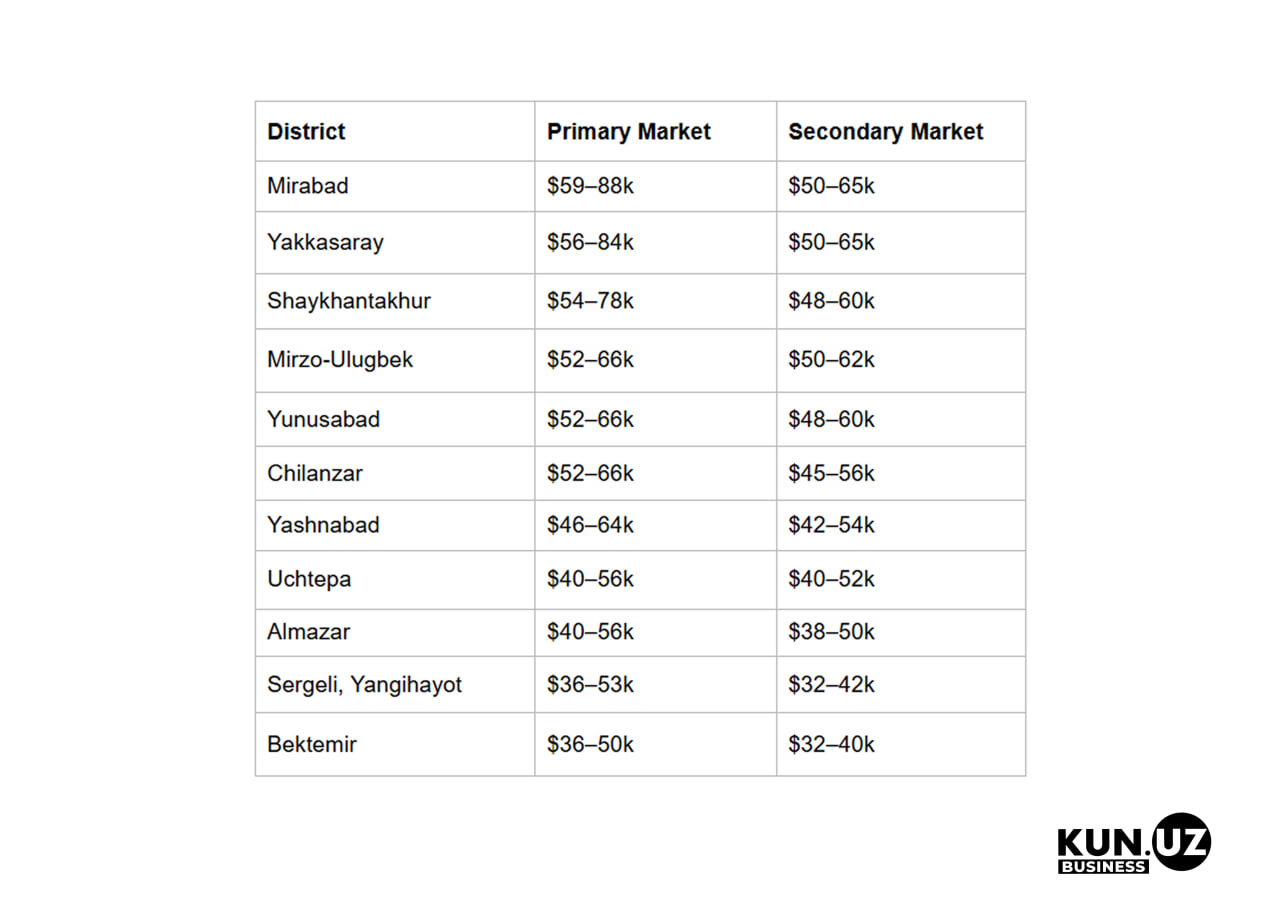
1-bedroom apartments (40 m²)
The largest gap between new developments and the secondary market is in Mirabad, Yakkasaray, and Shaykhantakhur. In Bektemir and Sergeli, the difference is minimal — $4,000–8,000.
2-bedroom apartments (60 m²)
Two-bedroom apartments are the most in-demand type of housing. They sell well both in new developments and on the secondary market. The price gap between central and peripheral districts is the most noticeable here — up to $100,000 in new developments.
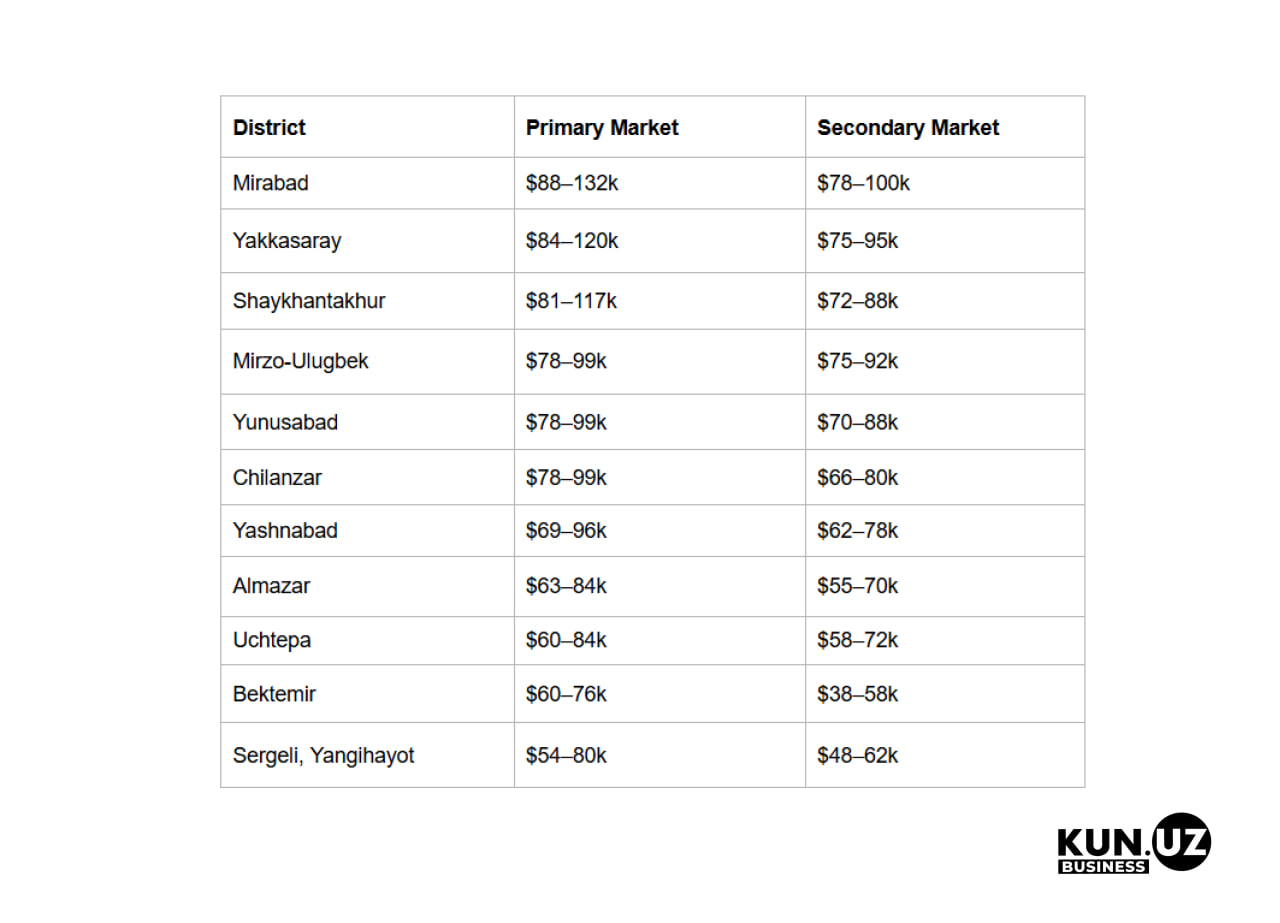
3-bedroom apartments (80 m²)
The larger the apartment, the greater the price differences between districts. In Mirabad, Yakkasaray, and Shaykhantakhur, three-bedroom apartments in new developments start from $120,000 and higher.
Why apartment prices vary within the same district
Even within the same district, prices can differ significantly. For example, in Mirabad:
The most expensive apartments are usually located in the northern part of the district, closer to Oybek metro station, Nukus Street, and the city’s business center. These areas have more new residential complexes, developed infrastructure, and better transport accessibility.
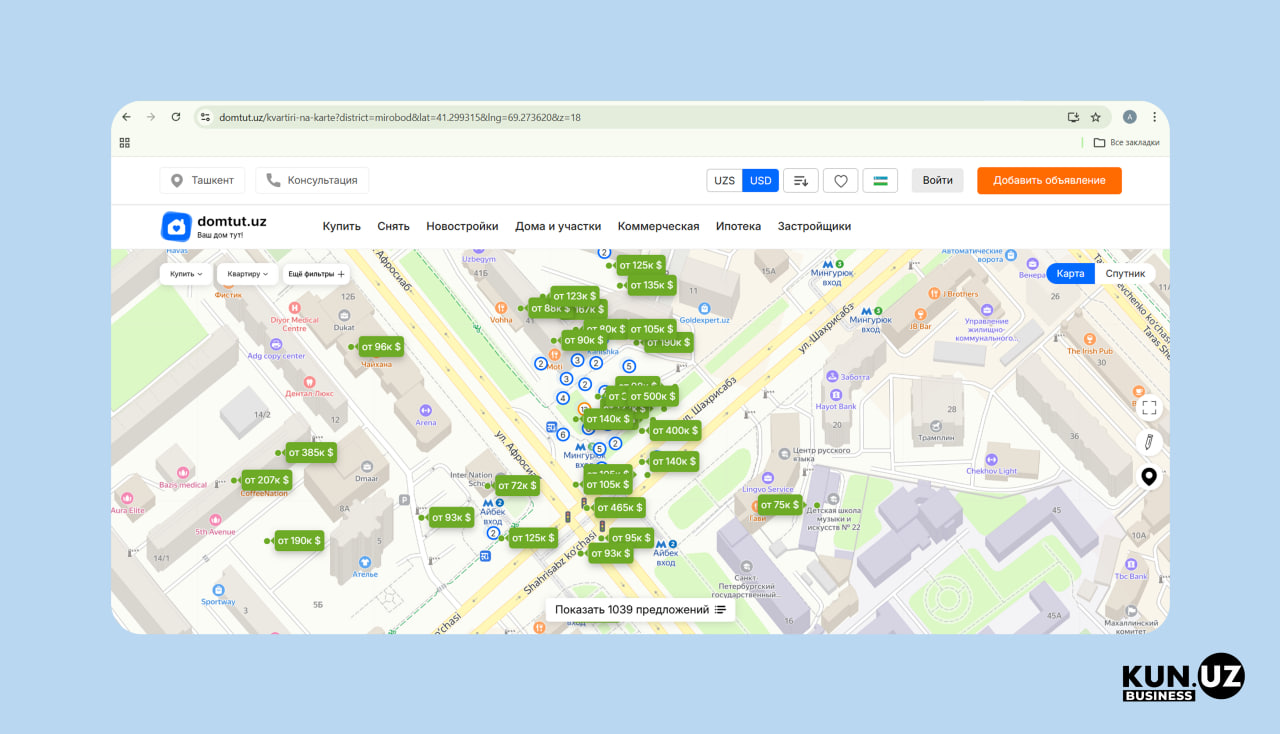
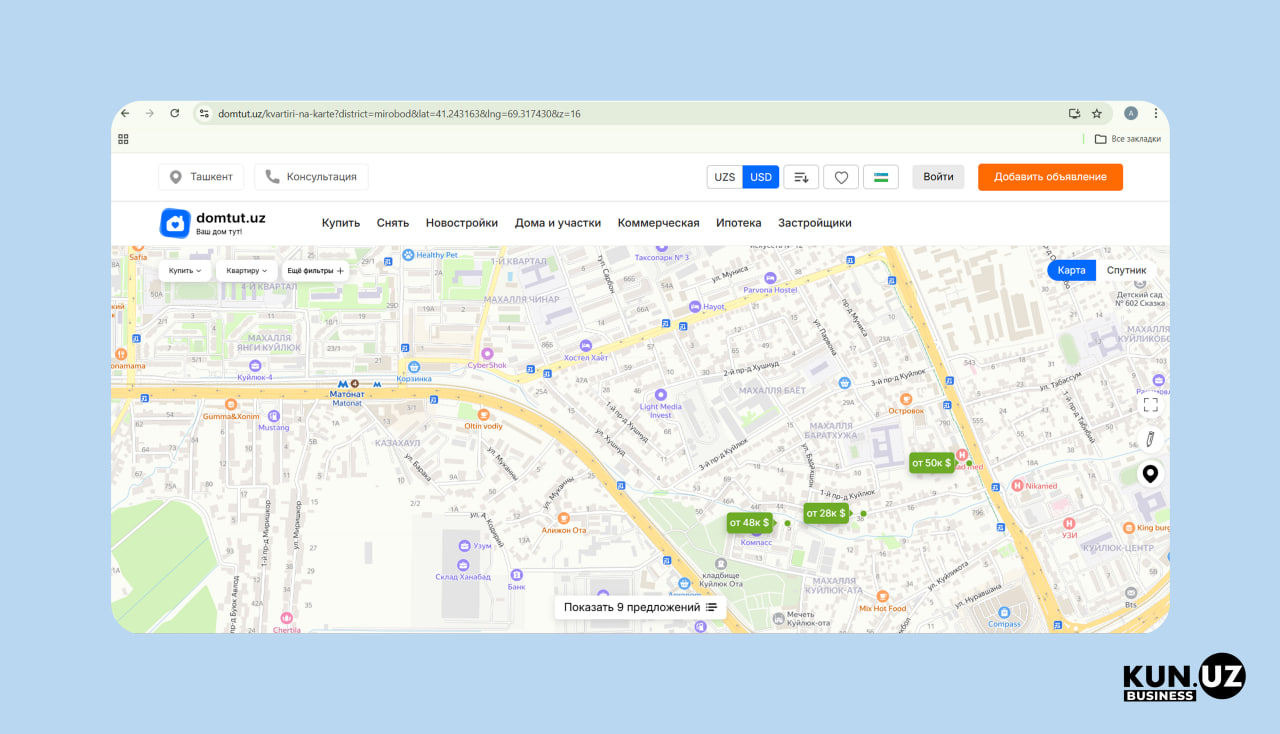
In contrast, the southern part of the district, closer to the airport and Kuylyuk, is more affordable. There are fewer new developments, and part of the area consists of industrial and warehouse zones.
Several factors influence the final price of an apartment:
Construction stage
Apartments at early construction stages are usually cheaper. As the building nears completion, prices increase, and completed properties are the most expensive. For example, listings may offer one-bedroom apartments for around $45,000–55,000 at early stages, while similar units in completed buildings can cost $80,000–100,000 or more.
Floor level
Prices can also vary depending on the floor and view. For example, two-bedroom apartments of 70–80 m² may sell for $95,000–110,000, with differences depending on floor level and window exposure.
Apartment size
Prices are typically quoted per square meter, so the total cost depends on the apartment’s size. For instance, a 60 m² apartment at $1,300 per m² would cost around $78,000, while a 90 m² apartment would cost approximately $117,000.
Layout
Price depends not only on size but also on layout. For example, a 60–70 m² apartment can be either a one-bedroom or a two-bedroom unit, depending on how the space is divided.
Finishing type
The condition of the apartment significantly affects the price:
- shell (no finishing) — bare unit with walls, windows
- white box — basic finishing with leveled walls and floor screed
- full finishing — ready walls, floors, doors
- turnkey renovation — fully ready-to-move-in apartment
Residential complex class
The class of the residential complex also affects pricing. New developments are typically categorized as comfort, comfort+, business, and premium. These differ in construction quality, architecture, landscaping, and infrastructure. Higher-class properties are generally more expensive.
Listing conditions
Prices may also vary depending on sale conditions. Some sellers offer discounts for full upfront payment, while others sell in installments or under different terms. As a result, even similar apartments in the same district can have different prices.
Data sources and methodology
Two sources were used for the analysis:
- The first is the real estate market report by the Center for Economic Research and Reforms (CERR) for 2025, which provides data on the average price per square meter in the secondary market.
- The second source is apartment listings from real estate platforms. We collected listings across Tashkent districts from OLX, Immo, Uysot, and Realting and compiled them into a single dataset.
The full database of listings is available via the link “Listings”.
For the analysis, we calculated apartment prices based on the price per square meter and compared offers across districts. Prices were converted into US dollars using the Central Bank exchange rate for February 2026 — 12,179 UZS per USD.
The tables show not the minimum and maximum values, but the price range where most listings are concentrated. Listings with unusually low or high prices were excluded from the calculations.
How prices have changed over the past 10 years
Over the past decade, housing prices in Tashkent have gone through several phases: a decline, several years of near stagnation, and a sharp increase in 2021–2023. In recent years, price growth has slowed.
According to the Center for Economic Research and Reforms (CERR), in 2025 the secondary housing market in Uzbekistan grew by 7.9%, while in Tashkent the increase was only 0.6%. New developments grew faster: on average by 9% across the city, with Mirabad up by 18% and Yashnabad by 14%.
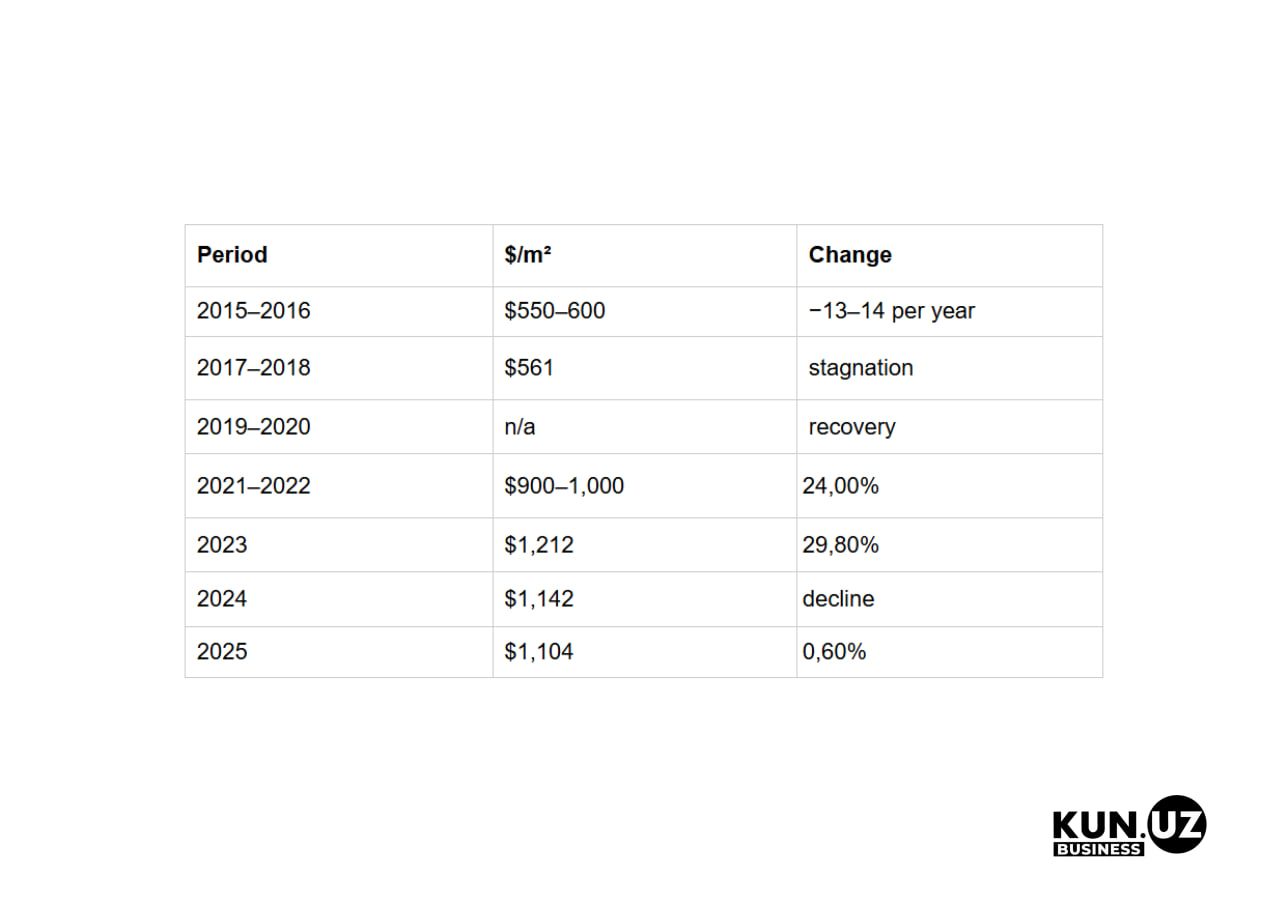
The gap between new developments and the secondary market continues to widen. In high-demand areas, apartments in new buildings can cost 1.5 to 2 times more than comparable units in the secondary market.
Primary vs secondary market: what’s the difference
The primary market refers to apartments purchased directly from a developer. The building may already be completed or still under construction.
The secondary market includes housing that has already been owned by someone. The age of the building does not matter: both Soviet-era panel buildings and newly built homes are considered secondary if the apartment has been resold after the initial purchase from the developer.
Apartment sizes
Layouts in new developments and on the secondary market differ significantly. Apartments in Soviet and post-Soviet buildings are generally more compact, while in modern residential complexes they are on average 8–20 m² larger.
Secondary market
(most of the supply consists of Soviet and post-Soviet buildings):
- 1-room: 30–38 m² (panel), 38–45 m² (brick)
- 2-room: 44–55 m² (panel), 55–65 m² (brick)
- 3-room: 65–75 m² (standard), 75–90 m² (improved layouts)
- New developments
- 1-room: 38–45 m², European layout: 45–55 m²
- 2-room: 55–70 m²
- 3-room: 80–95 m², up to 95–115 m² in business-class projects
Apartments in the primary and secondary markets differ in size, so in the tables prices are recalculated for standardized sizes — 40, 60, and 80 m².
How to check a new development before buying
Before purchasing an apartment in a building under construction, verify the project through the “Shaffof qurilish” (Transparent Construction) service of the Ministry of Construction. The website allows you to check whether the project is officially registered, its current stage, the developer, and the number of buildings included in the project.
This does not eliminate all risks, but it is a basic check that takes only a few minutes.
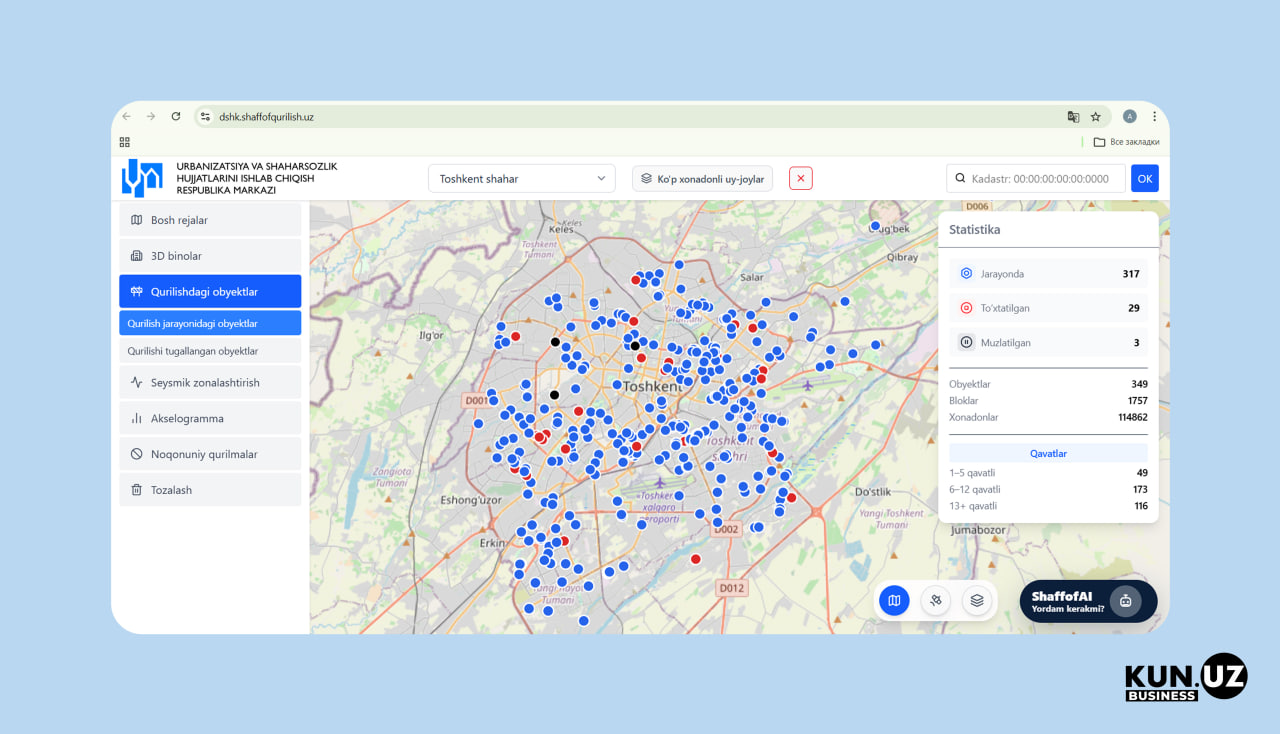
Using this service helps confirm that the project is officially registered and actively under development.
Key takeaways
- In 2026, housing prices in Tashkent remain stable but vary significantly by district.
- New developments are more expensive due to larger sizes and higher construction quality.
- The secondary market remains in demand due to affordability and move-in readiness.
- The most expensive districts are Mirabad, Shaykhantakhur, and Yakkasaray, while the most affordable are Sergeli and Bektemir.
- The price of a specific apartment depends on a combination of location, size, and building class.

Related News

18:30 / 24.06.2026
Anti-corruption audit in Tashkent exposes widespread conflicts of interest among officials

16:32 / 22.06.2026
China’s LinkWise plans cloud infrastructure development in Tashkent
11:44 / 19.06.2026
Tashkent housing market shows mixed trends in May as small apartments drive price growth

19:57 / 16.06.2026