



Additional features
-
Night mode

Uzbekistan, South Korea to establish $100 million biotechnology cluster in Tashkent region
Uzbekistan and South Korea have reached an agreement to establish several new industrial clusters, including a dedicated biotechnology cluster and a joint industrial zone. The Ministry of Investment, Industry, and Trade (MIIT) announced the partnerships following bilateral discussions at the Uzbek–Korean Business Forum, held on the sidelines of the Tashkent International Investment Forum (TIIF–2026).
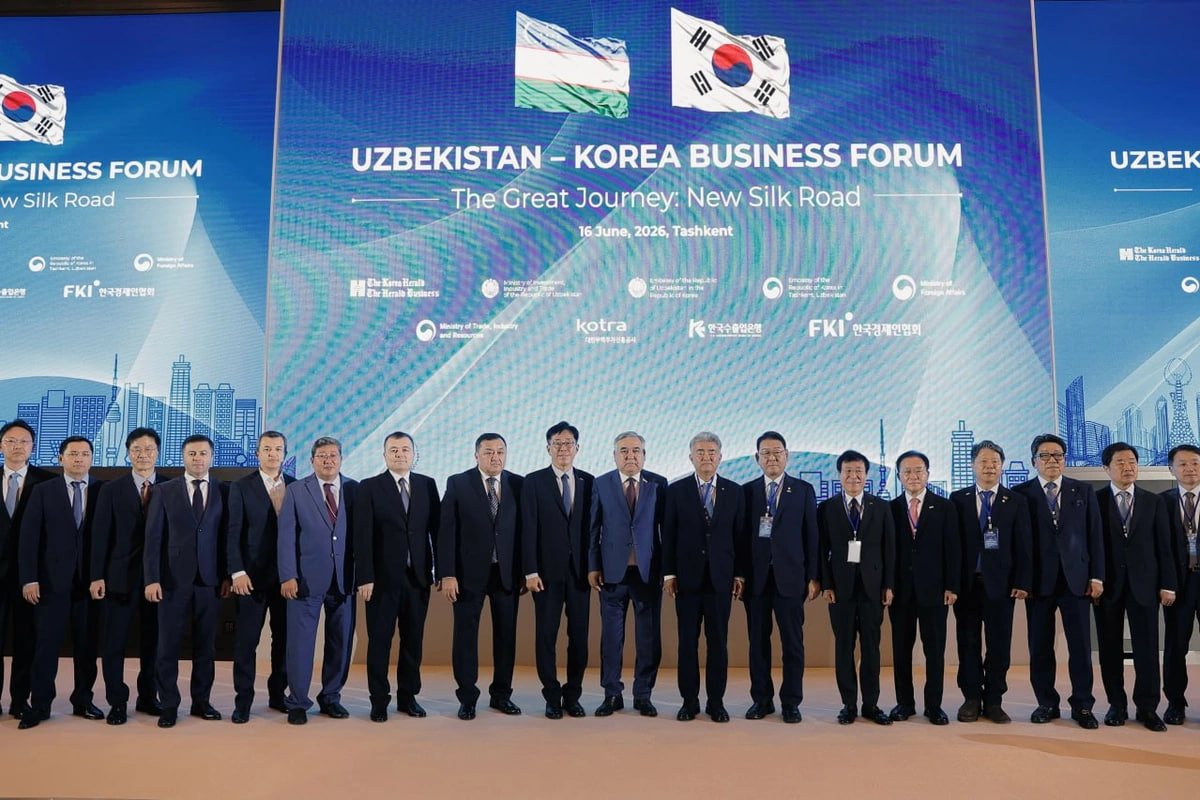
The high-profile event brought together state officials, business executives, financial institutions, and industry associations from both nations. South Korea’s corporate sector was represented by more than 300 companies, including major conglomerates and organizations such as Posco, Samsung, Lotte, Daewoo E&C, Hyundai Rotem, BoMI, ZYX Technology, Incheon International Airport Corporation, Youngone, the Korea Trade–Investment Promotion Agency (KOTRA), and the Export–Import Bank of Korea.
During the forum, Deputy Minister of Investment, Industry, and Trade Ilzat Kasimov briefed South Korean partners on the investment climate and the outcomes of recent economic reforms in Uzbekistan. He highlighted significant policy shifts, including tax reductions and the removal of restrictions on the repatriation of dividends. Kasimov shared macroeconomic projections, stating that Uzbekistan's economy is expected to reach $147 billion by the end of the year, with a long-term target of $240 billion by 2030.
The deputy minister detailed the launch of immediate collaborative initiatives, pointing to a project with KOTRA to develop a joint industrial zone, and another with the Korea Association of Information Technology (KAIT) focused on setting up a biotechnology cluster. Kasimov encouraged South Korean enterprises to actively leverage the country’s dedicated investment platforms to fund these and future ventures.
Kim Bokhwan, President of the Korea Overseas Infrastructure and Urban Development Corporation (KIND), provided specific operational details regarding the Tashkent Smart Bio-Cluster. Designed to accelerate the growth of the pharmaceutical sector, the $100 million facility will occupy a 61–hectare site in the Zangiata district of Tashkent region.
KIND is simultaneously advancing auxiliary infrastructure plans in the capital, including the development of a master plan for the new Tashkent airport and the Tashkent Smart Logistics City complex. The corporation aims to deliver an integrated development framework that combines modern airport infrastructure, advanced logistics centers, and a new urban city concept.
The business forum wrapped up with the signing of multiple commercial agreements and institutional memorandums. Key among these was a trilateral memorandum of understanding signed by MIIT, the Pharmaceutical Industry Development Agency of Uzbekistan, and KIND, solidifying the regulatory and financial commitment to the biotechnology project.

Related News
12:28 / 10.07.2026
World Bank: Uzbekistan could attract up to $6.4 billion in private investment through sector reforms
11:52 / 10.07.2026
Japanese company proposes energy-efficient heating upgrade for Uzbekistan's greenhouses
11:41 / 10.07.2026
Uzbekistan, Belarus approve $164 million pipeline of new joint industrial projects
19:17 / 09.07.2026