





Additional features
-
Night mode

Central Bank survey shows easing inflation fears alongside rising concern over utility costs
Inflation expectations among households and businesses in Uzbekistan continued to decline in May, dropping to 10.1% and 10% respectively for the upcoming 12 months. However, a Central Bank survey reveals that both groups increasingly view rising utility tariffs as the primary threat to future price stability. Concern over utility costs spiked to 59% in May, representing the highest level recorded in 14 months since March–April 2025.
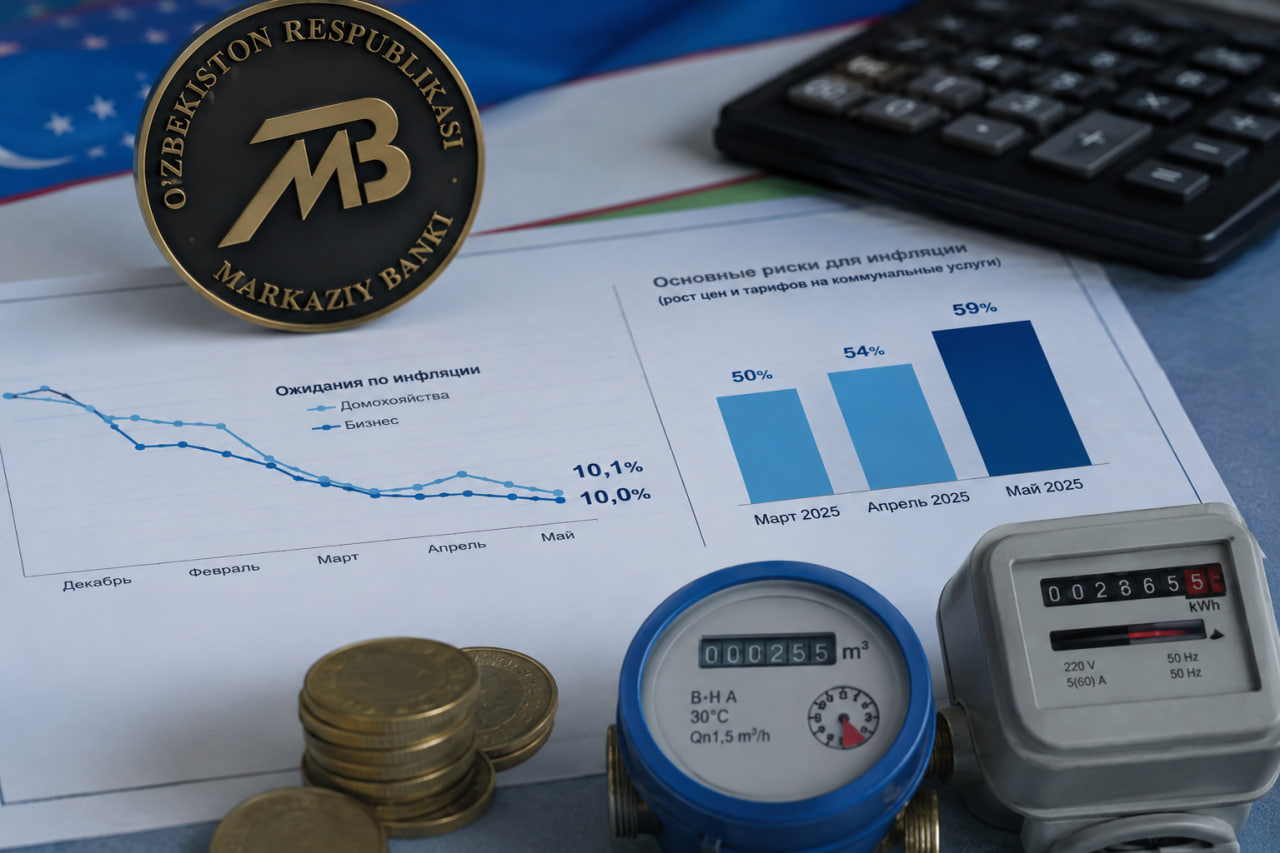
The average inflation projection among the public eased by 0.5 percentage points compared to April, settling at 10.1%. Entrepreneurial inflation expectations followed a similar path, ticking down from 10.3% to 10%.
While utility rates dominate public concern, anxieties regarding fuel and energy costs also increased slightly from 44% to 45%, and those anticipating higher transportation costs rose from 27% to 29%. Conversely, public fears regarding other traditional inflation drivers fell significantly. The share of respondents expecting food price hikes dropped from 28% to 19%, while concerns over exchange rate fluctuations fell from 27% to 19%. Similarly, apprehension regarding price pressures from wage and pension increases declined from 24% to 15%.
Among businesses, the rising cost of utilities also emerged as the foremost concern, matching the public at 59% up from 50% in April. Fuel and energy price hikes ranked second, cited by 49% of entrepreneurs compared to 48% a month earlier. Meanwhile, businesses expressed less concern over transportation costs, which dropped from 39% to 33%, raw material prices, falling from 33% to 19%, and tax burdens, which decreased from 27% to 19%. Anticipated pressure from wage increases and currency fluctuations also dropped to 18% and 16% respectively.
Demographic data reveals notable variations across sectors, regions, and income levels. Among the public, pensioners held the highest inflation expectations at 12.6%, followed closely by IT and media professionals at 12%, and transport and financial sector workers at 10.8% each. Students held the lowest expectations at 9%. In the business community, construction companies projected the highest future inflation at 11.9%, followed by manufacturing at 11.2%, transport services at 10.8%, and education and science at 10.7%. The lowest business expectations were recorded in agriculture and the restaurant sector, both at 8.5%.
Geographically, Tashkent reported the highest consumer inflation expectations at 12%, a 1 percentage point increase from April, followed by Surkhandarya region at 11.8% and Fergana region at 11.7%. Notably, 64% of Tashkent residents expect inflation to fall within the 9–16% range. The lowest public expectations were found in Namangan region at 8.7%, with Navoi and Andijan regions at 8.8% each. For enterprises, the highest expectations were registered in Jizzakh region at 11.9%, alongside Tashkent and Fergana region at 11.5% each, while Andijan region posted the lowest business outlook at 8.1%.
Income levels strongly correlated with inflation outlooks. Respondents earning below UZS 2 million expressed the lowest expectations at 8.2%, while individuals without an income expected inflation to hover around 8.9%. High–income earners anticipated the sharpest increases; respondents making over UZS 30 million monthly projected inflation at 13.9%, followed by those earning UZS 15–20 million at 12.6%, UZS 20–30 million at 12.3%, and UZS 10–15 million at 12.2%.
Inflation expectations represent how consumers and businesses anticipate prices will change over the next 12 months. These sentiment indicators are closely monitored by central banks because they can drive actual economic outcomes. When consumers anticipate higher prices, they often accelerate purchases, which boosts short–term demand and pushes prices up. Similarly, businesses expecting inflation tend to proactively raise consumer prices and adjust operating budgets, making these expectations a self–fulfilling driver of actual inflation.

Related News

19:41 / 13.07.2026
IMF advises caution as Uzbekistan prepares pension system reform
12:28 / 13.07.2026
Central Bank: Strong housing demand pushes up prices across Uzbekistan
12:28 / 10.07.2026
World Bank: Uzbekistan could attract up to $6.4 billion in private investment through sector reforms
12:19 / 10.07.2026