A total of 3,438 respondents participated in the study, pointing to specific everyday expenses as the primary sources of price pressures. Meat and milk continue to top the list of products driving public price perceptions, with 54% of respondents reporting increases, a slight decrease from 56% in April. Gasoline and other fuels ranked second, noted by 31% of those surveyed, marking an increase from 28% a month earlier. Fruits and vegetables were cited by 29% of respondents, while electricity and natural gas rates were flagged by 25% – both figures remaining unchanged from April.
Conversely, fewer consumers noticed sharp price hikes across several commercial categories. The percentage of respondents noting price increases for medicines fell to 17% from 23%, and building materials registered a similar decline to 17% down from 20%. Price concerns also eased for cafes and restaurants, dropping to 13%, vegetable oil down to 12%, and medical services down to 12%. Public transit and transportation costs were mentioned by 14% of respondents, while clothing and footwear were highlighted by 13%. The goods least frequently cited for price hikes included rice, bread, flour, and domestic maintenance services, each selected by only 7% of participants.
Geographically, public perceptions varied widely across the country. Fergana region recorded the highest level of perceived inflation in May at 12.2%, a sharp turnaround from April when it posted the nation's lowest rate at 9.5%. Samarkand region followed closely at 12.1%, up from 10.6%, while Tashkent hovered at 12%. Perceptions also exceeded the national average in Syrdarya region at 11%, Jizzakh region at 10.9%, and Bukhara region at 10.8%. On the lower end of the spectrum, Navoi region registered the lowest perceived inflation at 7.9%, down from 10.2%. Significant declines were also recorded in Khorezm region to 8.3%, Namangan region to 8.9%, and the Republic of Karakalpakstan to 9.5%. Kashkadarya region, which held the highest rate in April at 12.9%, saw its figure drop to 9.8% in May.
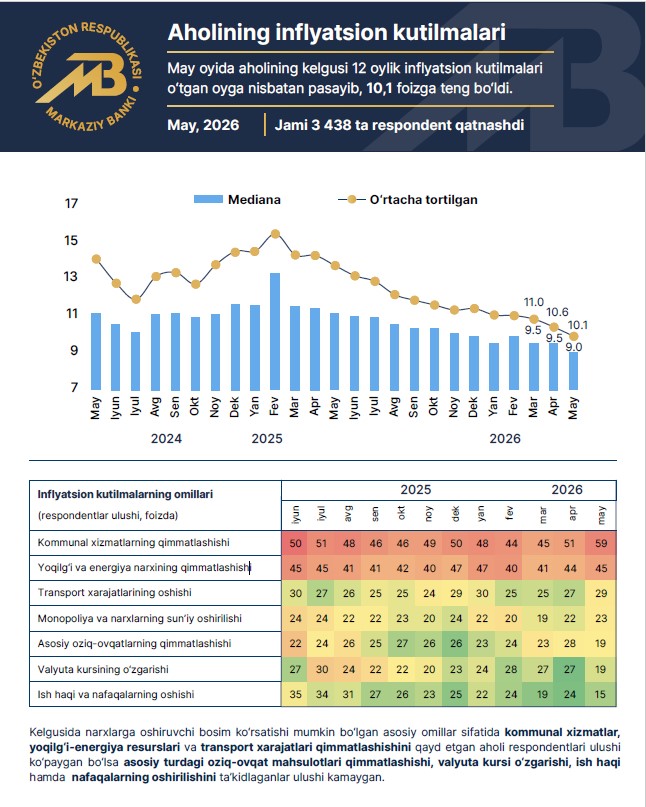
The data further demonstrates that perceived inflation is heavily influenced by profession and income level. Pensioners reported the highest personal inflation rate at 13%, up from 12.2% in April. They were followed by IT and media professionals at 12.1%, banking and finance employees at 11.3%, transportation workers at 11.2%, and public sector employees at 10.9%.
In alignment with broader inflation expectation trends, high–income earners perceived price increases much more acutely than lower–income groups. Respondents with a monthly income exceeding UZS 30 million estimated their personal inflation rate at 13.5%. For the group earning UZS 20–30 million, the figure dropped to 12.4%, while those earning UZS 15–20 million saw an increase to 12.3%. Perceived inflation stood at 12.2% for individuals making UZS 10–15 million and UZS 11.7% for those with an income of UZS 7–10 million. In contrast, citizens earning UZS 4–7 million reported 10.6%, those earning UZS 2–4 million reported 9.5%, and respondents making under UZS 2 million reported the lowest rate at 8%. Individuals with no regular income estimated their perceived inflation at 10%.
The discrepancy between these figures and official statistics stems from how the two metrics are calculated. The official inflation rate measures changes across a standardized national consumer price index basket based on broad household demand. In contrast, personal or perceived inflation is shaped entirely by the shifting prices of goods and services an individual or family purchases routinely over a 12–month period. When a regularly bought staple increases in price, it triggers a much stronger psychological impression of inflation than an expensive, infrequently purchased item, meaning personal inflation rates closely mirror immediate consumer sentiment rather than pure macroeconomic data.