Which vacation dates to choose in 2026 to avoid losing money
|18:02 / 08.07.20261,77811 min
There are months when taking a vacation just doesn't pay off. On a salary of 10 million so'm, time off in May will cost you more than the same vacation in July: the difference reaches 1.7 million for a single break, even though you get the same number of days off. The reason is that work and vacation are paid differently in Uzbekistan, so how much money you keep depends on the month. We break down when it's best to take time off in 2026.
What annual leave is and how it works
Annual leave is a period during which an employee does not work but retains both their position and average salary. All employees working under an employment contract are entitled to annual leave, including part-time and seasonal workers. This article focuses only on paid annual leave.
Since April 30, 2023, Uzbekistan has operated under a new Labour Code (adopted by Law No. ZRU-798 of October 28, 2022). The most important change is that annual leave is now calculated in calendar days rather than working days. The minimum annual leave entitlement increased from 15 working days to 21 calendar days.
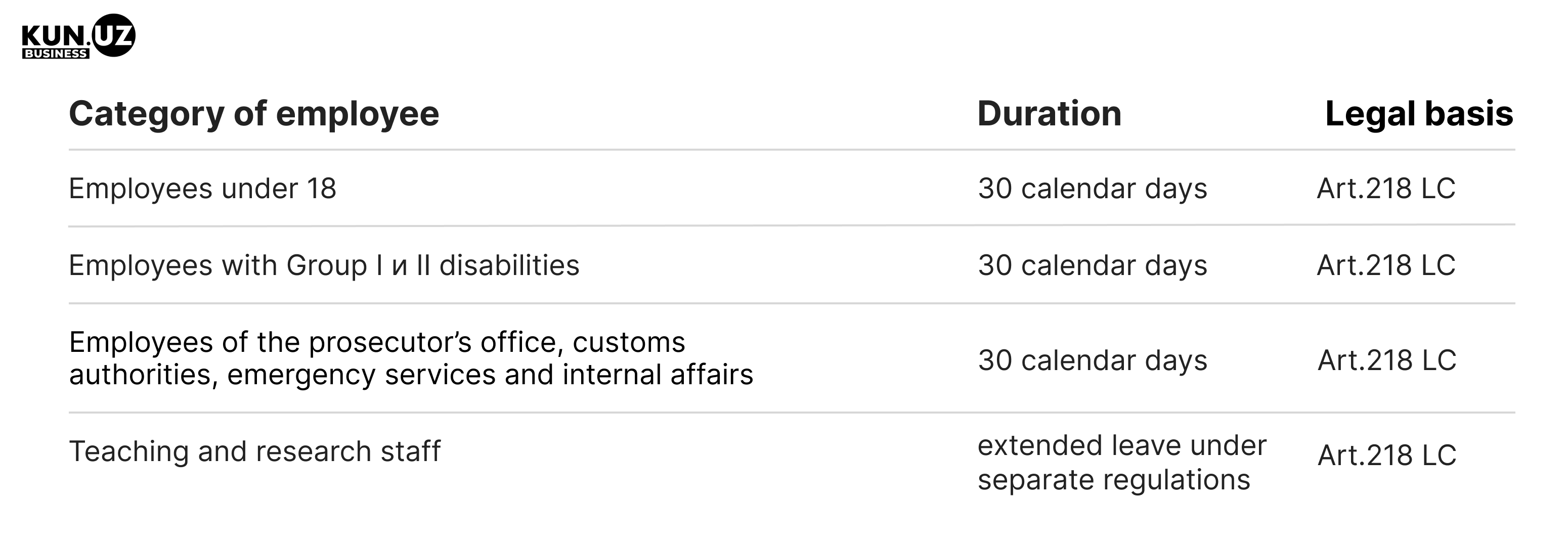
Annual leave consists of two types: Basic annual leave and additional annual leave. Every employee is entitled to basic annual leave. For most workers, this is 21 calendar days. Certain categories are entitled to longer leave periods.
Who is entitled to more than 21 calendar days of leave
Additional leave is added to the basic entitlement. Employees working in hazardous conditions, harsh climates or with long service records may qualify for extra days. Employees receive two additional calendar days for every five years of service, up to a maximum of eight additional days.
Basic leave entitlements are not combined, while additional leave days are cumulative. The total amount of leave for one working year cannot exceed 56 calendar days.
Several important rules apply:
● Employees generally become eligible for their first annual leave after six months of employment, although employers may grant leave earlier.
● Part-time employees receive leave simultaneously with their leave from their primary employer, even if they have worked less than six months.
● The minimum 21 calendar days cannot be replaced with cash compensation. Any days exceeding the minimum entitlement may be compensated upon the employee's request.
Related topics
● Annual leave may be divided into parts, but at least one part must be no shorter than 14 calendar days.
Vacation pay is not an additional payment on top of salary. It is part of your earnings that is paid in advance. After returning from vacation, you receive salary only for the days worked during that month.
Average monthly salary is calculated based on the 12 calendar months preceding the month when the vacation begins. It includes salary, bonuses and allowances but excludes one-time payments such as financial assistance and non-recurring bonuses.
The coefficient 25.3 is established by Article 257 of the Labour Code and represents the average monthly number of working days under a six-day workweek.
Vacation is granted in calendar days, but not all days are paid. Sundays and official public holidays are excluded from payment. Saturdays, however, are paid because the calculation is based on a six-day working week.
Public holidays that fall during annual leave are treated differently:
● They are not paid.
● They do not reduce the employee's leave balance.
● They extend the vacation period.
For example, if an employee takes 21 calendar days of leave and no public holidays fall within that period, three Sundays will normally be excluded from payment. As a result, the employee uses 21 vacation days but receives payment for only 18 days.
With a monthly salary of 10 million UZS, the average daily vacation pay equals:
10,000,000 ÷ 25.3 = 395,257 UZS per paid vacation day
This figure remains the same regardless of the month. What changes is the value of a working day.
Working day value in 2026
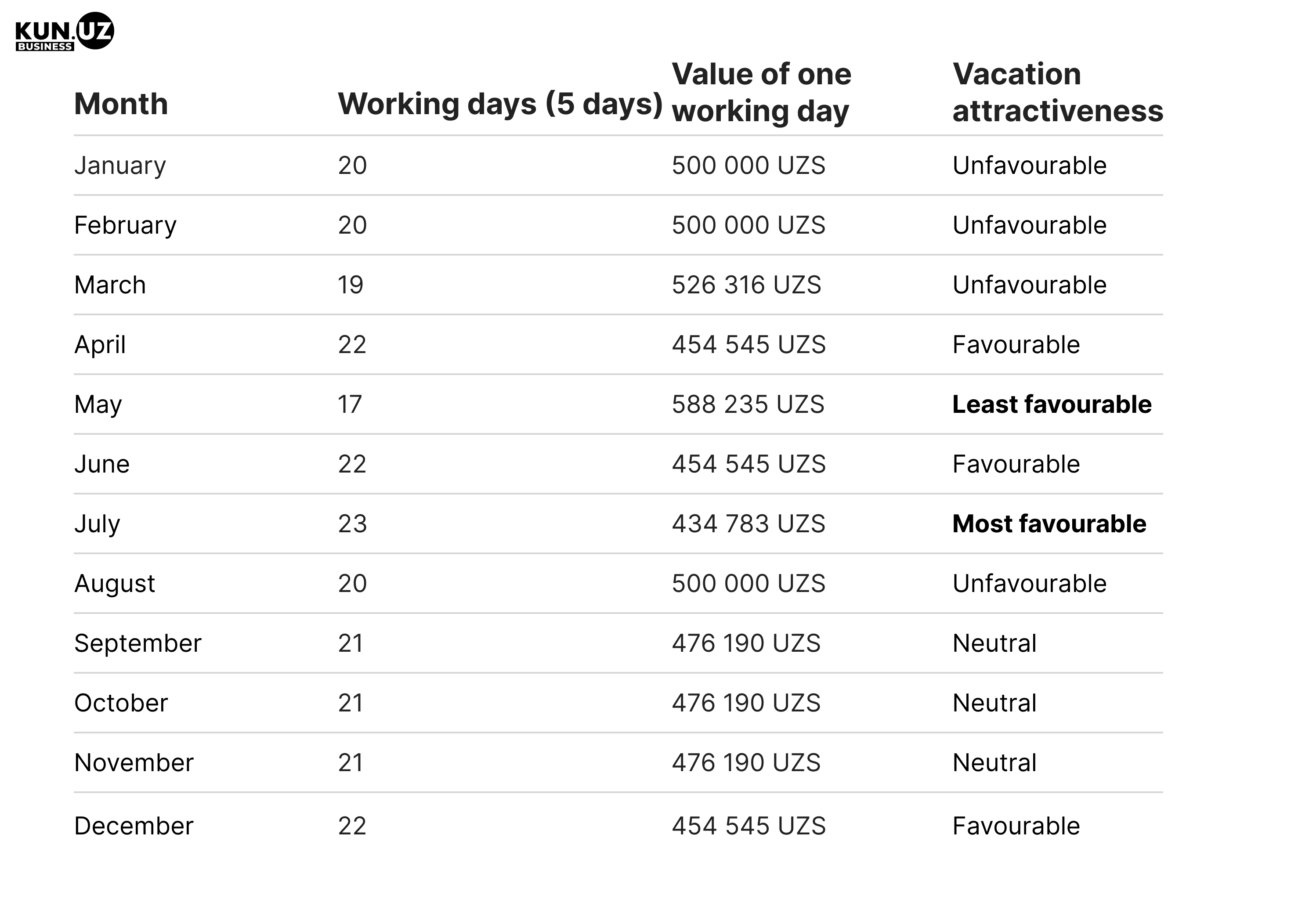
The value of a working day depends on the number of working days in a particular month. The more working days there are, the lower the value of each individual day.
The number of working days in 2026 was established by Presidential Decree No. UP-257 dated 24 December 2025. The table below shows the number of working days under a five-day workweek, along with the value of a working day for an employee earning 10 million UZS per month.
Months with many public holidays have fewer working days, which makes each working day more valuable. Replacing these expensive working days with vacation days often results in lower earnings.
Months with many working days have cheaper working days, making annual leave more financially attractive.
Why May is the least profitable month for vacation
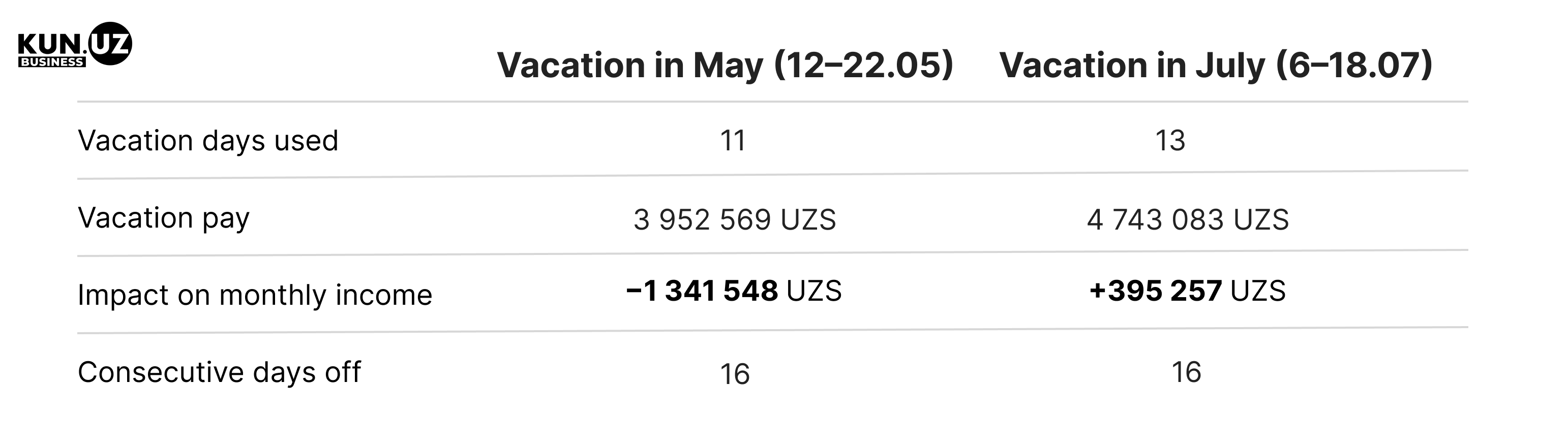
Consider two employees who both earn 10 million UZS per month. Each takes two weeks of annual leave and enjoys 16 consecutive days off.
The employee who takes leave in July ends up earning about 395,000 UZS more than usual. The employee who takes leave in May loses more than 1.34 million UZS. The difference exceeds 1.7 million UZS despite both employees taking vacations of the same length.
The explanation is straightforward. In May, one working day is worth 588,235 UZS, while a vacation day is paid at only 395,257 UZS. In July, the value of a working day is much closer to the vacation-day rate, and paid Saturdays improve the final result.
Three ways to maximise vacation pay
The Labour Code allows annual leave to be divided into parts, provided that at least one part lasts 14 calendar days or more.
This creates several opportunities to improve the financial outcome of a vacation.
● Include as many Saturdays as possible. Vacation pay is calculated according to a six-day working week. Saturdays are paid even if you normally work a five-day schedule. This effectively increases your paid leave days.
● Avoid spending too many vacation days on Sundays .Sundays reduce your annual leave balance but are not paid. They are the least profitable days within a vacation period.
● Use public holidays strategically. Public holidays are not paid, but they do not reduce your annual leave balance either. They simply extend the duration of your vacation.
For this reason, many employees take short leave periods from Monday to Saturday. This allows them to maximise paid days while minimising unpaid Sundays.
Key takeaways
● Vacation pay depends on your average earnings during the 12 months preceding the leave period.
● A vacation day is paid using a fixed formula: average salary divided by 25.3.
● A working day is valued differently each month because the number of working days varies.
● The most financially attractive months for annual leave in 2026 are July, April, June and December.
● May is the least attractive month, followed by January, February, March and August.
● Sundays and public holidays are not paid during annual leave, while Saturdays are paid.
● Public holidays extend vacation without reducing the employee's leave balance.
● Production calendars and religious holiday dates may change from year to year, so calculations should always be based on the specific vacation dates b