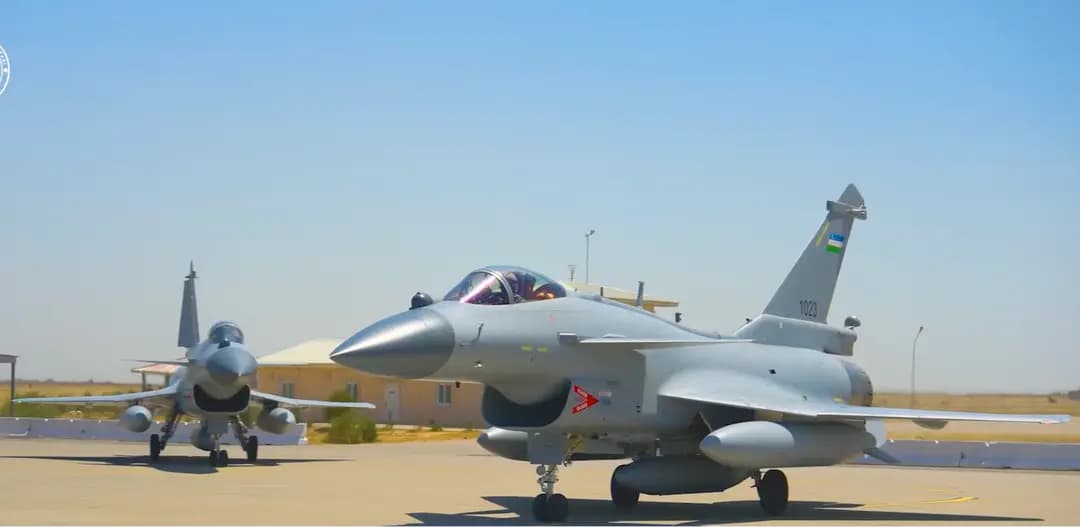
The Ministry of Defense released footage showing the aircraft flying and performing aerial maneuvers, describing them as “modern fighter jets protecting the country’s airspace.” The ministry did not disclose the aircraft type in its accompanying statement, but the jets shown in the footage have been identified as the J-10CE, the export version of China’s J-10C multirole fighter.
There is no official information on the total number of aircraft acquired, their technical specifications or the value of the deal.
The appearance of the aircraft provides the first official confirmation of their presence in Uzbekistan. Until now, reports about the acquisition had been based on photographs, open-source intelligence and assessments by military observers. Neither Tashkent nor Beijing had previously confirmed the purchase.
Kun.uz reported in late July, citing Chinese military observers and open-source analysts, that four additional J-10CEs had been added to Uzbekistan’s Air Force. At the time, the Uzbek and Chinese authorities neither confirmed nor denied the reports.
The possible acquisition had attracted considerable attention because the introduction of the Chinese fighters would mark a major change in Uzbekistan’s combat aviation fleet, which has traditionally relied on Soviet-designed aircraft such as the MiG-29 and Su-27.
What is the J-10CE?
The Chengdu J-10CE is the export version of China’s J-10C. It is a single-engine, multirole fighter generally classified as a 4++ generation aircraft. The fighter is equipped with an active electronically scanned array (AESA) radar, modern avionics and electronic warfare systems.
The aircraft has a reported maximum speed of around Mach 2.2, or roughly 2,300 km/h. Its AESA radar enables it to detect and track multiple targets and engage them with beyond-visual-range weapons.
The J-10CE has 11 hardpoints for carrying weapons and other equipment. Its weapons configuration can include air-to-air, air-to-ground and other guided munitions, giving the fighter a broader range of missions than a dedicated air-superiority aircraft.