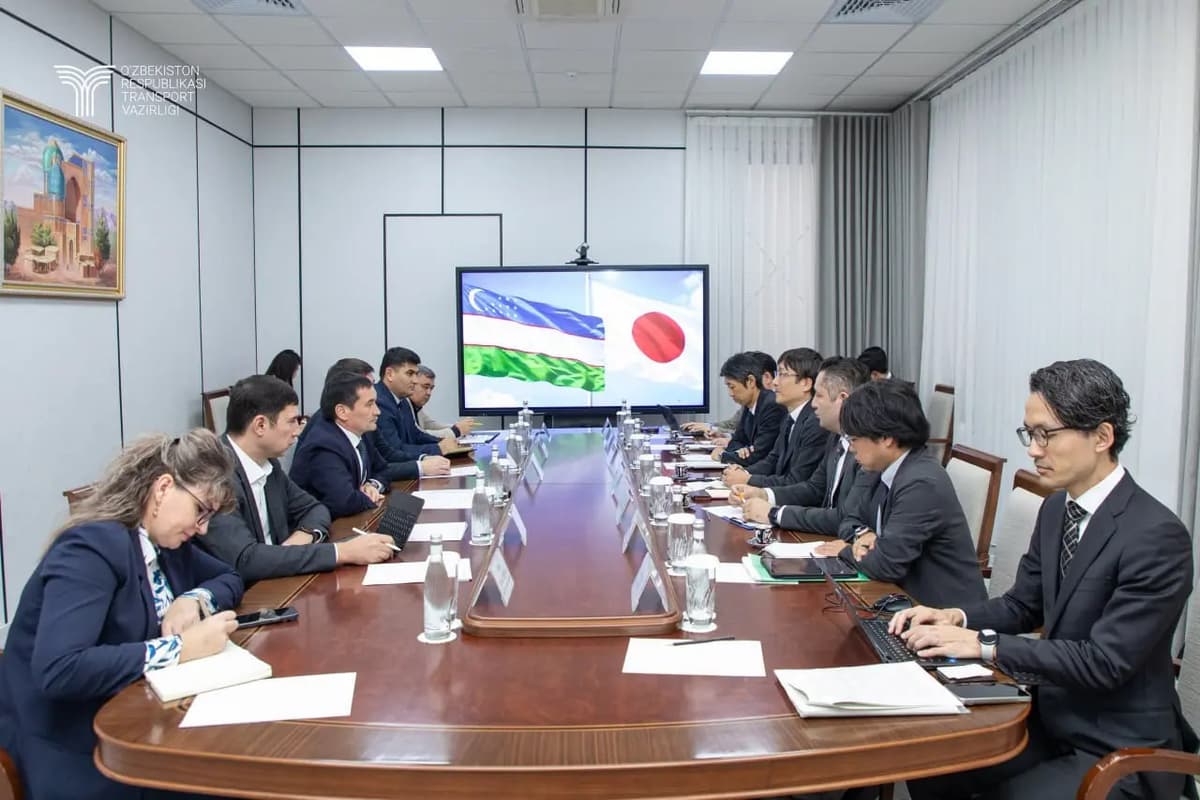
The prospects for cooperation were discussed on October 7 when Uzbekistan’s Transport Minister Ilhom Mahkamov met with a JBIC delegation led by Hiroki Sekine, senior managing executive officer and board member of the Japanese bank.
Sekine noted the growing interest of Japanese financial institutions in projects in Uzbekistan. JBIC plans to participate in financing 14 projects in the country over the next three years, two of them in the transport sector, the Transport Ministry said.
The meeting focused on the status of two projects – construction of the new Tashkent airport and the supply of air traffic management systems for the Uzairnavigation Center. The sides discussed the possibility of attracting JBIC financing for both projects.
The parties agreed to accelerate joint transport initiatives and continue cooperation on prospective projects.
New Tashkent airport
The new international airport is being built in Tashkent region under a public-private partnership. In October 2025, President Shavkat Mirziyoyev reviewed the project and formally launched construction.
The private partners selected for the project are Saudi Arabia’s Vision Invest, Japan’s Sojitz and South Korea’s Incheon International Airport Corporation (IIAC). The consortium shares are divided among Vision Invest with 45%, Sojitz with 30%, IIAC with 15% and Uzbekistan Airports with 10%.
The airport is expected to handle up to 20 million passengers and 129,000 tonnes of cargo annually once commissioned. It will be capable of handling up to 30 takeoffs and landings per hour and accommodating 62 aircraft simultaneously.
The passenger terminal will be four times larger than the existing complex and could eventually handle up to 46 million passengers a year. More than 40 passenger boarding bridges and 160 aircraft parking stands are planned.
The airport will be connected to the Tashkent–Samarkand, Tashkent–Andijan and Tashkent–Bostanlyk toll roads. A railway station for high-speed trains and shuttle services connecting Tashkent with New Tashkent are also planned.
South Korea’s The Korea Herald