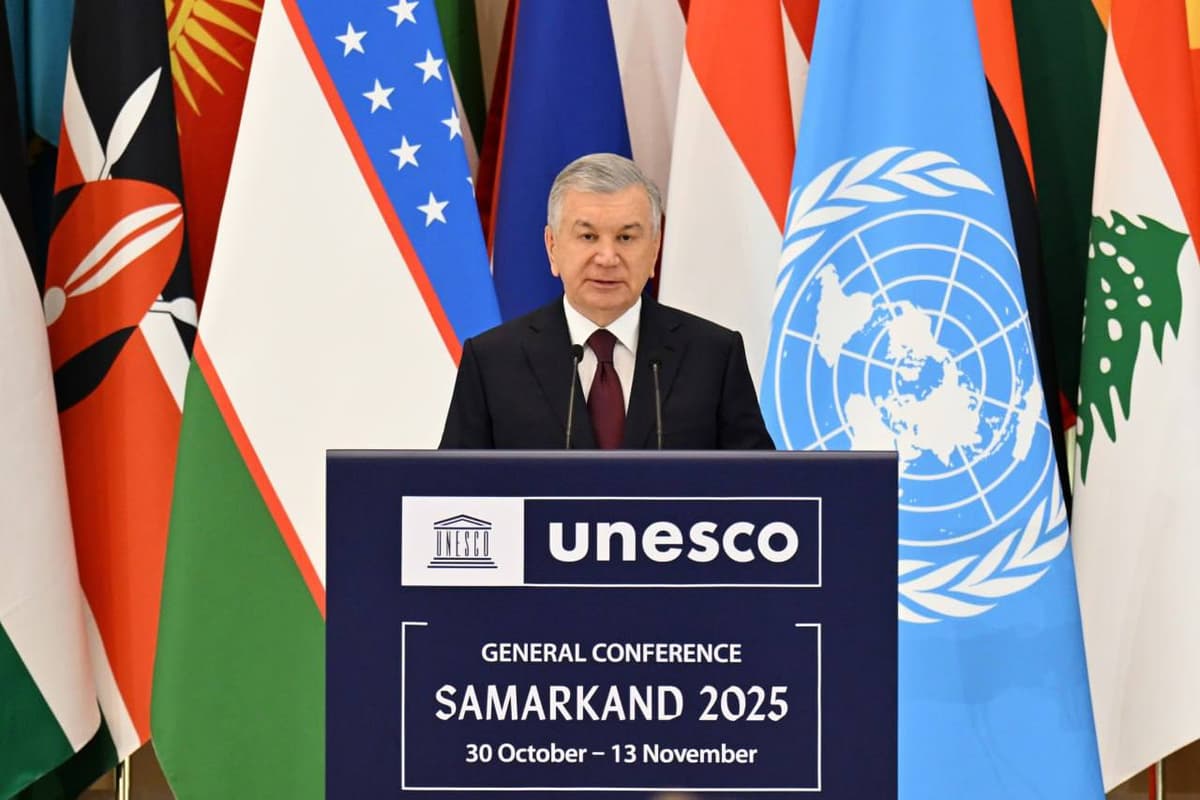
During his address on 30 October, the president highlighted the significance of hosting such a prestigious event in Uzbekistan, calling it “a vivid expression of the high confidence that UNESCO member states have in the large-scale and dynamic reforms being carried out in the New Uzbekistan.”
“Celebrating its glorious 80th anniversary, UNESCO has over the decades established itself as one of the most influential global institutions in fostering cooperation, mutual trust, and solidarity in the fields of education, science, culture, art, and information,” Mirziyoyev said at the start of his speech.
The president reaffirmed Uzbekistan’s firm commitment to UNESCO’s noble goals and values, emphasizing that the country has always sought to serve as a bridge of harmony between East and West, North and South, and remains open to constructive cooperation with all.
Mirziyoyev noted that, as an equal member of UNESCO, Uzbekistan has organized numerous international events, festivals, and conferences dedicated to historical milestones in recent years.
The president then outlined several proposals addressing key agenda items of the conference:
First, he proposed establishing a UNESCO platform for developing inclusive education for children with special needs, organizing a World Vocational Education Summit, implementing a model project titled “Artificial Intelligence – School” with UNESCO’s participation, and convening an international expert conference on AI ethics.
Second, Mirziyoyev called for strengthening joint efforts to preserve the world’s intangible cultural heritage – humanity’s priceless treasure – expanding the UNESCO Memory of the World program, declaring 19 November as the International Day of Documentary Heritage, and establishing an International Digital Heritage Institute within UNESCO’s structure.
Third, he proposed launching global programs to enhance women’s leadership and competence, founding a UNESCO Academy for Women’s Leadership, and organizing a Global Forum for Women in Education, Culture, and Science in Samarkand.
Fourth, to combat the climate crisis effectively, the president suggested introducing a “UNESCO Ecological Capital” global initiative, developing a resolution titled “On strengthening measures to preserve cultural heritage in the context of globalization and climate change”, and hosting an international symposium on this topic in the city of Khiva.