SOCIETY | 09:57 / 22.11.2025
1405
10 min read

Border politics and economic logic: Why did Uzbekistan move its capital from Samarkand to Tashkent 95 years ago?

Lately, politicians in Iran and Kyrgyzstan have begun discussing the need to move their capitals. Uzbekistan itself went through exactly such an experience. So what prompted the republic’s capital to be shifted from Samarkand 95 years ago and why was Tashkent chosen?

Changing a country’s capital is a rare event in world practice, but it does happen for a variety of reasons. Just days ago, Iranian President Masoud Pezeshkian announced plans to relocate the capital from Tehran to the Persian Gulf coast, opposite Dubai, because of acute water shortages and land subsidence. In neighboring Kyrgyzstan, politicians have also started talking in recent weeks about moving the capital from Bishkek to the city of Manas for various stated reasons.

Uzbekistan too has experience of relocating its administrative center. Exactly 95 years ago the political and administrative heart of the republic unexpectedly moved from Samarkand to Tashkent. Why was this decision taken, and why was Tashkent selected? That is the story we explore today.

The division of Central Asia

After the creation of the communist state known as the USSR, the deliberate fragmentation of Central Asia’s peoples began. The main aim was to draw artificial borders that would sow lasting tension between the region’s future states. Although the Jadid leaders who emerged at the time advocated the idea of a unified Turkestan, that vision never materialized. As a result of the national-territorial delimitation carried out in September–October 1924, the former Turkestan ASSR, Bukhara, and Khorezm republics were replaced by six national entities.

Thus, on 27 October 1924 the Uzbek SSR was established, initially comprising seven provinces: Samarkand, Zarafshan, Kashkadarya, Surkhandarya, Fergana, Tashkent, and the Tajik Autonomous Republic. Tajikistan separated as a full union republic in 1929, while Karakalpakstan joined the Uzbek SSR in 1936, giving the country the borders we know today.

Three capitals in five years

In the very first months after the Uzbek SSR was formed, Bukhara briefly served as capital from February to April 1925. In April of the same year, the status passed to Samarkand. Historically Samarkand had long enjoyed the prestige of a capital city. Moreover, until 1929, Tajikistan remained part of Uzbekistan as an autonomous republic, and until 1930 Karakalpakstan belonged to Kazakhstan – making Samarkand geographically the near-exact center of the enlarged republic.

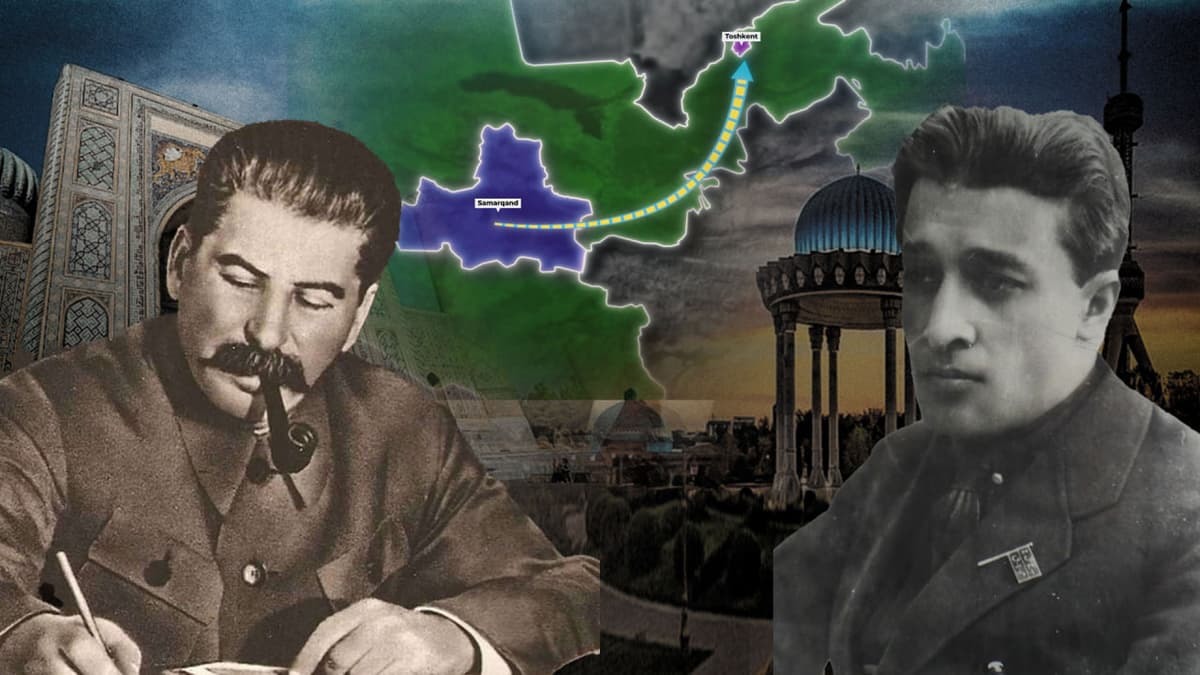
Yet circumstances changed over time. On 17 August 1930, the decision was taken to move the capital from Samarkand to Tashkent. Some sources claim the issue was settled in a single day by Fayzulla Khojaev, the chairman of the Uzbek SSR government at the time, suggesting possible hidden political motives behind the abrupt move.


Why Tashkent?

Before the creation of the Uzbek SSR, Tashkent had already been the seat of the Turkestan Governor-Generalship under the Russian Empire. For that reason, major Soviet institutions were based there: the Central Committee of the Communist Party of the Soviet Union for Central Asia, the Central Asian Economic Council, the Turkestan Front, and the Central Asian Military District, among others. A number of additional factors also influenced the choice.

Economic factors. By the late 1920s, Tashkent had clearly overtaken Samarkand in economic development. During the imperial period, as the administrative capital of Turkestan, it had acquired railways, an electricity station, industrial enterprises, and modern communications. Under the first Soviet five-year plan in the 1930s, new industrial facilities were planned around Tashkent, giving the city a clear advantage in economic potential and skilled workforce.

Transport and communications infrastructure played a major role as well. At the start of the 20th century Tashkent became the principal rail hub linking Central Asia with Russia and Siberia. The Orenburg–Tashkent railway, opened in 1906, connected the city both to the Russian Empire and to the interior of Central Asia. The Turkestan–Siberia railway built between 1926 and 1931 further enhanced Tashkent’s transport significance, enabling rapid freight movement from Novosibirsk in the north to Tashkent and onward to the Fergana Valley in the south. As a result, Tashkent emerged not only as Uzbekistan’s but as the entire region’s major transport crossroads.

Political factors. Hidden territorial ambitions are also said to lie behind the move. According to some accounts, after the 1924 delimitation the Kazakh leadership decided to make Tashkent its own capital and even wrote to Stalin about it. Upon learning this, the Uzbek government hurriedly relocated the capital to Tashkent, thereby removing any prospect of the city being transferred to Kazakhstan.

Some historians note that the Soviet leadership in Moscow opposed proposals to hand Tashkent to Kazakhstan from the outset. Stalin himself is reported to have declared: “Tashkent to the Uzbeks, Alma-Ata to the Kazakhs.”

Moving the capital to Tashkent also served Moscow’s interests. The central authorities preferred republican capitals to be located not in the geographic heart of each republic but closer to the borders – so that, in the event of any secessionist moves, a border-adjacent capital could be seized without difficulty. A glance at the map shows Tashkent sitting right on the frontiers with Kazakhstan to the north, Kyrgyzstan to the east, and Tajikistan to the south.

When Mustafa Kemal Atatürk moved Turkey’s capital from Istanbul to Ankara, he explained his reasoning as follows: “Positioning the national capital on the periphery is akin to placing the heart at the extremity of the body.”

At the time, Kazakhs did live in villages around Tashkent, yet the city itself – its language, culture, and way of life – was unmistakably Uzbek, an argument even Moscow could not deny. In exchange, parts of Syrdarya Province, including the areas around present-day Turkestan and Shymkent, were ceded to Kazakhstan.

Proximity to cotton and industrial zones. Official documents cited the need to optimize governance, particularly by being closer to the main agricultural and industrial regions. Given the slow communications of the era, this was a logical consideration.

Geographically, Tashkent brought the capital much nearer to the Fergana Valley – the country’s primary cotton-producing region. In the 1920s and 1930s cotton was the cornerstone of the Uzbek economy, and the valley’s cities such as Andijan, Namangan, and Kokand were developing light industry. Unlike Samarkand, Tashkent had direct rail and road links to the valley in several directions, making administration easier for the Soviet authorities. The 1930 decree of the Central Executive Committee explicitly highlighted “proximity to the main cotton-growing and industrial region – the Fergana Valley” as the principal justification.

Security. In the 1920s national liberation movements against Soviet rule continued in various parts of Uzbekistan, especially in the mountainous areas around Samarkand and Bukhara and in the Fergana Valley. Tashkent was geographically more distant from these hotspots and therefore safer for the regime. The city hosted the headquarters of the Red Army’s Central Asian Military District, giving the authorities better control over surrounding provinces and the ability to suppress uprisings more effectively. Thus, political stability and the concentration of security forces also played a role in the decision.

Related News