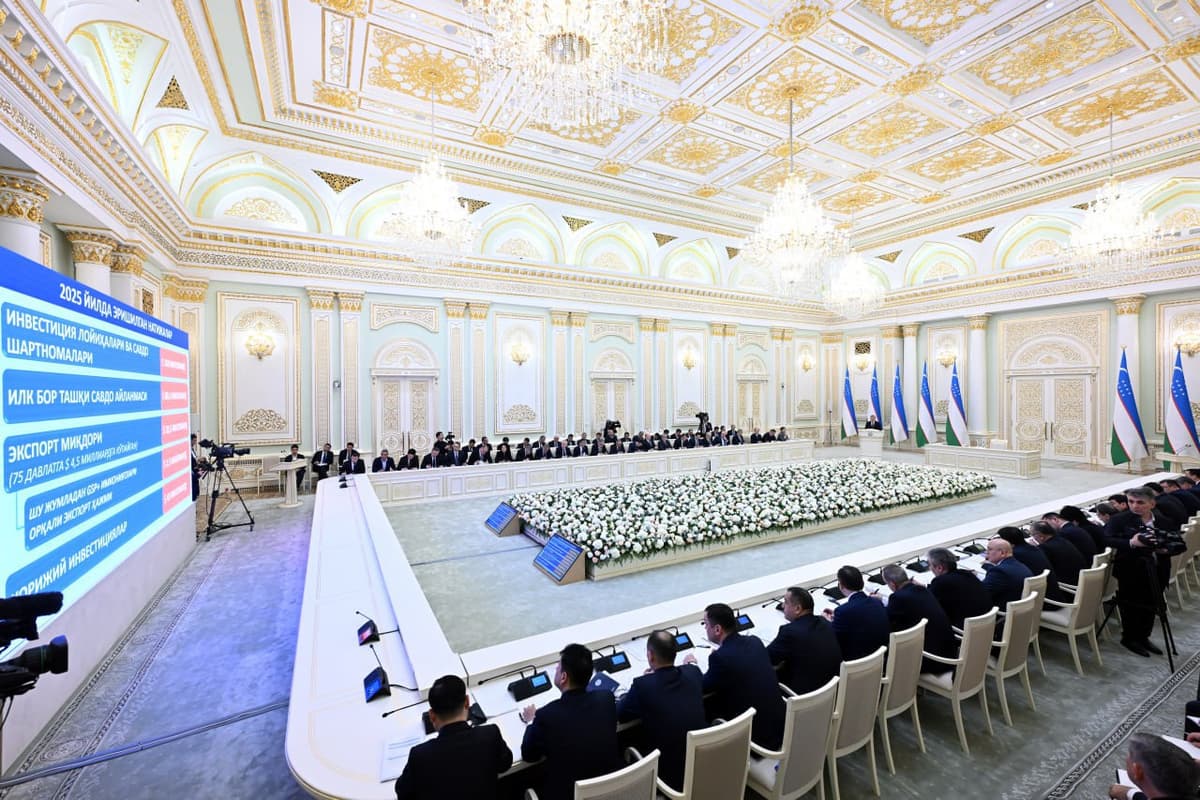
The directive was announced during a videoconference meeting reviewing the activities of the Ministry of Foreign Affairs and overseas diplomatic missions. Participants discussed the need to enhance the effectiveness of foreign policy amid a more complex and volatile geopolitical environment and to introduce modern approaches to diplomatic engagement.
The president described 2025 as a productive year for Uzbekistan’s foreign policy, noting that high-level visits were conducted to 26 countries. For the first time in the country’s modern history, Uzbekistan also hosted visits by leaders from several European, Middle Eastern, and Latin American states, while cooperation formats under the “Central Asia plus” framework continued to expand.
Over recent years, Uzbekistan has established strategic partnerships with 11 countries, bringing their total number to 19. Allied relations with Kazakhstan, Azerbaijan, and Tajikistan have also been strengthened. According to the president, an open, pragmatic, and proactive foreign policy has enabled Uzbekistan to take on a more prominent and confident role in international dialogue and diplomacy.
Officials reported that since 2017 the country has opened 16 new diplomatic and consular missions abroad, raising their total number to 60. Uzbekistan now maintains diplomatic relations with 165 countries. Embassy and consular staffing levels have been expanded, and salaries for Foreign Ministry personnel and diplomats serving overseas have been increased.
At the same time, the president stressed that not all missions are fully utilizing the opportunities available to them. He emphasized that diplomatic work should no longer be judged by formal activity alone, but by tangible results.
“In today’s environment, an ambassador is not only a political interlocutor,” Mirziyoyev said. “An ambassador is a representative of the state who attracts investment and technology, opens new export markets, develops transport and logistics corridors, boosts tourism, creates conditions for lawful labor migration, and, above all, protects the rights and interests of our citizens.”
Based on this approach, new key performance indicators have been introduced for diplomatic missions. These include export revenues generated from host countries, the number of tourists arriving in Uzbekistan, and concrete results in facilitating legal employment opportunities for Uzbek citizens abroad.
Officials said these indicators will serve as the decisive criteria for assessing the effectiveness of embassies and consulates, with ambassadors held personally accountable for performance measured against these outcomes.