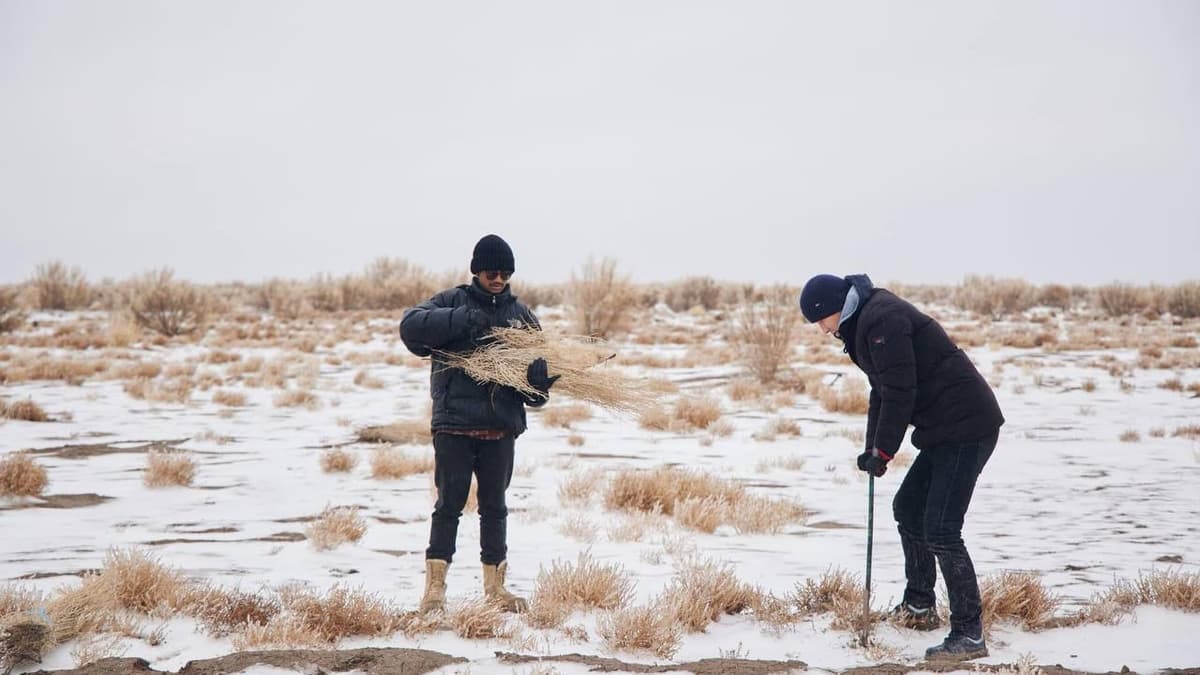
The project is a joint effort of the United Nations Development Programme, the Art and Culture Development Foundation of Uzbekistan and Aral School. According to the foundation’s press service, participants in Aral School, UNDP experts on the Aral Sea and foresters from the Karauzyak State Forestry planted saxaul and other salt-tolerant species in one of the most challenging landscapes in the world.
The field campaign is described as a direct outcome of the developing institutional partnership between ACDF and UNDP in Uzbekistan.
Restoring degraded land through cross-sector cooperation
Gayane Umerova, Chairperson of the Art and Culture Development Foundation of Uzbekistan, said Aral School brings together disciplines that rarely intersect, including design, ecology, science, culture and local knowledge.
“It is at their intersection that new solutions emerge. By working together with UNDP, we can directly implement this concept in practice – in the field, in communities and with a future generation that will rethink the meaning of restoration for this region and beyond,” she said.
The initiative focuses on planting saxaul (Haloxylon), a key native species used to stabilize soil on the former seabed, along with other halophyte plants adapted to the extreme conditions of the Aralkum desert. These conditions include high soil salinity, temperatures ranging from –30 to +45 degrees Celsius, minimal precipitation and constant salt-dust storms.
Saxaul’s role in combating dust storms and climate impact
Saxaul is uniquely adapted to such harsh environments. A single mature shrub can retain up to four tons of shifting sand, while its root system can reach depths of 10-15 meters. Each hectare of saxaul plantations absorbs more than 1,100 kg of CO2 annually.
In seven-year-old plantations, wind speed at ground level is reduced almost to zero, directly limiting the spread of toxic dust storms that affect the health of millions of people in the region. The seedlings used in the project were grown in local nurseries of the state forestry system, ensuring full adaptation to local conditions.
Akiko Fujii, Resident Representative of the United Nations Development Programme in Uzbekistan, emphasized that restoring the Aral region requires more than technical solutions.
“Restoration demands institutions that share a common belief that education, science and culture are inseparable from environmental recovery. This is what unites UNDP and the foundation. When partners come together around such a goal and act jointly, genuine change begins,” she said.