I receive part of my salary in cash. What will happen to my employer
|14:30 / 14.07.20261,34815 min
In Uzbekistan, almost one in three workers receives an under-the-table salary. But it is the employer, not the employee, who is held responsible: they face back taxes, penalty interest, and fines.
How does an undeclared salary differ from a partially declared salary
Before discussing the consequences, it is important to understand which scheme is being used, as the violations and penalties differ.
What is an undeclared salary
Under an undeclared salary scheme, the entire salary is paid in cash and the employee is not officially registered anywhere. This violates two areas of law at once: labor law, because the employment relationship is not formalized, and tax law, because no payroll taxes are paid at all.
How does the partially declared salary with a minimum official salary work
An employment contract exists, but it states only the minimum salary, most commonly the statutory minimum wage of UZS 1,271,000. The rest is paid in cash.
The main violation here is tax-related: the employer understates the salary amount on which taxes are paid.
For every salary payment, the employer must withhold 12% personal income tax from the employee and pay 12% social tax at the employer’s expense. If this does not happen, the tax authorities will assess the unpaid taxes based on the employee’s actual earnings.
Sources may include the state labor accounting system at mehnat.uz, bank statements, and other digital records.
What additional taxes and penalties can the tax authorities assess
Related topics
What amount will be used to recalculate taxes
The first consequence for an employer caught using an cash-in-envelope salary scheme (commonly known as an envelope salary) is an additional tax assessment. The tax authorities recalculate personal income tax and social tax based on the employee’s actual earnings rather than the officially declared salary.
In addition to the assessed taxes, interest accrues for every day of delay. With the Central Bank’s policy rate at 13.5%, the daily interest rate is approximately 0.045%, which is roughly 16% per year. For large amounts, the debt can grow at a rate comparable to a bank loan.
Are financial sanctions imposed separately from interest and fines
Yes. The law also provides for financial sanctions: 20% of the unpaid amount for understating taxes and up to 10% for failing to submit reports on time.
It is important to understand that these sanctions are imposed on the company itself and do not replace either the accrued interest or the administrative fine imposed separately on the director. The authorities do not choose one measure instead of another — they are applied simultaneously.
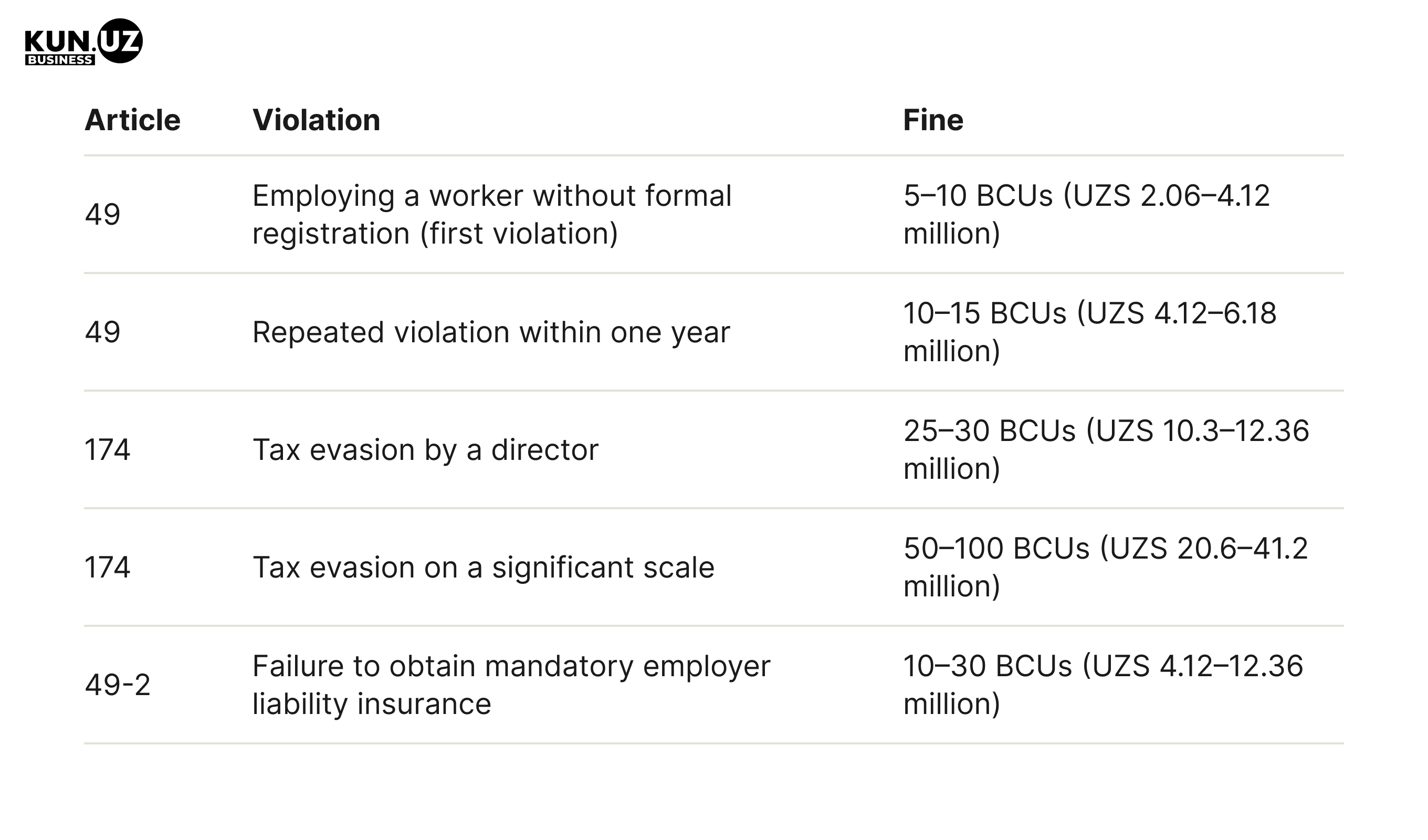
Administrative fines are imposed personally on the director. In Uzbekistan, fines are calculated not in soums but in Base Calculation Units (BCUs). This is a standard reference unit used for most administrative penalties. Since August 1, 2025, one BCU has been equal to UZS 412,000.
How much are the fines under Articles 49 and 174
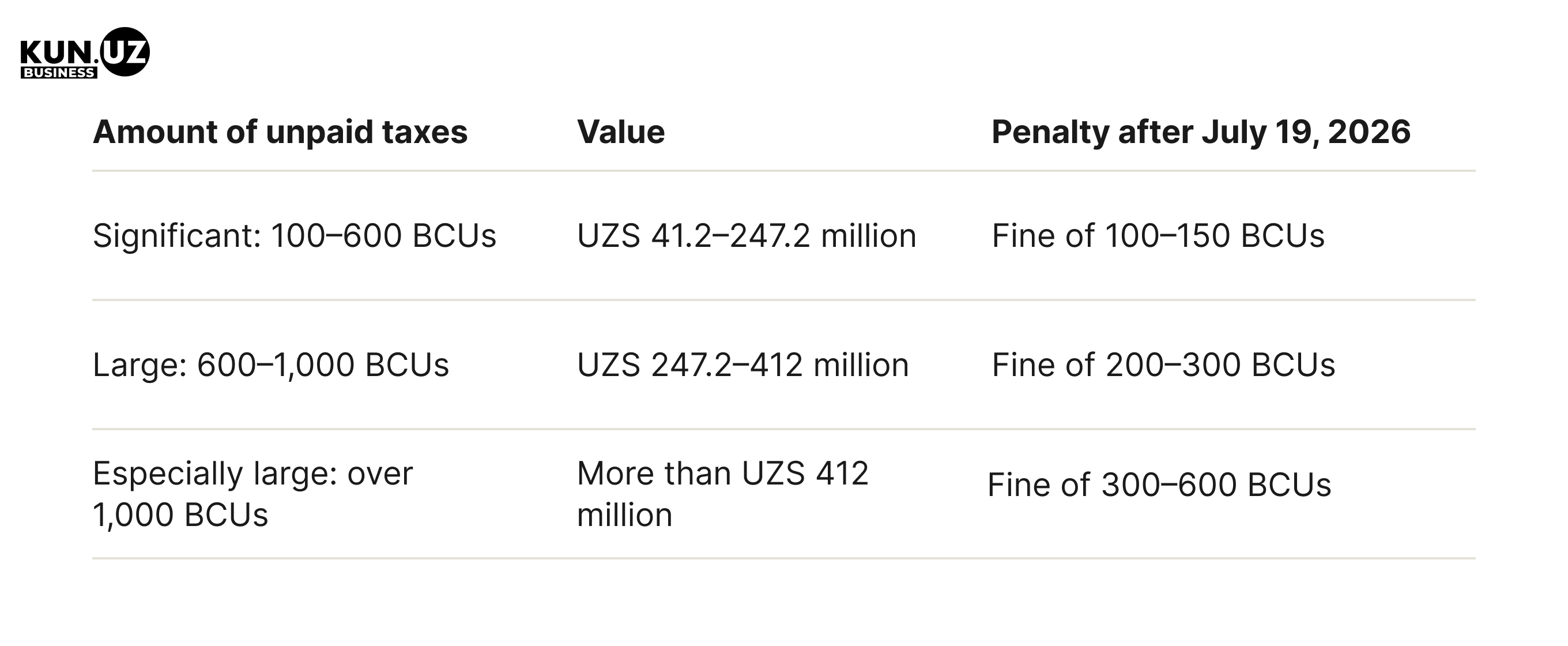
The basic fine for employing a worker without formal registration is established by Article 49 of the Code of Administrative Responsibility. Since July 19, 2026, penalties for tax evasion under Article 174 have also increased.
Before the reform, the fine for a director under Article 174 was 15 BCUs, meaning the maximum penalty has more than doubled.
Tax evasion cases are now handled by a specialized department under the Prosecutor General’s Office, meaning employers may come under the scrutiny not only of the tax authorities but also of law enforcement agencies.
Can you be imprisoned for tax evasion?
When tax evasion reaches a significant amount or higher, the Criminal Code applies — Article 184. The thresholds are also calculated in base accounting units as of the date the offence ended.
If the employer fully repays the taxes, penalty interest, and financial sanctions before the judge retires to the deliberation room, the court does not impose imprisonment and limits the punishment to a fine.
Kun.uz
Can imprisonment be avoided
There is one lenient option for first-time offenders. If the employer fully pays all taxes, accrued interest, and financial sanctions before the judge retires to deliberate, the court will not impose imprisonment and will limit the punishment to a fine.
Can an employer save money by understating only the official salary
A reasonable question arises: can an employer save money by reducing only the official portion of the salary to the minimum level? In practice, the answer is usually no, and the consequences can cost more than the savings.
How did one company pay downtime compensation based on the minimum wage
At a company in the Tashkent region, downtime was declared in December 2022, as well as in January and February 2023. The employee received UZS 920,000 per month, exactly equal to the minimum wage at that time.
However, under the Labor Code, downtime must be paid based on the employee’s average earnings, not the minimum wage. The employee’s average monthly earnings were UZS 2,842,690, meaning the shortfall was UZS 1,922,690 per month.
Over three months of downtime, the unpaid amount reached UZS 5,768,070. This was later supplemented by unpaid regular wages for May and September 2023, as well as interest for each day of delay.
Kun.uz
How much did the court ultimately recover
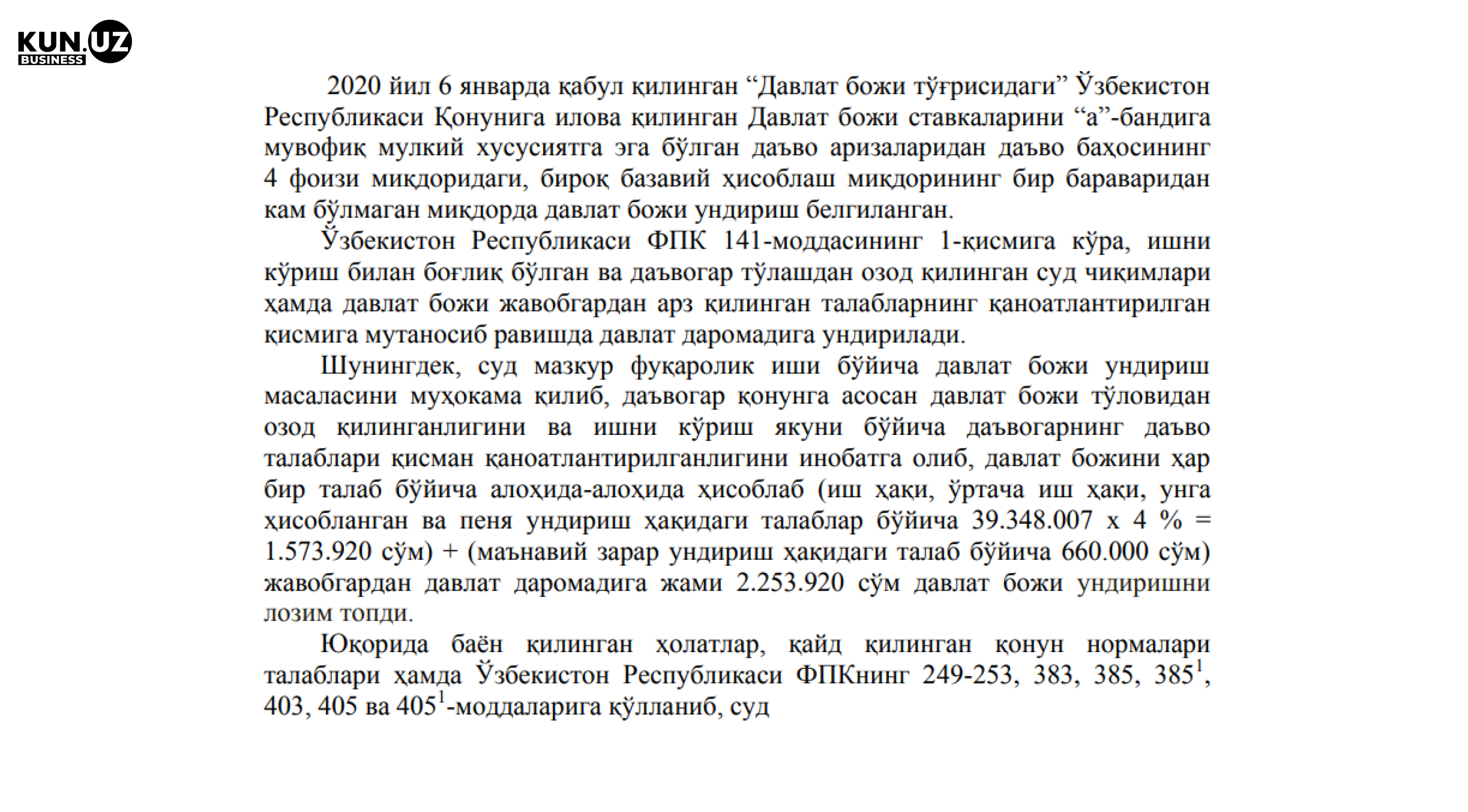
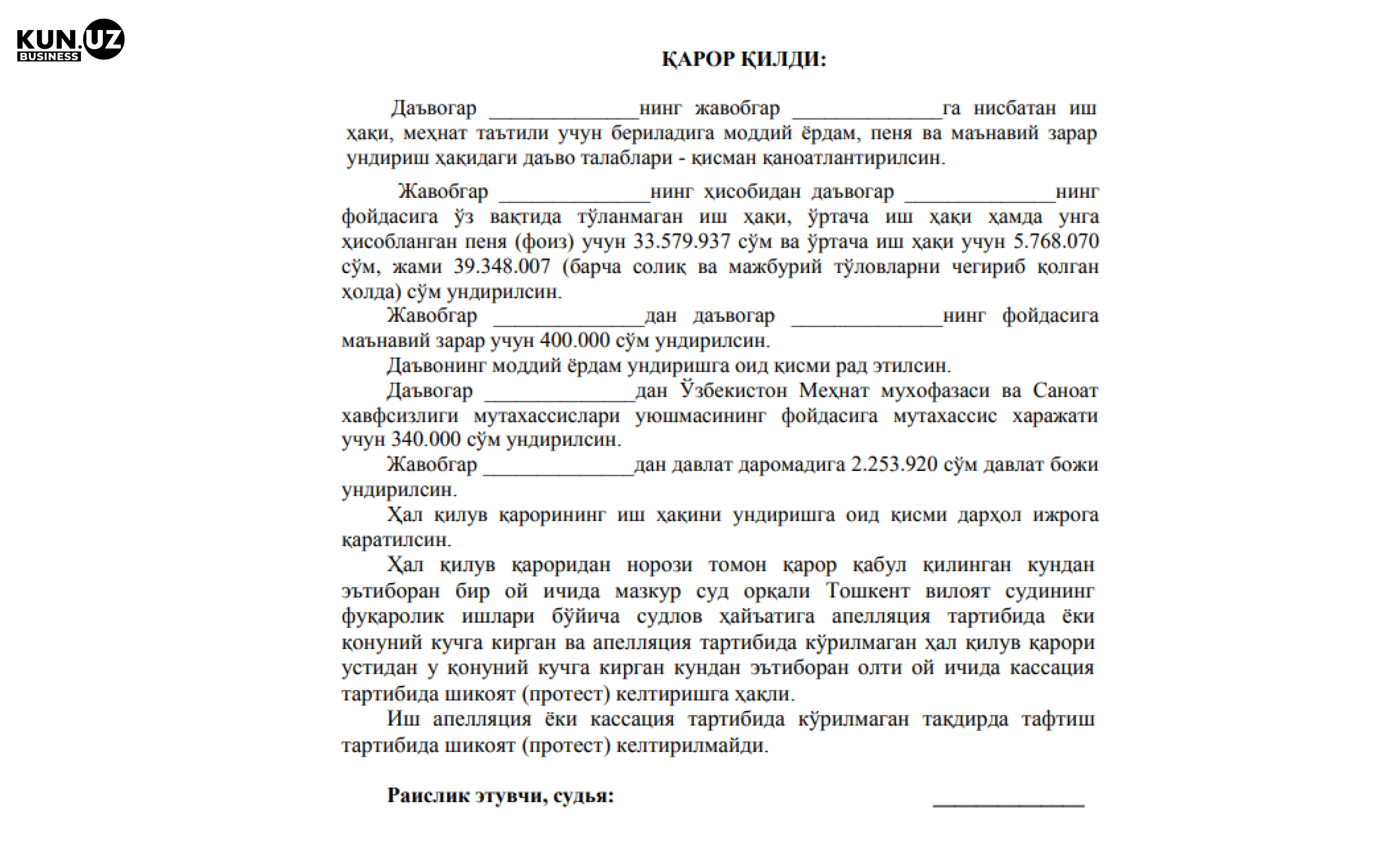
In the end, the court ordered the employer to pay UZS 39,348,007, including unpaid official wages, additional downtime compensation based on the employee’s average earnings, and late-payment interest.
In addition, the employee was awarded UZS 400,000 in moral damages, and the wage-related portion of the judgment was declared immediately enforceable.
Kun.uz
Can an employee recover the cash portion of their salary through court
If an employer owes the employee the unofficial cash portion of their salary, there is a chance of recovery, but proving it is significantly more difficult than recovering officially declared wages. Courts almost always rely on the amount specified in the employment contract rather than verbal promises that a higher amount was paid in cash.
What evidence do courts accept
Bank statements showing payments labeled as “salary,” “bonus,” or “remuneration”; payroll records signed by employees; attendance sheets and internal reports revealing parallel accounting; and job advertisements offering salaries higher than those stated in employment contracts.
What evidence do courts usually reject
A simple bank statement showing transfers described only as “transfer,” “representation expenses,” or “compensation,” as well as testimony from dependent colleagues.
There have been cases where payments recorded as representation expenses were recognized by the court as exactly that, and employees were ordered to return the money.
In practice, employees are most likely to prove the existence of a partially declared salary when they can provide internal payroll records showing the actual amounts paid and bearing employees’ signatures. Once such evidence is presented, the court may recover the difference, while the case materials are forwarded to the tax authorities for further investigation of the employer.
Is it possible to pay salaries officially without visiting a bank
In many sectors, especially services and small workshops, employees are still not formally registered. However, this is gradually changing, partly because the employment process itself is becoming simpler. For example, TBC recently launched a payroll solution that allows entrepreneurs to pay employee salaries directly to bank cards online.
When a salary is paid officially:
●12% personal income tax is withheld;
●social tax is paid;
●the employee accumulates work experience and pension contributions exactly the benefits that envelope salaries deprive workers of.
As such tools become more accessible, the main argument in favor of envelope salaries that full compliance is too complicated becomes less convincing.
Can you be listed as an employee somewhere you have never worked
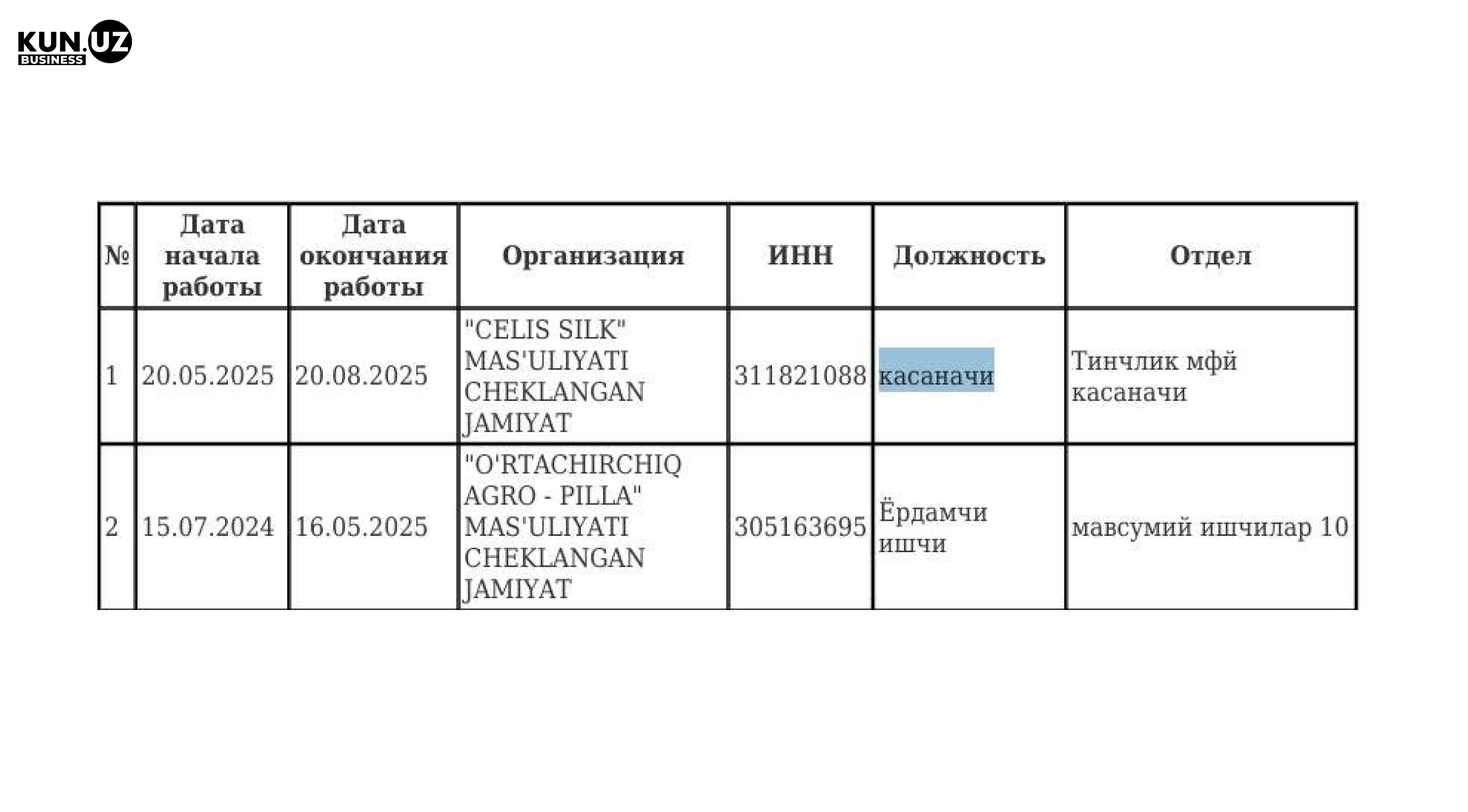
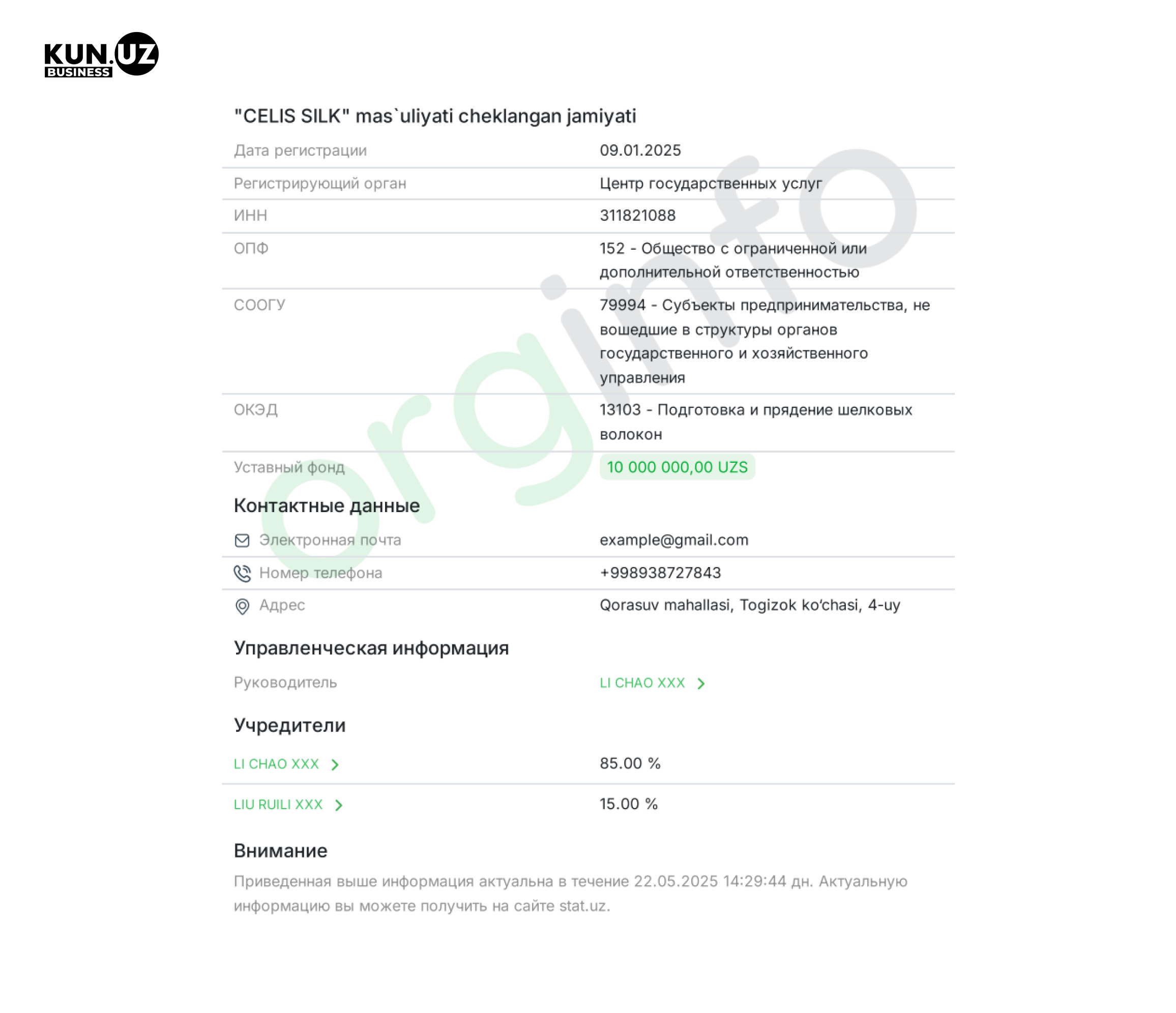
Yes. This is a separate risk that also affects employers. In recent years, people have increasingly discovered entries in their electronic employment records onmy.mehnat.uzshowing companies they have never worked for.
Kun.uz
How does an unfamiliar employment record appear
A mahalla committee or employment center submits data on unemployed individuals. A company formally registers them as employees, receives employment incentives or subsidies, and later dismisses them. In some cases, salaries are formally paid in the name of a real person but are actually received by someone else. For the individual, this appears as an unfamiliar entry in the employment record system. For the tax authorities and statistics agencies, however, it looks like a perfectly legitimate employee.
How can an incorrect employment record be removed
The government services portal my.gov.uz provides a service for editing employment record data. Users must select the disputed entry, choose “Edit,” then “Delete,” and upload supporting documents.
The review period is 15 working days.
If the company is still operating, it is often easier to contact it directly and request that the dismissal be processed through my.mehnat.uz. If the company fails to act, a complaint can be submitted through the Presidential Virtual Reception portal, from where it is forwarded to the tax authorities and labor inspectorate.
What risks do false employment records create for employers
Any manipulation of employee data constitutes a separate violation. For using personal data without an individual’s consent, the law provides for a fine of 50 BCUs (UZS 20.6 million) under Article 46-2 of the Code of Administrative Responsibility.
If intent is proven and the violation is committed by a group of persons, Article 141-2 of the Criminal Code applies, providing for a fine of 100–150 BCUs or imprisonment for up to two years.
What should you do now
How can you check your employment record
Open your electronic employment record on my.mehnat.uz and remove any unfamiliar entries. This is the foundation of any future dispute.
How can you check your work history and pension savings
Request a certificate of pension savings and employment history through my.gov.uz to see your actual officially reported income and future pension entitlements.
What should you do if your employer owes you the cash portion of your salary
First, try to reach an agreement and suggest formalizing the payment through an official settlement, severance compensation, or a bonus payment. Avoid threats or ultimatums: applying pressure to obtain money carries risks of its own.
If negotiations fail, begin collecting evidence in advance: payroll records, correspondence, job advertisements showing salary levels, and bank statements with clear payment descriptions.
What happens to the company if a complaint is filed
A complaint submitted to the labor inspectorate or tax authorities triggers an inspection of the entire company.
The employer may face liability under both tax and labor legislation, while the employee may become a witness in the investigation process.