The $20 billion question: Is FIFA selling football?
|16:41 / 31.07.20261,56413 min
For more than a century, the FIFA has portrayed itself as the guardian of the world's most popular sport. It survived corruption scandals, political crises and fierce opposition to controversial reforms by insisting that football ultimately belongs to its players, supporters and national associations, not private interests.
Now, the governing body finds itself accused of crossing a line it once defended.
A proposal to create a new commercial company valued at around $20 billion and sell up to a 20% stake to private investors has triggered one of the most significant governance disputes in modern football. UEFA has threatened to boycott FIFA competitions, the Confederation of North, Central America and Caribbean Association Football (CONCACAF) has formally rejected the proposal, while the Asian Football Confederation (AFC) has joined the growing opposition. The resignation of Carlos Cordeiro, a senior adviser to FIFA President Gianni Infantino, has only intensified scrutiny.
FIFA rejects claims that it is "selling football," insisting that critics have misunderstood both the proposal and its purpose. It argues that the initiative would unlock billions of dollars for football development while leaving the governance of the sport firmly in FIFA's hands.
Whatever the outcome, the proposal has already evolved into something much bigger than a corporate restructuring. It has exposed a widening divide over how world football should be governed, how major decisions should be made and whether commercial innovation can coexist with the traditions that have long defined the global game.
What exactly is FIFA proposing?
Much of the public debate has centered on the idea that FIFA wants to sell the World Cup. That description, while attention-grabbing, oversimplifies what is actually on the table.
establishing a new commercial subsidiary, FIFA Forward Enterprise (FFE), which would manage the commercial rights associated with FIFA competitions, including the men's and women's World Cups and other international tournaments.
The company would reportedly be valued at around $20 billion, with FIFA offering up to a 20% minority stake to external investors. According to multiple reports, the investor group is expected to be led by Thrive Eternal, a fund managed by Thrive Capital founder Joshua Kushner.
Crucially, FIFA itself would remain a non-profit association under Swiss law. The governing body insists it would retain exclusive control over football matters, including tournament formats, sporting regulations, the international match calendar and disciplinary decisions. Investors would not own FIFA or the World Cup itself, but rather a minority stake in the commercial vehicle responsible for generating revenue from FIFA competitions.
FIFA argues that the distinction is fundamental. Critics acknowledge the legal difference but question whether it changes the underlying reality.
Why does FIFA want outside investment?
The proposal comes at a time when FIFA is arguably stronger financially than at any point in its history.
Since Gianni Infantino became president in 2016, FIFA has aggressively expanded its commercial operations. The men's World Cup has grown from 32 to 48 teams, the Club World Cup has been transformed into a much larger tournament and commercial revenues have reached record levels.
Against that backdrop, FIFA argues that outside investment would accelerate football's development worldwide. In a letter to its 211 member associations, Infantino said every association would receive $40 million in development funding if the proposal is approved – a dramatic increase that FIFA says would strengthen infrastructure, youth development and grassroots football across every continent.
Supporters of the proposal view it as an innovative financial model. Instead of relying solely on future tournament revenues, FIFA would monetize part of the commercial value of its competitions today and reinvest those funds throughout the global game.
The question raised by critics is straightforward: if FIFA has already staged the most profitable World Cup in history and holds substantial financial reserves, why is private equity needed at all?
A growing backlash
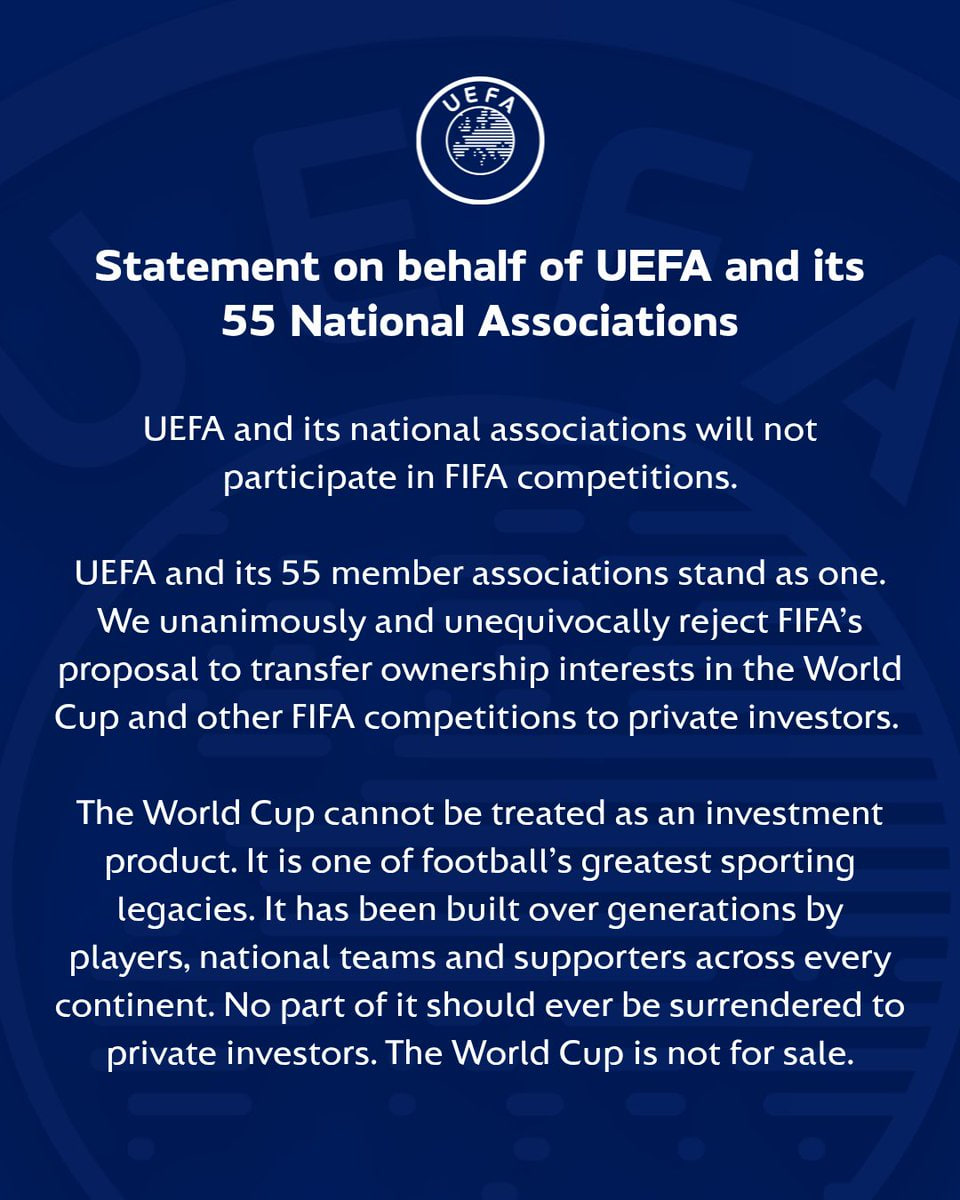
The strongest opposition has come from UEFA, whose 55 member associations unanimously rejected the proposal and warned that they could boycott FIFA competitions if it proceeds in its current form.
UEFA argues that football's "soul and governance" should never become an investment product and has criticized FIFA for developing such a significant proposal without adequate consultation with the confederations and member associations.
Initially, the dispute appeared to reflect the often-tense relationship between UEFA and FIFA. That perception changed rapidly.
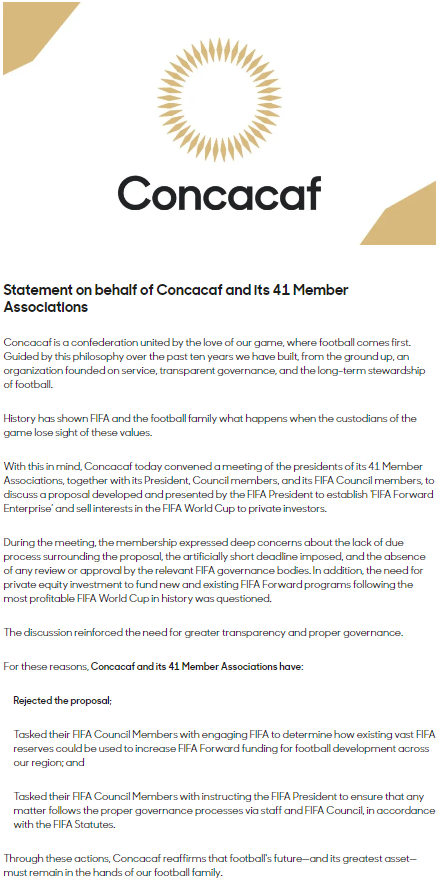
CONCACAF, representing 41 national associations, convened an extraordinary meeting of its leadership and member associations before formally rejecting the proposal.
Its objections extended well beyond the question of private investment. The confederation criticized what it described as a lack of due process, pointing to the compressed timeline for consideration, the absence of review by FIFA's statutory bodies and insufficient consultation before the proposal was presented.
CONCACAF also questioned the financial rationale behind the initiative, arguing that FIFA should first explore whether its existing reserves could provide greater support for football development through the FIFA Forward programme.
In one of the strongest passages of its statement, the confederation declared that “football's future, and its greatest asset, must remain in the hands of our football family.”
The AFC soon echoed many of those concerns.
Although it stopped short of endorsing UEFA's boycott threat, the Asian confederation said it stood "in solidarity with UEFA and CONCACAF" in expressing serious concerns over both the proposal itself and the process through which it had been developed.
The AFC warned that the fact a possible World Cup boycott had entered public discussion should concern everyone involved in football and argued that any initiative capable of undermining the unity and universal character of the tournament should be reconsidered.
Perhaps more importantly, the AFC suggested the controversy had exposed deeper weaknesses in FIFA's governance, calling for an urgent review of the organization's consultation and decision-making framework.
Together, UEFA, CONCACAF and the AFC represent 143 of FIFA's 211 member associations. However, FIFA's statutes give each national association an individual vote, meaning confederation positions do not automatically determine how every member will vote.
Indeed, not all associations appear prepared to follow their confederations' lead. The Czech Football Association has spoken positively about FIFA's intentions, while the Mexican Football Federation has said it will study the proposal independently despite CONCACAF's rejection.
FIFA pushes back
Faced with mounting criticism, FIFA has rejected suggestions that it is privatizing football.
"Nobody is selling football. This is not something FIFA would ever entertain," the governing body said in its latest statement.
FIFA argues that inaccurate media reports have distorted the proposal before member associations have had an opportunity to examine it properly. It says the consultation process will continue and emphasizes that every one of its 211 member associations should be free to make its own decision.
"No single entity can claim to represent all 211 member associations around the world," FIFA said, in what appeared to be a direct response to UEFA's opposition.
According to FIFA, the proposal will not proceed without the support of a majority of member associations. The organization has framed the debate as a democratic process rather than a confrontation between confederations.
More than a financial debate
Although the immediate controversy centers on FIFA Forward Enterprise, the dispute raises broader questions about the future direction of football.
Supporters argue that the proposal reflects the realities of modern sport. Private investment has become increasingly common across football clubs, Formula One, rugby, cricket and other major competitions. From that perspective, FIFA is simply adopting financial tools that have already reshaped the wider sports industry.
Critics, however, argue that the World Cup occupies a unique position. Unlike a club competition or a commercial league, it is widely regarded as a global sporting institution whose value extends beyond financial returns.
Their concern is not necessarily that investors would dictate sporting decisions. FIFA insists governance would remain entirely under its control. Instead, critics fear that introducing shareholders into football's commercial engine could gradually alter the incentives surrounding the game.
Investors expect returns. Over time, that could increase pressure to expand tournaments, create additional competitions, maximize broadcasting revenues or pursue new commercial opportunities. Whether those pressures ever translate into changes on the pitch remains uncertain, but opponents argue that the incentives would inevitably change.
There is also an irony that has not gone unnoticed.
When FIFA opposed the European Super League in 2021, it argued that football should not become the preserve of private commercial interests. Today, critics contend that introducing private equity into the commercial structure of the World Cup risks moving the sport in precisely that direction, even if the legal framework is very different.
FIFA rejects the comparison, maintaining that the proposal strengthens rather than weakens football by generating unprecedented investment for member associations around the world.
A defining moment for football governance
Whether FIFA Forward Enterprise is ultimately approved remains uncertain.
What is already clear is that the proposal has exposed the deepest divisions within football's governance in years. The disagreement is no longer simply about attracting outside investment. It has become a debate over transparency, consultation and the balance of power between FIFA, the continental confederations and the 211 national associations that make up the global game.
Both sides make arguments that deserve serious consideration.
FIFA sees an opportunity to unlock billions of dollars for football development without surrendering control of the sport. Its critics believe the proposal introduces unnecessary commercial risks while exposing weaknesses in FIFA's governance and decision-making process.
The coming weeks will determine whether the proposal secures the support needed to move forward. Regardless of the outcome, the controversy has already forced football to confront a fundamental question: can the world's biggest sporting institution embrace new forms of commercial investment without compromising the principles that have defined it for generations?
The answer may shape not only the future of FIFA, but also the future of football itself.