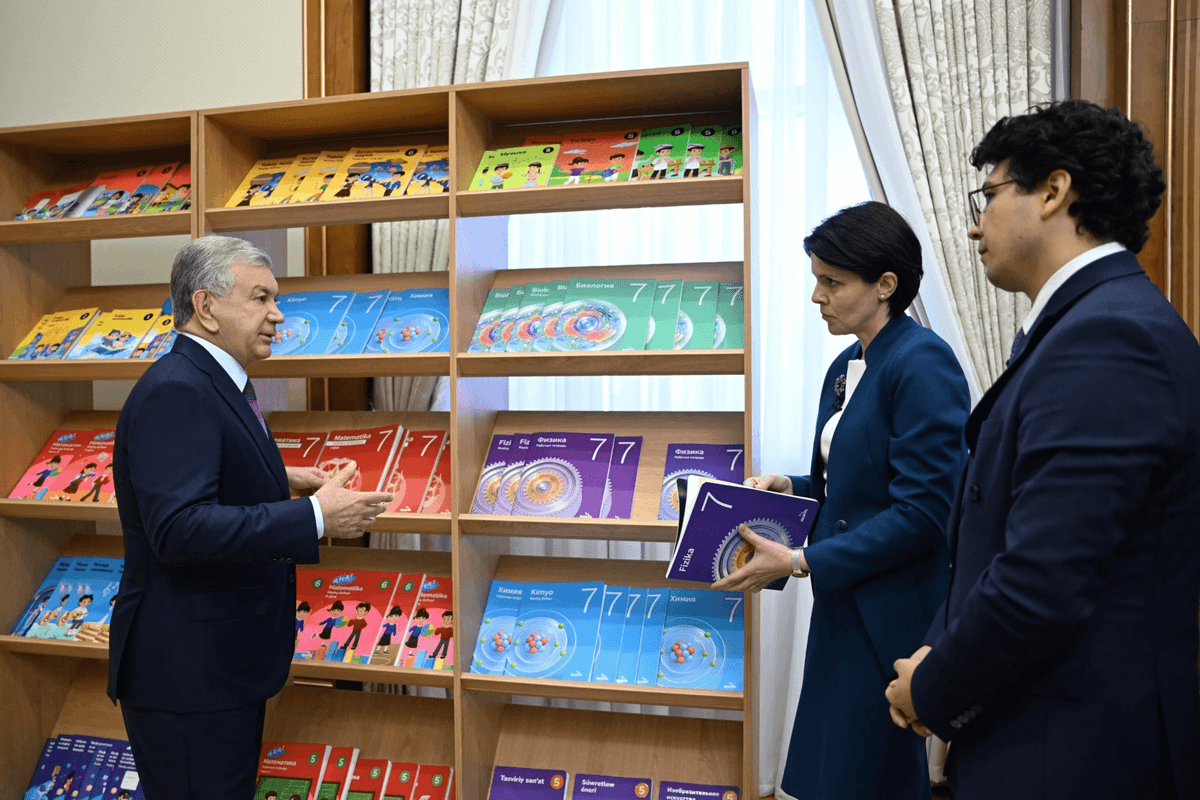
President Shavkat Mirziyoyev reviewed proposals on dual education, new-generation school textbooks and the development of the Uzbekistan branch of Liaoning Normal University on September 28.
Under the planned expansion of dual education, students will combine academic study at universities with practical training at companies. By the 2027/2028 academic year, the system is expected to involve 75 universities and 3,500 enterprises, covering 12,500 students.
The longer-term target is to bring at least 80% of third- and fourth-year students into the system. The model will initially focus on engineering, manufacturing, construction and agriculture.
Uzbekistan has studied Germany’s dual education system, with 10 university rectors sent there three months ago to examine its implementation. In Germany, 70–75% of graduates continue working at the companies where they completed their practical training after receiving their degrees.
A similar model is already being used in Andijan region, where 11,000 students are undertaking practical training at 2,000 enterprises. Mirziyoyev instructed all university rectors to study the region’s experience firsthand. The rectors who visited Germany will be assigned to regional governors and tasked with preparing strategies and proposals for expanding dual education.
Under the proposed model, universities, companies and students will formalize their relationships through contracts. Curricula will be adapted to employers’ needs, while students will be assigned qualified mentors.
Companies participating in student training will be offered support through a digital platform. The proposed measures include reimbursing 50% of the salaries paid to students, providing customs and depreciation benefits, and granting preferences in public procurement to companies that take on more than 25 students for practical training.
Universities and companies that organize dual education most effectively will also compete for recognition under a dedicated evaluation system. The assessment will consider the number of students covered, their salaries, academic performance and employment rates after graduation.
The meeting also reviewed the results of an analysis of existing school textbooks. A total of 1,257 errors were identified in 260 textbooks, while another 51 textbooks contained 464 translation errors. Some materials were also found to be unsuitable for students’ age groups or too difficult to understand.