According to monitoring conducted by a special commission under the National Committee on Ecology and Climate Change, the monthly average Air Quality Index (AQI) fell from 138 in October 2025 to 115 this year.
The number of days classified as “good” under Uzbekistan’s national air quality index increased from three to 14. Meanwhile, the number of days with “orange” or “red” air quality levels dropped from 16 to four.
The improvement was not consistent throughout the month. Air quality remained considerably better than a year earlier during the first 20 days of October, but deteriorated between October 25 and 31.
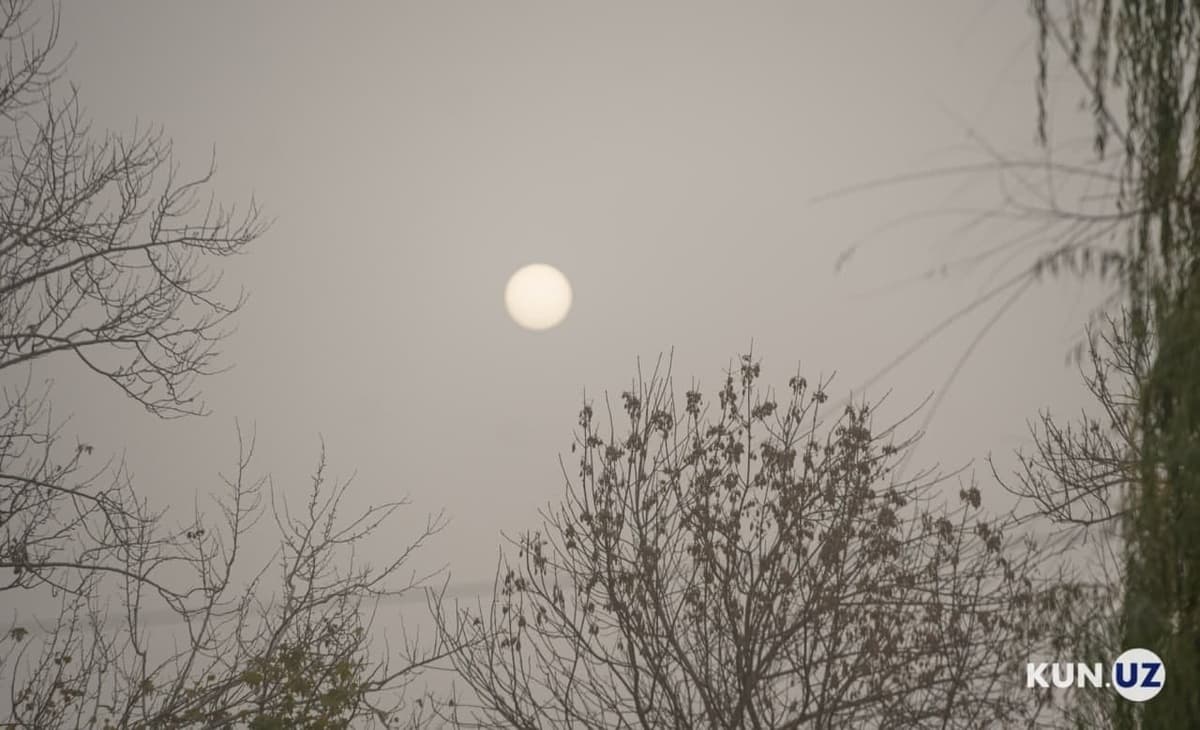
The committee attributed the late-month deterioration to falling temperatures, weak winds, frequent temperature inversions and insufficient rainfall. These conditions restricted the dispersion of pollutants emitted in Tashkent and neighboring areas, allowing particulate matter to remain trapped close to the ground.
What is behind Tashkent’s air pollution?
The committee also examined the composition of airborne pollutants. Laboratory analysis of 60 PM2.5 samples collected in October found that components associated with fuel combustion in industry, transport and the energy sector accounted for an average of 44.4% of particulate matter.
Natural dust made up another 42.6%.
The proportions remained broadly unchanged even on days when air quality deteriorated toward the end of the month. The committee concluded that the worsening conditions were primarily caused by pollutants from local and neighboring areas accumulating over the city as weak winds and unfavorable weather prevented their dispersion.
Air circulation patterns also play an important role in Tashkent’s pollution levels. Located in the foothills near a valley, the capital is particularly affected by winds blowing from the northeast and southwest. Wind direction and speed directly influence air exchange and the movement of pollutants.
Experts say that air pollution in Tashkent is driven not only by human activity but also by natural dust, limited rainfall and unfavorable meteorological conditions. Insufficient precipitation reduces the amount of dust washed out of the atmosphere.
Rainfall in the capital during October was nearly six times below the monthly average, further contributing to the accumulation of airborne particles.