The year proved eventful for Uzbekistan’s economy. Gross domestic product growth reached 7 percent, with GDP expected to total $145 billion by year-end. The poverty rate declined from 8.9 percent at the start of the year to 5.8 percent, while unemployment fell from 5.5 percent to 4.9 percent. Inflation may ease to 7.3 percent. Kun.uz reviews the main economic trends that defined 2025.
Strengthening of the UZS
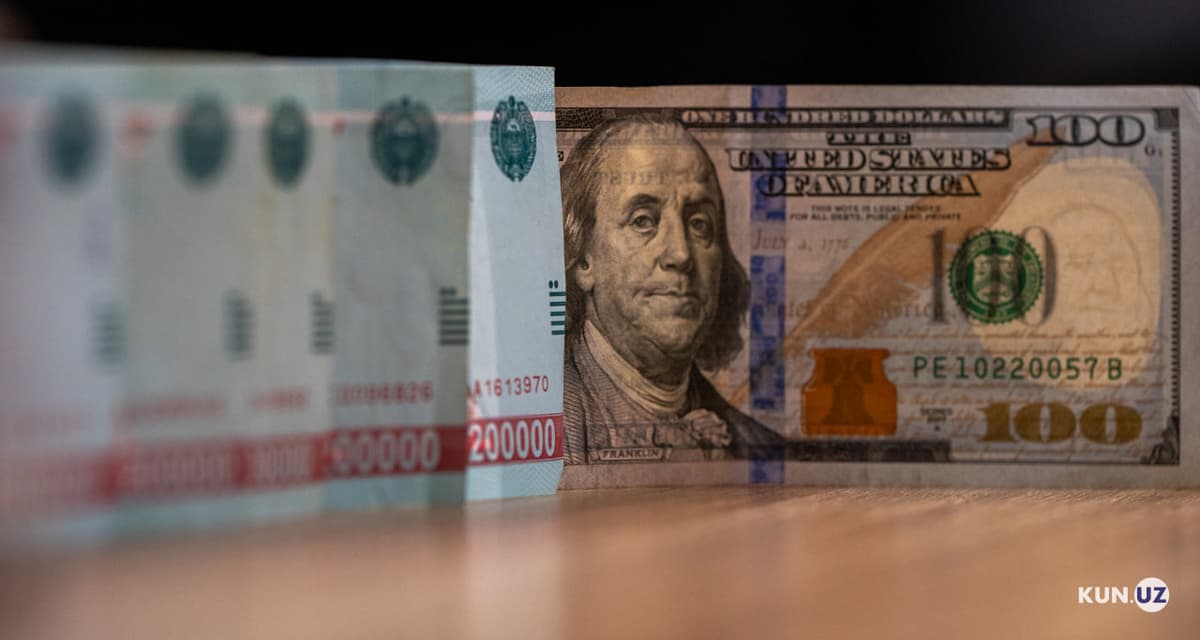
The UZS is ending the year with a 6.8 percent appreciation against the US dollar. At the start of the year, it was difficult to imagine the dollar weakening rather than rising, given the long-held perception that the US currency only appreciates. In February, the exchange rate even exceeded UZS 13,000 per dollar for the first time. However, the year demonstrated that under certain economic conditions even the strongest currencies can lose value.
The UZS’s strengthening was driven by higher remittance inflows, increased foreign direct investment, stabilization of partner countries’ national currencies, rising exports amid soaring gold prices, and a narrowing trade deficit. At the same time, tighter duty-free import limits widened the gap between foreign currency inflows and outflows.
As a result, dollarization in Uzbekistan’s economy declined markedly, while external debt servicing costs also fell. By comparison, the UZS depreciated against the dollar by 3.4 percent in 2021, 3.6 percent in 2022, 9.9 percent in 2023, and 4.7 percent in 2024.
Surge in gold prices
One of the most influential factors for Uzbekistan’s economy in 2025 was the sharp rise in gold prices. Typically, gold appreciates amid economic or political stress. After the 2008 global financial crisis, prices reached $1,000 per ounce, rose to $2,000 during the pandemic, and climbed to $3,000 in March this year amid the Trump administration’s aggressive tariff policy. Growing uncertainty in global trade, concerns over the independence of the Federal Reserve System, and doubts about US fiscal stability pushed prices above $4,000 in October. By December, gold surpassed $4,500 per ounce. Overall, gold gained 70 percent in 2025 – the largest annual increase in 46 years.
Uzbekistan is among the world’s largest gold producers and exporters. Against the backdrop of rising global prices, the value of the Central Bank’s gold and foreign exchange reserves exceeded $61 billion as of December 1, becoming a key factor in improving the country’s sovereign credit ratings.
The International Monetary Fund has advised the Uzbek government to restrain spending increases financed by unplanned budget revenues. This would help curb inflationary pressures, prevent excessive real exchange rate appreciation, and reduce the risk of macroeconomic volatility should gold prices decline.
Protectionist measures
From May 1, 2025, several protectionist measures came into force in Uzbekistan. Recycling fees for electric vehicles less than three years old were raised from 30 times to 120 times the base calculation amount – equivalent at the time to an increase from UZS 11 million to UZS 45 million. This significantly raised prices for imported electric cars outside BYD’s official dealer network. The dramatic hike was widely viewed as another attempt to shield domestic producers.
In addition, duty-free import limits for individuals entering Uzbekistan were reduced. For air travelers, the limit was cut from $2,000 to $1,000, while for rail passengers it fell from $1,000 to $500. Those crossing the border by car or on foot may now import duty-free goods worth no more than $300. Moreover, from July 20, the duty-free allowance for trips abroad lasting two to three days was reduced to zero.
Major privatizations
Large-scale privatization continued in 2025. A 75 percent state stake in the Samarkand Automobile Plant was sold to Turkey’s Anadolu Isuzu for $80 million. In addition to the purchase price, the investor committed to invest a further $80 million.
UAE companies TAQA and Mubadala announced the acquisition of an 80 percent stake in a 874-megawatt thermal power plant at the Talimarjan energy complex. The transaction value and other terms were not disclosed. According to the investors, the state committed to purchasing electricity under guaranteed terms for 25 years.
Doniyor Kamilov, the son of former foreign minister Abdulaziz Kamilov, further expanded his business interests in Uzbekistan. A company he owns privatized Trest-12, one of the country’s largest construction firms. A 51 percent stake was valued at UZS 111 billion.
Another major state-owned construction company, Uzshahar Qurilish Invest, was also sold, becoming public knowledge only after the company purchased the Ministry of Construction’s administrative building for UZS 182 billion.
The Dehqonobod Potash Plant, which was expected to be listed on international markets, was sold behind closed doors in violation of a presidential decision. The price and terms remain undisclosed; only the buyer is known – Asian Chemical Group LLC. The plant is one of the largest chemical facilities in Uzbekistan and cost the state $128 million to build, financed through borrowing from China.
Meanwhile, the Quartz plant, privatized non-transparently two years ago, was returned to state ownership after the buyer failed to meet the agreed payment schedule, leading to the cancellation of the sale contract.
Nuclear power construction begins
In October 2025, within the framework of the Central Asia – Russia Summit, excavation began for the reactor building of a small-capacity nuclear power plant in Forish district. The first concrete pour is scheduled for March 2026. The issue of a large nuclear power plant also returned to the political agenda this year, with several documents signed in Moscow. Under a September 26 agreement, both a small-capacity and a conventional large nuclear plant will be built at a selected site in Jizzakh. If implemented, Uzbekistan would become the world’s first country to integrate small and large nuclear power plants at a single site.
Assessing the economic efficiency of nuclear power construction remains difficult, as financial details have not been disclosed – including total project costs and the cost of electricity generation.
Slower growth in public debt
As of October 1, 2025, Uzbekistan’s public debt reached $44 billion, up 12.5 percent, or $4.9 billion, year on year. By comparison, as of October 1, 2024, public debt had increased by $7.1 billion, or 22.1 percent, compared with the same period in 2023.
Uzbekistan’s largest creditors remain the World Bank and the Asian Development Bank. About 63 percent of the debt is denominated in US dollars, 12 percent in UZS, and 8 percent in euros. At the same time, the country’s total external debt continues to rise rapidly, reaching $72.2 billion in the first half of 2025.