

The proposals were presented on July 30 during a fiscal dialogue hosted by the ministry. They are not yet law and would require amendments to the Tax Code before taking effect.
Under the proposal, the corporate income tax rate for banks, mobile network operators, polyethylene granule manufacturers, markets and shopping complexes would be reduced from 20% to 15%.
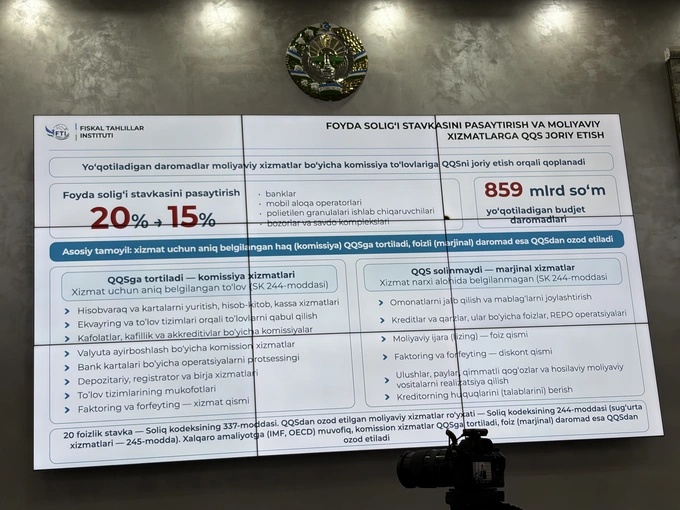
According to the institute, the resulting budget shortfall, estimated at UZS 859 billion, could be offset by applying VAT to commission-based financial services that are currently exempt.
Distinguishing commissions from interest
The proposed reform would draw a clear distinction between two types of financial income.
Commission-based services, where customers pay a fixed fee for a specific service, would become subject to VAT. These include charges for maintaining bank accounts and payment cards, settlement and cash services, merchant acquiring and payment processing, bank guarantees, letters of credit, foreign exchange commissions, payment system services, securities depository and exchange services, as well as the service component of factoring and forfaiting.
By contrast, interest-based (or margin-based) financial services would remain exempt from VAT. These include deposit-taking, lending, interest on loans, repurchase (repo) transactions, the interest component of financial leasing, the discount component of factoring and forfaiting, transactions involving shares, securities and financial derivatives, and the assignment of creditors' claims.
According to the presentation, the proposed approach reflects international practice endorsed by the International Monetary Fund (IMF) and the Organisation for Economic Co-operation and Development (OECD), under which explicit fees charged for financial services are generally subject to VAT, while interest income remains exempt.
What could change for consumers?
If adopted, the proposal would most directly affect the cost of financial services that involve fixed commissions rather than interest payments.
For example, fees for maintaining bank accounts or payment cards, processing payments, issuing bank guarantees or charging commissions on foreign exchange transactions could become subject to the standard VAT rate. If financial institutions pass the tax on to customers, these services could become more expensive.