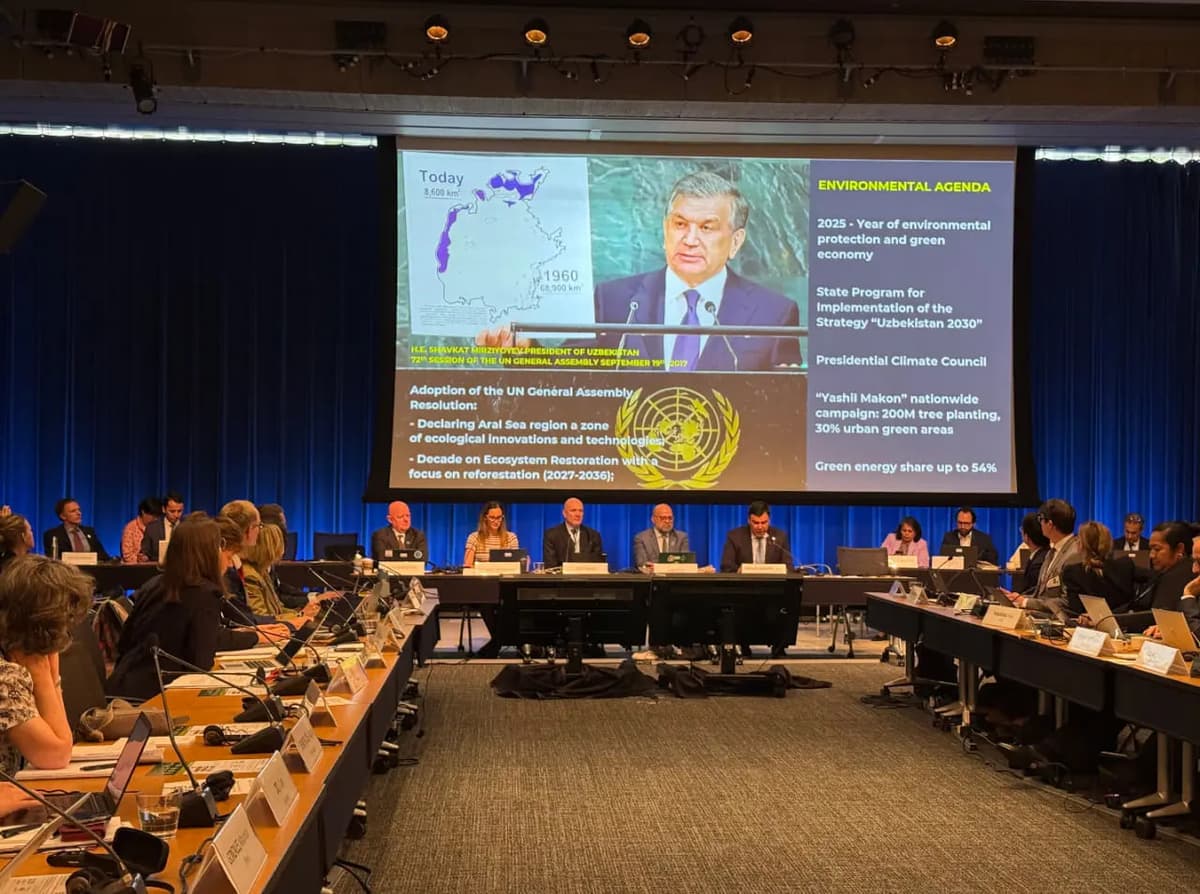
Speaking at the council, Uzbekistan’s Minister of Ecology, Environmental Protection, and Climate Change, Aziz Abdukhakimov, highlighted several key environmental initiatives spearheaded by the president. These include a large-scale afforestation campaign on the dried seabed of the Aral Sea, which has turned 2 million hectares into green zones, the nationwide "Green Space" initiative that plants 200 million trees annually, and plans to increase green areas to 30%. Additionally, Uzbekistan aims to raise the share of renewable energy to 54% by 2030 and promote the transition to renewable energy and zero-emission transportation.
The minister also emphasized Uzbekistan’s recent legislative improvements focused on environmental protection and the enhancement of environmental education. For instance, the Constitution has been amended to include stronger environmental protection provisions, and the Administrative Responsibility Code and other related laws have been revised to further strengthen ecological sustainability.
Furthermore, at the initiative of the president, several institutions have been established in Tashkent: the Central Asian University for Environmental and Climate Change Studies (Green University), the Climate Council under the President of Uzbekistan, and a national climate center. The year 2025 has been declared the “Year of Environmental Protection and Green Economy.” Moreover, several UN General Assembly resolutions are being promoted, including one focused on forest and land restoration between 2027 and 2036.
At the council meeting, it was officially decided that the Eighth GEF Assembly and the GEF Council’s 71st meeting will be held in Samarkand in 2026. Expressing his gratitude on behalf of the Uzbek government, Minister Abdukhakimov stated that with GEF support, Uzbekistan has achieved significant progress in shaping its environmental agenda and looks forward to continued cooperation.
It was noted during the event that due to Uzbekistan’s active role and initiatives, the global community is paying increased attention to addressing climate change and its impacts in Central Asia. The upcoming events in Samarkand are expected to bring together major donor countries to find solutions to regional environmental challenges.
"Central Asia remains highly vulnerable to climate change, water scarcity, and land degradation. The 2026 GEF Assembly will serve as an important platform to address these issues, mobilize resources, exchange knowledge, and enhance sustainability. During the summit, we aim to strengthen regional cooperation, increase climate resilience, and prevent biodiversity loss,” said the minister.