How citizens of Uzbekistan can obtain a visa to South Korea
|19:20 / 03.02.202614,40716 min
Citizens of Uzbekistan are required to obtain a visa to travel to South Korea in all cases, regardless of the purpose or duration of the trip — including short tourist visits. Documents can be submitted only through accredited agencies, while consular requirements remain strict.
Photo: ReutersPhoto: Reuters
At the same time, statements about possible restrictions on visa issuance due to the growing number of Uzbek citizens violating migration rules in South Korea have drawn public attention. Although the rules have not changed so far, it is important to understand how the visa application process works and which requirements are currently in force.
Below is an overview of the current rules for obtaining a South Korean visa for citizens of Uzbekistan: available visa categories, document requirements, application procedure, and the most common reasons for refusal.
Who needs a visa to South Korea and when
Citizens of Uzbekistan must obtain a visa for any trip to South Korea, regardless of the purpose: tourism, education, employment, or visiting relatives. Entry without a visa is not permitted even for one day.
The K-ETA electronic travel authorization, available to citizens of Europe, the United States, and some CIS countries, does not apply to Uzbek citizens. All applications are submitted offline using a visa application form and a full set of documents. For tourist and visitor visas, documents are accepted only through accredited agencies.
Types of South Korean visas
Citizens of Uzbekistan most commonly apply for six types of visas. They differ in purpose, length of stay, and documentation requirements.
C-3 — short-term visa (up to 90 days)
Used for tourism, visiting relatives, and business trips. Depending on the purpose, hotel reservations, an invitation letter, or a company letter may be required. Applications in Uzbekistan are accepted only through accredited agencies.
C-4 — short-term work visa
Issued to specialists invited to South Korea for short-term work assignments. An employment contract and employer documents are required. Valid for up to 90 days.
D-2, D-4 — student visas
D-2 is issued to university students, D-4 to language course participants. Applicants must provide an admission letter, proof of tuition payment, and evidence of financial capacity.
E-9 — employment visa under the government program (EPS)
Related topics
Issued through the Agency for External Labor Migration. Granted after selection and quota approval. Independent submission to the consulate is not предусмотрено.
E-7 — for qualified professionals
Requires relevant education, confirmed work experience, and an employment contract with a South Korean employer. The visa is issued after prior approval from South Korean immigration authorities.
H-2 — for ethnic Koreans
Issued upon documented proof of Korean ethnicity. Grants the right to work and reside in South Korea for up to 4 years and 10 months. Applicants must pass a selection process, including a language exam and interview. The visa is not issued automatically based on ethnicity alone.
There is also the F-4 visa, available to individuals who have officially obtained overseas Korean status. This is a separate category available to a limited number of applicants. For most citizens of Uzbekistan, the primary option remains the H-2 visa.
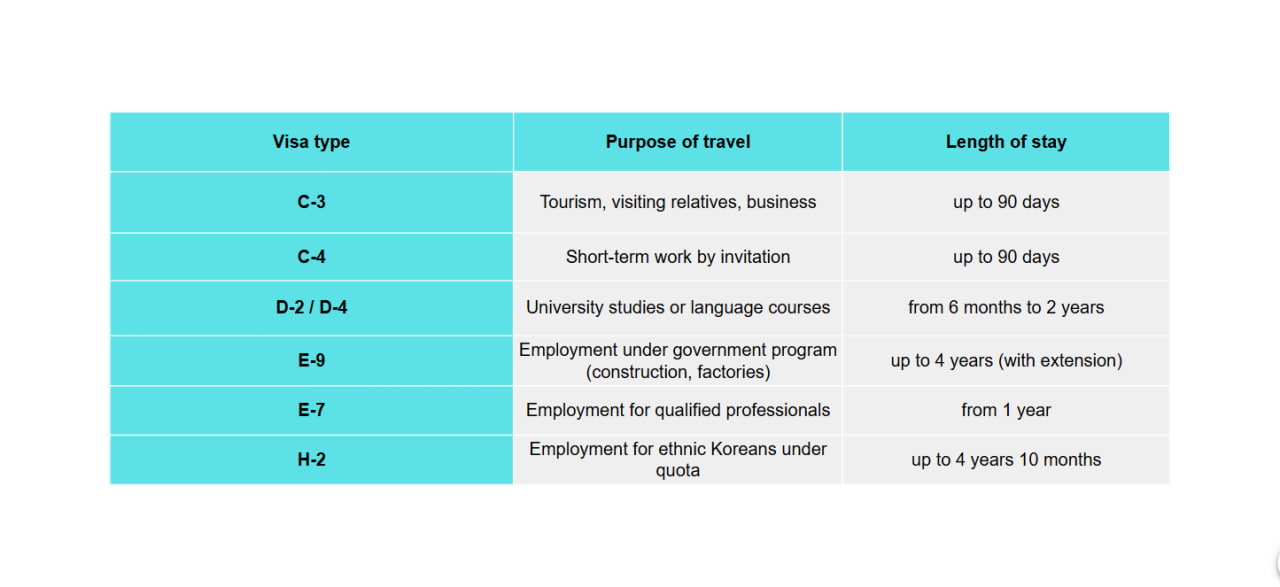
Types of South Korean visas
Comparison of key visas by purpose and duration of stay.
For most visa categories — primarily tourist and visitor visas — personal submission is not предусмотрено. Documents are accepted only through accredited travel agencies that cooperate with the embassy’s consular section. The list of these agencies is published on the official embassy website, and only they are authorized to collect applications and submit them for review.
Visas based on official employment contracts, certain student visa categories, and visas under government programs are submitted directly through the embassy.
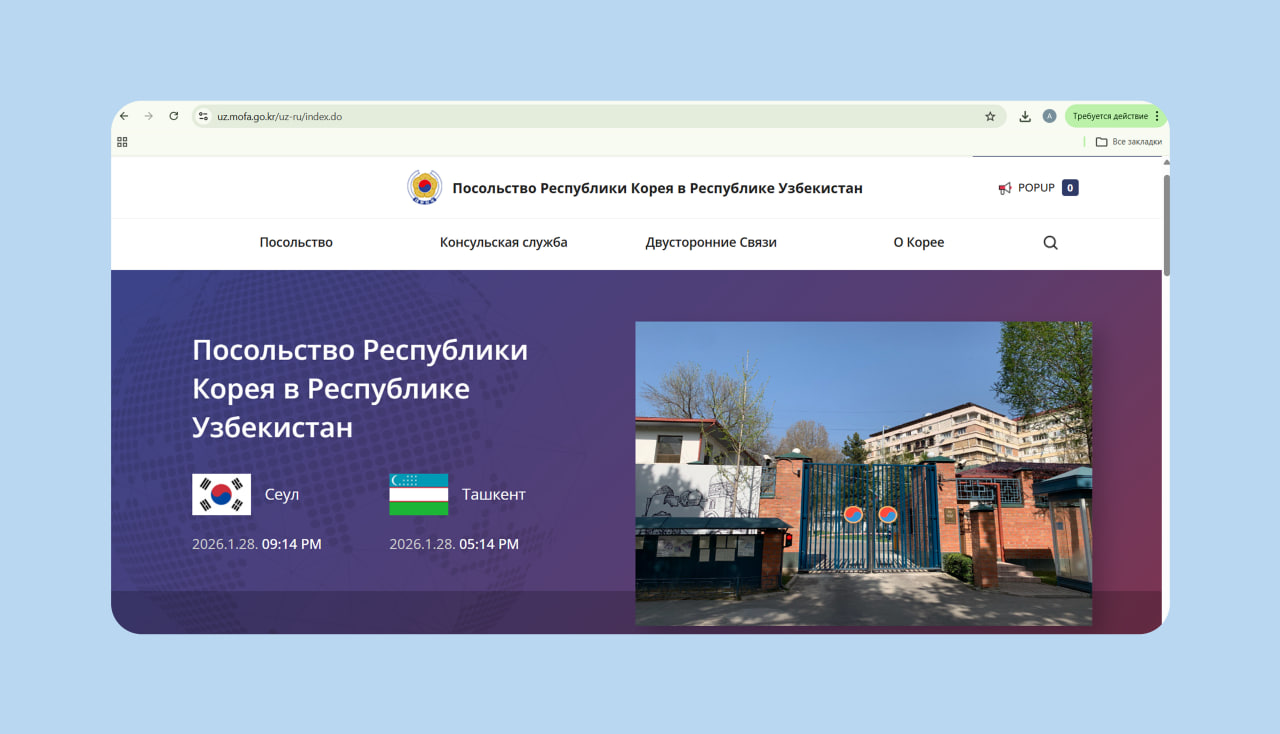
Working hours and the list of accredited agencies are published on the embassy’s official website.
Required documents for a visa
The basic set of documents for a South Korean visa is largely the same for all applicants, but the final list depends on the purpose of travel.
Basic document package:
International passport
Must be valid for at least 6 months at the time of travel. The original passport and a copy of the first page with personal details are required.
Visa application form
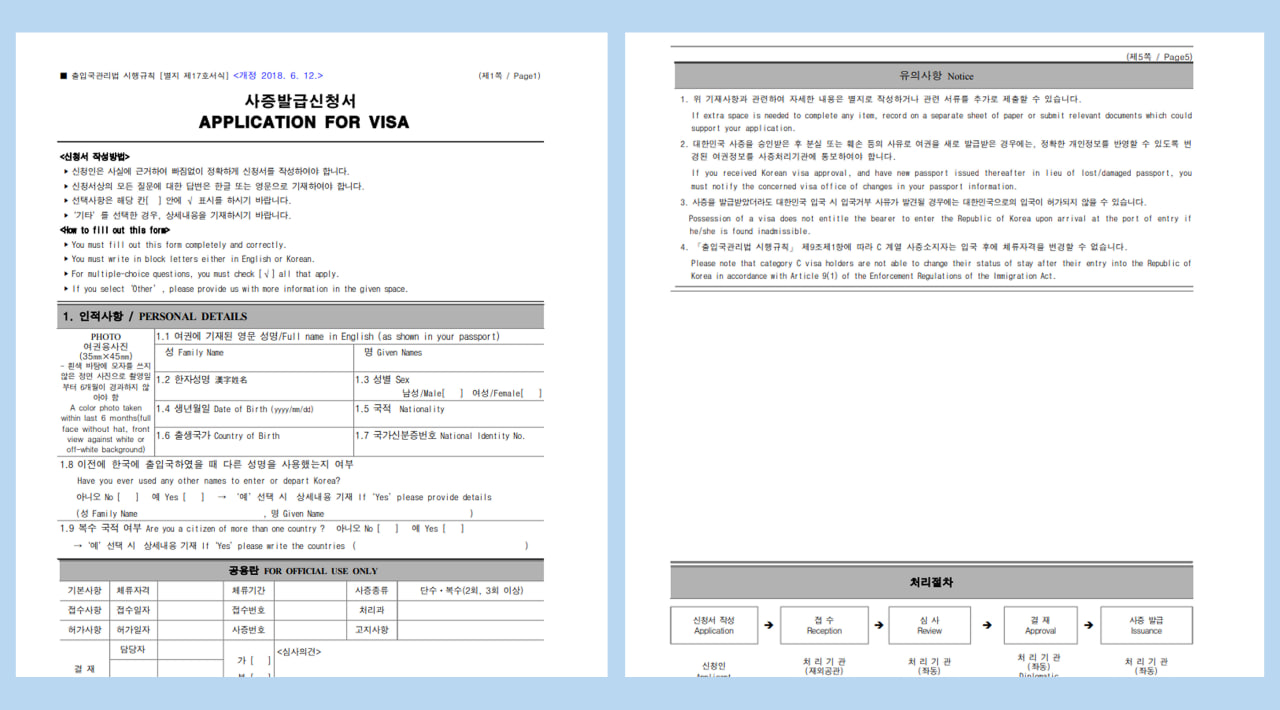
Completed in English or Korean, handwritten or printed. Signature is mandatory. The form can be downloaded from the embassy website or obtained from an accredited travel agency.
Sample visa application form.
It is recommended to download all forms only from official sources. Outdated versions (for example, issued before 2020) may not be accepted. Some agencies use their own Russian-language templates, but original forms are preferred.
Photograph
Color photo, 3.5 × 4.5 cm, light background, no headwear or glasses. Two copies.
Documents confirming the purpose of travel:
— tourism: flight and hotel reservations, tour operator contract;
— visiting relatives: official invitation, copy of the inviter’s ID, proof of relationship (if required);
— studies: admission letter, proof of payment, education documents;
— employment: employment contract, letter from the South Korean side, or work permit.
Invitation letters, sponsorship letters, and documents for student visas (such as D-2 or D-4) are usually prepared by the receiving party — the university, employer, or relative in South Korea.
Financial documents
Bank statement for the last 3 months, employment certificate indicating income, salary confirmation. If the trip is sponsored by a relative, a sponsorship letter, the sponsor’s financial documents, and proof of relationship are required.
Even when applying through an agency, the applicant remains responsible for the accuracy of the documents. Incomplete packages or errors in the application are among the most common reasons for refusal.
Financial requirements
The consulate assesses the applicant’s financial capacity — the ability to cover travel expenses and return to the country of residence. This is a key condition when reviewing tourist, student, and visitor visa applications.
Bank statement
Applicants must provide a bank statement covering the last three months, showing account activity and current balance. The document must be issued in English or Korean and include the applicant’s name, the bank’s stamp, and signature.
The minimum required amount for a tourist visa is USD 1,500–2,000.
Where to obtain it:
The most reliable option is to obtain the statement directly from a bank branch. In this case, the document is issued on official letterhead with a stamp and signature, meeting consular requirements.
Some banks allow statements to be generated via mobile applications. However, if the document does not include an electronic signature or QR code, it is recommended to have it certified at a bank branch.
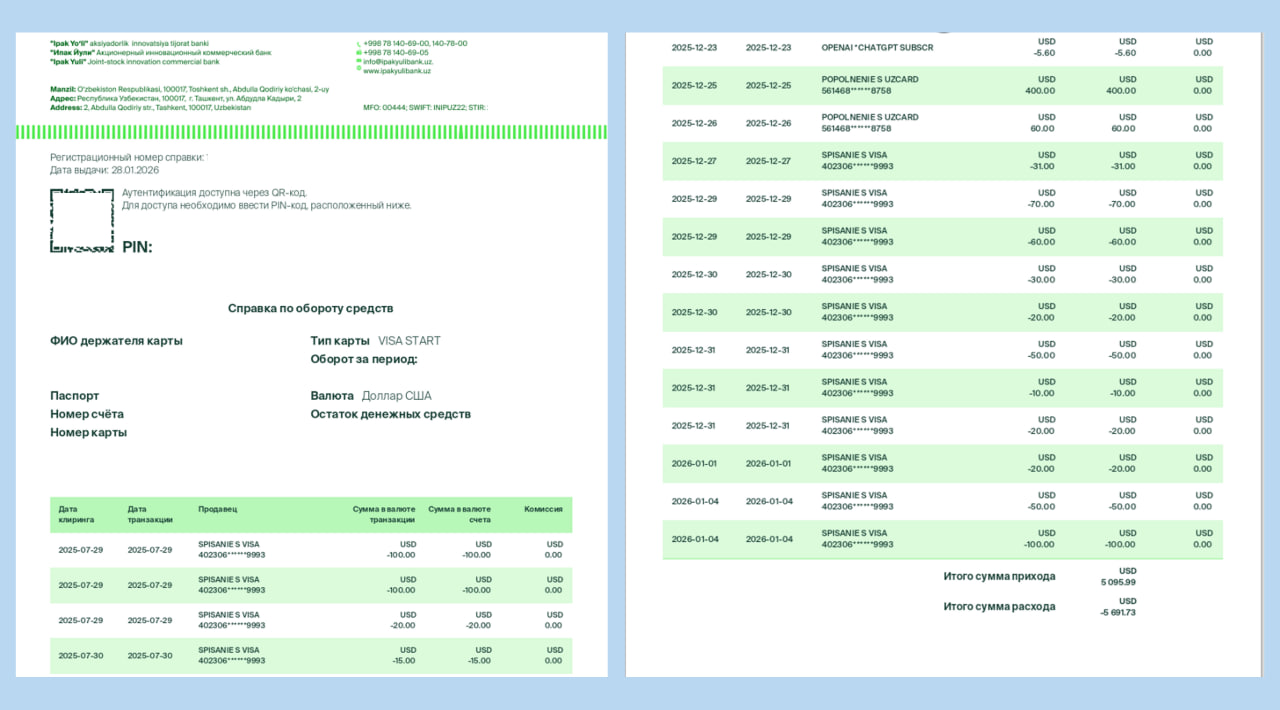
Sample bank statement confirming financial capacity.
Visa authorities generally accept only official bank documents. Online statements without verified authenticity may not be accepted. If the account is registered in the sponsor’s name (for example, a parent), a sponsorship letter, the sponsor’s financial documents, and proof of relationship must be submitted.
For student visas (D-2 and D-4), financial capacity must be confirmed by a statement issued specifically by KDB Bank Uzbekistan, in the applicant’s name, indicating the required amount and the deposit holding period in accordance with consular requirements.
Employment certificate
Confirms employment status, income level, and length of employment. Indicating that the job position is retained during the travel period is considered an advantage.
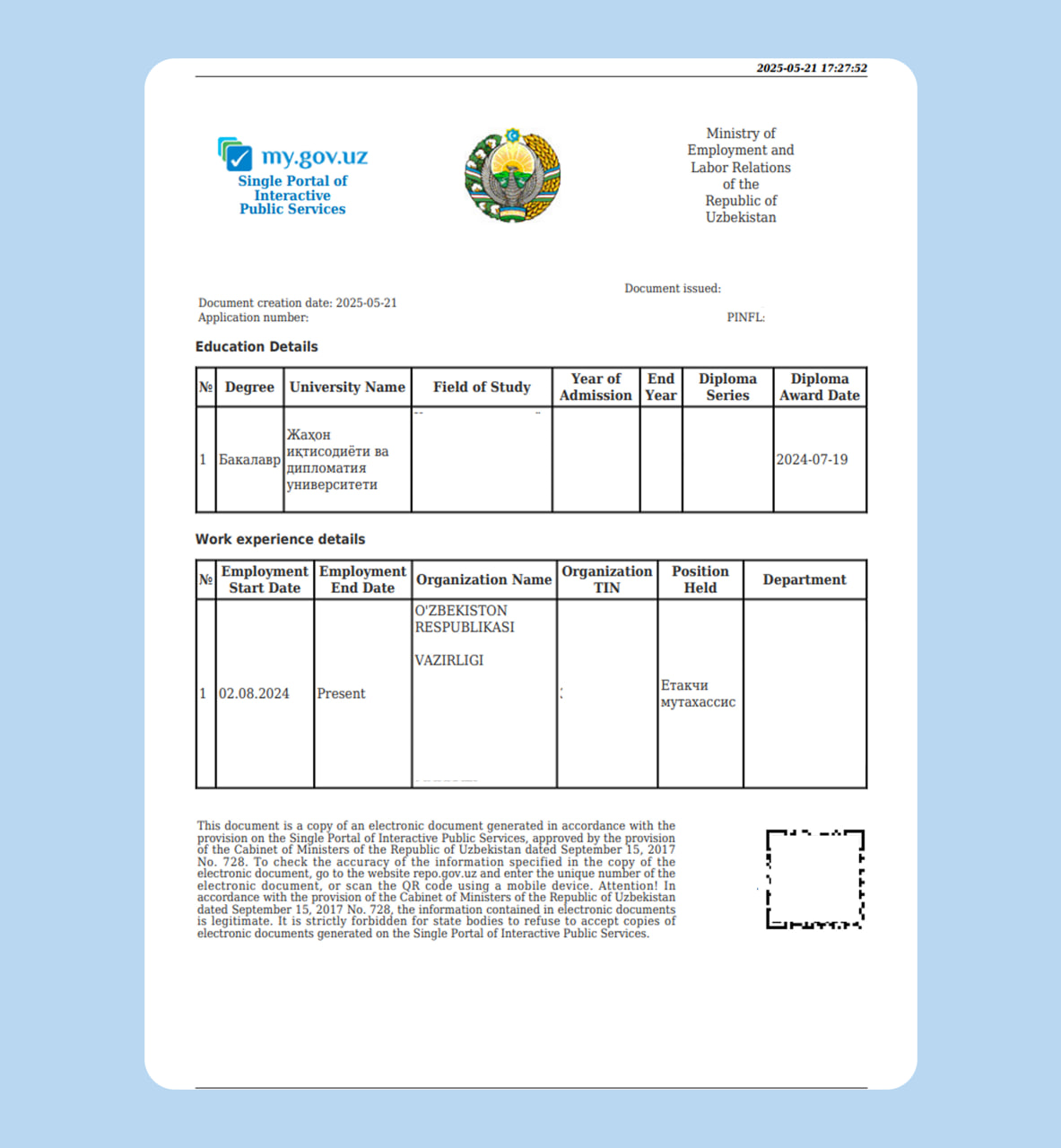
Sample employment certificate for a South Korean visa.
Sponsorship letter
If the applicant is unemployed or studying, the trip may be sponsored by a relative. In this case, a sponsorship letter in English, the sponsor’s bank statement, a copy of the sponsor’s passport, and proof of relationship must be provided.
Financial documents allow the consulate to assess migration risks and confirm that the applicant has sufficient funds for travel and valid reasons to return.
Application procedure
The South Korean visa application process consists of several stages. For citizens of Uzbekistan, it proceeds as follows:
1. Document preparation
The applicant collects the application form, photographs, passport, financial documents, and papers confirming the purpose of travel. The exact list depends on the visa type.
2. Submission through an agency
As a rule, the consulate does not accept documents in person. Most applications are submitted through accredited travel agencies authorized to submit documents to the consular section.
3. Registration and submission to the consulate
The agency prepares the application, registers the applicant in the queue, and submits the documents. Personal attendance is usually not required, except for certain work and student visas.
4. Waiting for a decision
After submission, the review stage begins. The average processing time is 7–14 working days. The agency informs the applicant when the visa is ready. Passports are collected through the same agency.
Once documents are submitted, changes cannot be made. If the documents are incomplete or unconvincing, a refusal is possible. Therefore, thorough preparation before submission is essential.
How long visa processing takes
Typically, a South Korean visa is issued within 7–14 working days after document submission. In practice, processing time may vary depending on the season, visa type, and consular workload.
Factors affecting processing time:
Visa type
— Tourist and visitor visas (C-3): usually processed faster — 5–10 working days.
— Student and work visas (D and E categories): up to 15 working days.
Season
Summer and autumn are peak periods, especially for tourist visas. Processing times may increase.
Additional checks
If information is insufficient or raises concerns, additional documents may be requested, adding at least 3–5 days.
Submission channel
Accredited agencies usually submit documents accurately and on time. Errors or incomplete documents may delay processing or result in refusal.
A visa is considered issued only after the visa sticker is placed in the passport. The passport can be collected only through the agency that submitted the application.
Cost of a South Korean visa
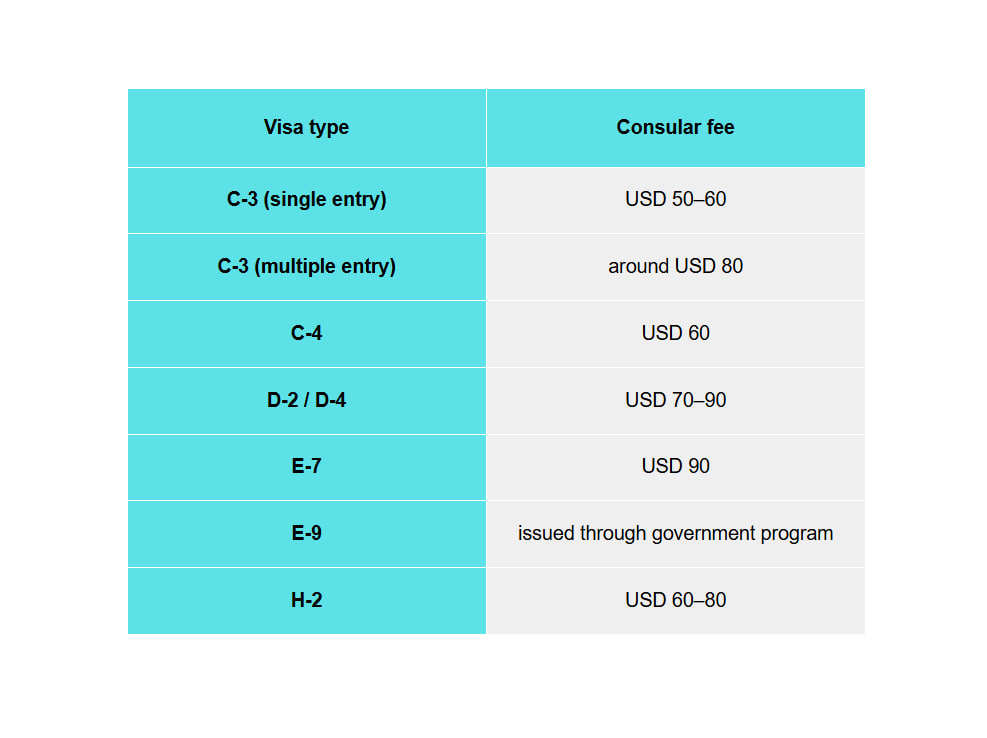
Visa cost depends on the visa type and number of entries. For citizens of Uzbekistan, the consular fee is paid in US dollars and transferred to the consulate through an accredited agency.
Consular fees
The consular fee may vary depending on the visa category and consular decisions.In case of refusal, the consular fee is non-refundable.
What to do in case of refusal
A visa refusal does not mean a ban on reapplication. The South Korean consulate allows repeat applications if the applicant corrects errors or strengthens the document package.
Reason for refusal
The agency through which documents were submitted may receive a general explanation. Most often, refusals are due to insufficient confirmation of travel purpose, weak financial evidence, or migration risk concerns.
Documents most often filled out incorrectly
— incomplete or questionable bank statements;
— unclear travel purpose;
— errors in the application form;
— inconsistency between the declared purpose and submitted documents.
Most of these issues can be corrected for reapplication.
How to improve documents
When reapplying, it is advisable to add:
— proof of ties to Uzbekistan (employment or study certificate, family);
— a clearer travel itinerary;
— additional financial documents or a new invitation.
When to reapply
There is no formal restriction on reapplication timing. In practice, agencies recommend waiting about one month and making real changes to the documents.
Submitting the same documents without improvements is likely to result in the same outcome.
Conclusion
Citizens of Uzbekistan must obtain a visa for travel to South Korea regardless of purpose.
The K-ETA electronic authorization does not apply to Uzbek citizens.
Most visas are processed only through accredited agencies.
Visa type and document requirements depend on the purpose of travel.
Financial documents are a key factor in visa decisions.
A refusal does not prevent reapplication, but requires document revision.