The comments came after the United Nations highlighted earthquakes as the deadliest of all natural disasters and called on Central Asian countries to strengthen preparedness. The organization also noted that parts of Uzbekistan, along with countries in the South Caucasus, are located in areas of very high seismic risk, with the Fergana Valley identified as one of the most vulnerable regions.
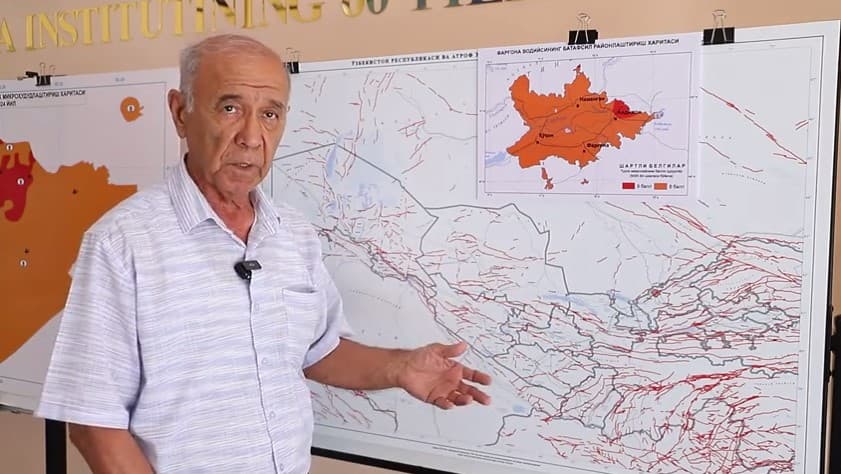
"We should not pay attention to alarming claims because our region is naturally seismically active. The faults capable of generating earthquakes here have been thoroughly studied," said Ulfat Nurmatov, head of a laboratory at the Institute of Seismology.
According to Nurmatov, specialists have assessed the maximum possible magnitude of earthquakes that could occur both within Uzbekistan and in neighboring countries, and have developed detailed seismic hazard maps based on those assessments.
He noted that buildings and infrastructure across the country are designed in accordance with these maps.
The expert said strong earthquakes have historically occurred both in Uzbekistan and neighboring states. The most recent significant event affecting the Fergana Valley was the magnitude 6.4 earthquake that struck Kyrgyzstan in 2011. Since then, no earthquake of comparable strength has occurred in the region, although earthquakes with magnitudes of 5.0–5.5 continue to occur relatively frequently.
Nurmatov added that the region's largest and most seismically active fault systems are located farther south, primarily in Tajikistan's Pamir Mountains. These faults are capable of generating earthquakes of up to magnitude 7.
Even if such an earthquake were to occur, he said, its seismic intensity in affected areas would not exceed nine points on the macroseismic intensity scale.
The Institute of Seismology also commented on earthquake activity in Afghanistan, noting that the country's earthquakes frequently originate at depths of 250–300 kilometers. Although tremors from these deep-focus earthquakes are felt across Central Asia, their impact weakens significantly before reaching the surface.
Displaying a seismic hazard map of the Fergana Valley, Nurmatov said that more than 90% of the region is classified as an eight-point seismic zone. Even if local fault lines were to release their maximum seismic potential, ground shaking would not exceed eight points in most areas, while only limited parts of the Andijan region could experience shaking of up to nine points.